Nila Kartika Wati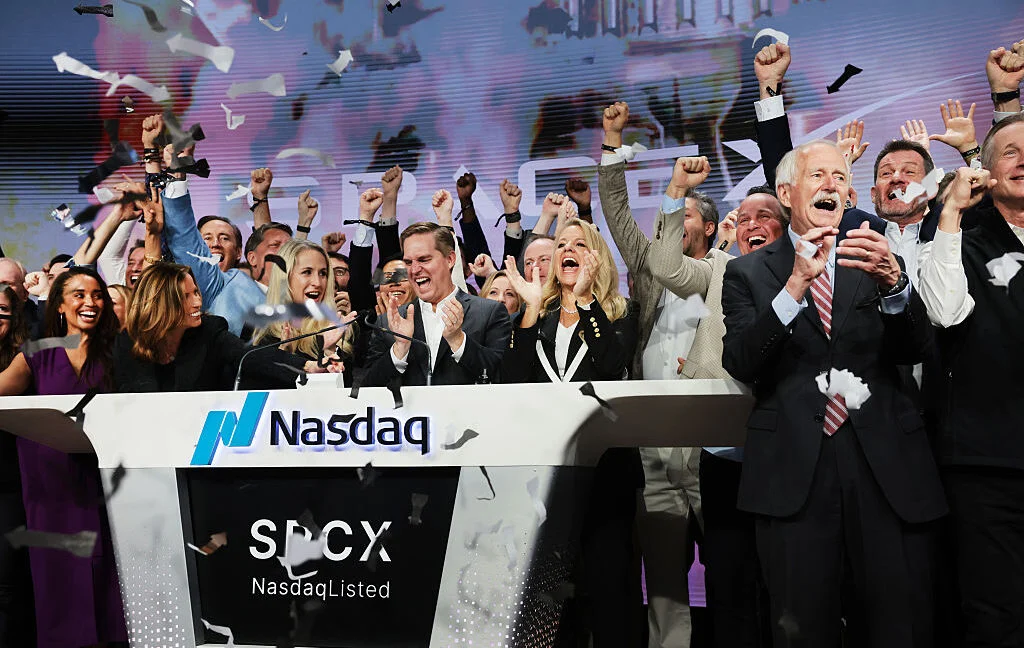
Main Facts: A New Titan Emerges
In a landmark event that marks the end of a quarter-century of private operations, Space Exploration Technologies Corp. (SpaceX) officially transitioned into a publicly traded entity on Friday. The aerospace giant, which has revolutionized orbital logistics and satellite communications, began trading on the NASDAQ exchange under the ticker symbol "SPX."
The debut was nothing short of historic. Opening at $135 per share, the market immediately signaled a massive appetite for the stock, driving the valuation of the Hawthorne-based firm to an eye-watering $1.8 trillion. By the closing bell, shares had climbed to $160.95—a staggering 19.2% increase in a single day of trading. This valuation cements SpaceX as a central pillar of the global economy, rivaling the world’s most established technology conglomerates.
For founder Elon Musk, the IPO serves as a personal financial milestone, pushing his net worth into unprecedented territory. With his remaining stake in the company now valued at upwards of $700 billion, Musk has effectively become the world’s first trillionaire. Yet, the wealth generation was not confined to the C-suite. Through a long-standing and generous stock options program, thousands of current and former SpaceX employees saw their equity stakes transform into life-changing fortunes overnight, turning the company’s parking lots into veritable showrooms of newfound affluence.
Chronology: A 24-Year Journey to the Public Markets
The journey from a struggling startup in a converted warehouse to a $1.8 trillion behemoth is a testament to both persistence and rapid technological maturation.
- 2002: Elon Musk founds SpaceX with the ambitious goal of reducing space transportation costs and enabling the colonization of Mars.
- 2008: Following three failed launches, the Falcon 1 finally reaches orbit, narrowly saving the company from bankruptcy.
- 2015: SpaceX achieves the first successful landing of a first-stage rocket, fundamentally changing the economics of launch providers.
- 2020: The Crew Dragon Demo-2 mission marks the first time a private company sends humans to the International Space Station.
- May 2026: SpaceX submits its S-1 filing to the Securities and Exchange Commission, confirming long-held rumors of an impending IPO.
- Friday, June 2026: SpaceX begins trading on the NASDAQ, closing the day as one of the most valuable corporations in human history.
Supporting Data: Beyond the Rocketry
While public perception of SpaceX is anchored in reusable rockets and the Starlink satellite constellation, the company’s internal financial disclosures paint a much more complex picture. According to the S-1 filing released last month, the company’s leadership has pivoted the firm’s long-term strategy away from being a pure-play aerospace manufacturer.
In a surprising revelation to many retail investors, SpaceX’s "space-enabled solutions" and the Starlink internet network account for less than 7% of the company’s total addressable market valuation. Instead, the company has pivoted to position itself as a provider of high-compute AI infrastructure. By leveraging its unique position in low-earth orbit, SpaceX intends to host massive data centers and AI training clusters that operate outside the latency and regulatory constraints of terrestrial infrastructure.
Investors are now looking at a company that, while physically launching rockets, is digitally architecting the next generation of enterprise AI. The market’s 19% surge on Friday suggests that institutional capital is buying into the "Space-AI" thesis, even if it leaves some traditional space enthusiasts questioning the company’s shifting priorities.
Official Responses and Market Sentiment
The atmosphere at the NASDAQ bell-ringing ceremony was electric, though tempered by the weight of the company’s new obligations. In a brief statement, SpaceX President Gwynne Shotwell emphasized that the core mission—to make life multi-planetary—remains unchanged despite the new quarterly earnings requirements.
"Going public provides us with the capital and the transparency to accelerate our mission," Shotwell noted. "However, our north star remains the same: the settlement of Mars and the advancement of humanity. We are simply adding a layer of fiscal accountability that will ensure our longevity for the next century."
Conversely, Wall Street analysts remain divided. Skeptics point to the company’s sky-high P/E ratio, arguing that it is "fool’s gold" based on speculative AI promises that have yet to generate significant revenue. "The valuation is detached from current reality," says Sarah Jenkins, a senior market analyst at Sterling Financial. "Investors are betting on a future where SpaceX is the backbone of global AI compute, but they are paying for that future today, not tomorrow."
Bullish investors, however, argue that SpaceX has never failed to deliver on its technological promises. "Every time they said a reusable rocket was impossible, they did it," says investor Mark Vance. "I wouldn’t bet against them on the AI front either."
Implications: A New Era of Corporate Accountability
The transition to a public company brings profound implications for SpaceX and Elon Musk. While Musk retains majority voting control—shielding him from the whims of activist investors—the company is now subject to rigorous SEC scrutiny.
The Transparency Burden
SpaceX will no longer be able to operate in the shadows. Quarterly earnings calls will now be the stage upon which Musk must justify his expenditures to shareholders who may care more about AI profit margins than the technical hurdles of a Mars landing. This shift could force a realignment of resources. If investors demand higher returns on their capital, projects like Starship, which are inherently high-risk and capital-intensive, may face intense internal pressure to demonstrate immediate profitability.
The AI-Space Convergence
The move to pivot toward AI services is the most significant strategic pivot in the company’s history. By placing data centers in orbit, SpaceX aims to solve the "energy and heat" problem of terrestrial AI. With infinite solar power available in space and the ability to vent heat into the vacuum of the thermosphere, SpaceX is betting that it can offer a cooling and power solution that earth-bound data centers cannot match.
Impact on Employees and Talent
The "overnight millionaire" status of thousands of employees is expected to trigger a significant shift in the aerospace labor market. With a massive influx of liquidity, many early-stage employees may choose to retire or pursue independent ventures, potentially leading to a "brain drain" at the company. SpaceX will need to implement aggressive new retention strategies to maintain its competitive edge in the high-stakes engineering sector.
A Test of Vision vs. Value
Ultimately, the SpaceX IPO is a litmus test for the modern economy. It challenges the market to decide if it values long-term, civilization-altering endeavors or short-term AI-driven returns. As the company navigates its first few months on the exchange, it will serve as the world’s most prominent case study on how to balance the heavy, expensive work of rocket science with the high-margin, software-centric world of artificial intelligence.
For now, the markets have spoken: they believe in the future that SpaceX is building. Whether that belief is backed by sustainable growth or inflated expectations remains to be seen. But one thing is certain—the trajectory of the company, and the wealth of its stakeholders, is now firmly tethered to the cold, hard numbers of the NASDAQ ticker.
As the sun sets on the first day of trading, the world watches to see if SpaceX can continue to defy gravity—both in the literal sense of orbital mechanics and the metaphorical sense of market valuation.


 Pevita Pearce
 Ammar Sabilarrohman