Ammar Sabilarrohman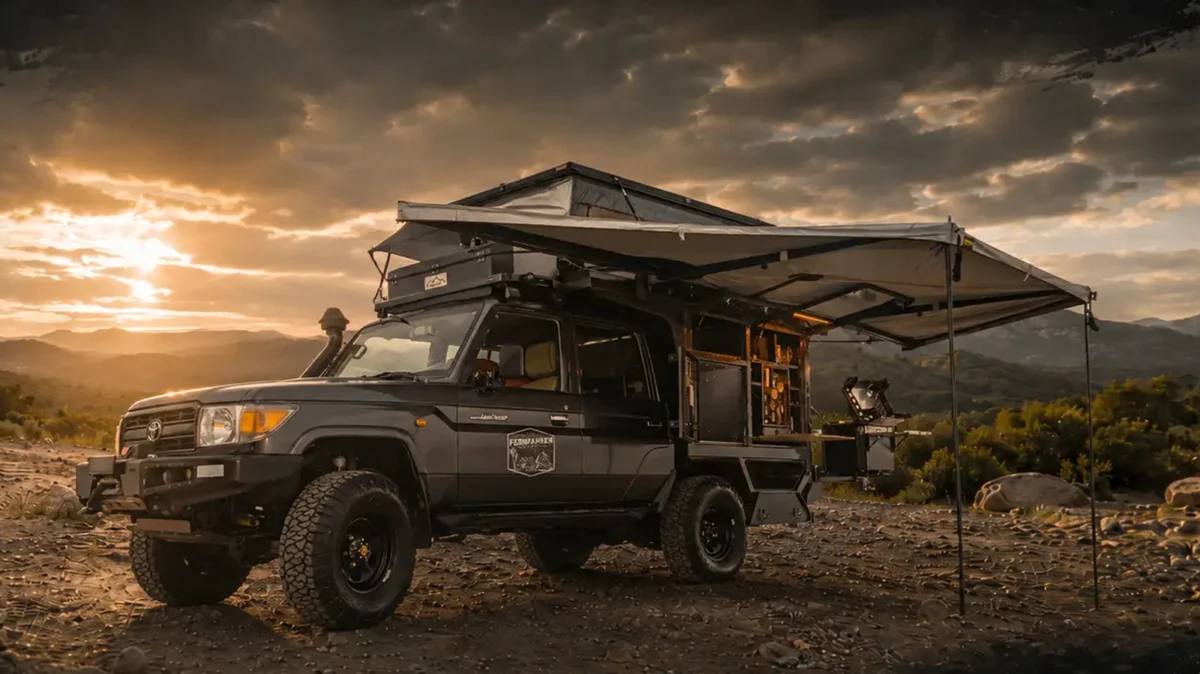
For those who view the horizon not as a boundary, but as an invitation, the name "Bushwakka" has become synonymous with rugged, uncompromising engineering. Based in the heart of South Africa—a region that serves as the ultimate proving ground for off-road machinery—the company has carved a niche for itself by building some of the most resilient camping RVs on the planet. Their latest innovation, the Bushwakka Land Cruiser Double Cab 4-Sleeper Kamelback Camper Conversion, is a masterclass in space optimization, designed specifically for those who refuse to leave family behind when venturing into the wild.
Main Facts: A Mobile Sanctuary for the Modern Explorer
At its core, the Bushwakka 4-Sleeper is a specialized living module engineered to be mounted onto the chassis of a Toyota Land Cruiser 79 Series Double Cab. While the base vehicle is legendary for its mechanical longevity, the Bushwakka conversion transforms it into a self-sufficient, all-terrain home.
The standout feature of this specific model is its capacity. By extending the living module over the vehicle’s cab by approximately 500 mm (nearly 20 inches), the designers have created a dual-level sleeping arrangement. This allows the vehicle to comfortably house four adults or a family with children, a significant upgrade from the original 2-Sleeper design. Despite this added capacity, the unit maintains a dry weight of just 1,653 pounds, ensuring that the Land Cruiser’s off-road prowess remains largely uncompromised.
The build quality emphasizes survival in harsh environments, featuring superior insulation, advanced ventilation, and structural integrity that protects occupants from both the elements and the wildlife that characterize the African backcountry.
The Chronology of a Concept: From 2-Sleeper to 4-Sleeper
The evolution of the Kamelback series began with the 2-Sleeper, a unit praised by overlanders for its simplicity and efficiency. However, feedback from the community—specifically from families who wanted to share the experience of remote exploration with their children and grandchildren—prompted the design team at Bushwakka to rethink the interior geometry.
Phase I: The 2-Sleeper Foundation
The original design focused on a queen-size bed configuration with a streamlined kitchen and storage layout. It was designed for long-range solo travelers or couples who required a low center of gravity and ease of setup.
Phase II: Conceptualizing the Expansion
The engineering challenge was how to add a second, full-sized sleeping berth without significantly increasing the vehicle’s footprint or total weight. The decision was made to extend the "over-cab" section. This required a re-evaluation of the weight distribution and structural mounting points to ensure that the added length did not create undue stress on the vehicle’s frame during heavy off-roading.
Phase III: The Debut
The 4-Sleeper was officially unveiled to the public through an immersive demonstration video led by Bushwakka’s Jasper Hewitt. The video served as the primary launch vehicle for the product, showcasing not just the technical specifications, but the intended "lifestyle" use-case: enabling multi-generational travel in total safety.
Supporting Data: Technical Specifications and Amenities
For the serious overlander, the equipment list is as important as the engine. The Bushwakka 4-Sleeper is equipped to handle extended trips far from the electrical grid.
Power and Energy Management
The unit comes standard with a 100-Ah lithium battery, which serves as the heart of the electrical system. Recognizing the power demands of modern camping—including refrigerators, lighting, and charging devices—Bushwakka offers a robust DC-to-DC charger. For those who intend to stay stationary for longer periods, an optional 380-watt roof-mounted solar-charging system is available, effectively turning the camper into a mobile power plant.
Interior Comforts
The interior is designed to prioritize ergonomics.
- Sleeping Quarters: The primary queen-size bed offers excellent headroom and overhead lighting. The secondary bed, added in this iteration, measures a comfortable 53 inches by 71 inches, making it a true full-size sleeping surface. A folding extension panel provides the necessary length while remaining stowable during the day to maximize floor space.
- Kitchen and Galley: Accessibility is key. The unit features single-door access to a dedicated kitchen prep area. The work surface is finished in bamboo—a material chosen for its durability and aesthetic appeal—and is fully illuminated. Integrated storage solutions cater to cutlery, dishes, and pantry goods.
- Environmental Control: Large, strategically placed windows allow for natural ventilation, while the premium insulation ensures that the interior remains temperate even in extreme heat or cold.
Official Perspectives: The Philosophy of Safety
Jasper Hewitt, the voice of the brand in their product demonstrations, emphasizes that the 4-Sleeper is more than just a camper; it is a safety solution. In the context of the African bush, where proximity to wildlife is a reality, the elevation of the sleeping quarters serves a practical, protective purpose.
"We wanted to make sure that families could take their kids and grandkids into the wilderness without the anxiety that comes with ground-level tents," Hewitt explains. By creating a secure, elevated, and well-lit sleeping environment, Bushwakka has effectively created a "fortress" that allows explorers to focus on the scenery rather than their safety. The focus on headroom and interior light reflects a design philosophy that values the psychological comfort of the user during long-term travel.
Implications: The Global Overlanding Market and Constraints
The Bushwakka 4-Sleeper represents a significant milestone in the customization of the Toyota Land Cruiser 79 Series, yet it also highlights the stark differences between global automotive markets.
The Vehicle Constraint
The biggest hurdle for North American enthusiasts is the base vehicle itself. The Land Cruiser 79 Series Double Cab is not imported to the United States due to strict emissions and safety regulations. For American buyers, this means the dream of owning a Bushwakka 4-Sleeper requires either sourcing a vehicle in another country or settling for alternative chassis options, which may not offer the same iconic off-road reputation.
Economic Accessibility
At an all-inclusive price of 546,924 South African Rand (approximately $33,000 USD), the conversion is competitively priced for the high-end overlanding market. When compared to the cost of bespoke luxury RVs or complex overland builds, the Bushwakka offers a high degree of utility and durability for the price. However, this cost covers only the camper module; the cost of the donor vehicle is a separate, significant investment.
The Future of "Adventure Living"
As the popularity of "van-life" and overlanding continues to rise globally, the demand for modular, high-capacity, and off-road-capable campers is set to increase. The Bushwakka 4-Sleeper sets a new benchmark for how manufacturers can balance the need for more space with the realities of backcountry travel. By proving that a four-person sleeping arrangement can exist without sacrificing the agility of a 4×4, Bushwakka has provided a roadmap for future design in the industry.
Conclusion: A New Standard for Expedition Travel
The Bushwakka Land Cruiser Double Cab 4-Sleeper Kamelback is a testament to the ingenuity required to thrive in the world’s most demanding environments. It is a product of necessity—born from the need to accommodate families in the wild while maintaining the rugged, "go-anywhere" spirit of the Land Cruiser. While its availability may be limited to specific markets due to vehicle regulations, its influence on the design of overlanding equipment is undeniable. For those lucky enough to operate one, it offers a rare combination: the freedom of the wilderness, the safety of a fortress, and the comfort of home.

 Rifan Muazin