Nana
Nana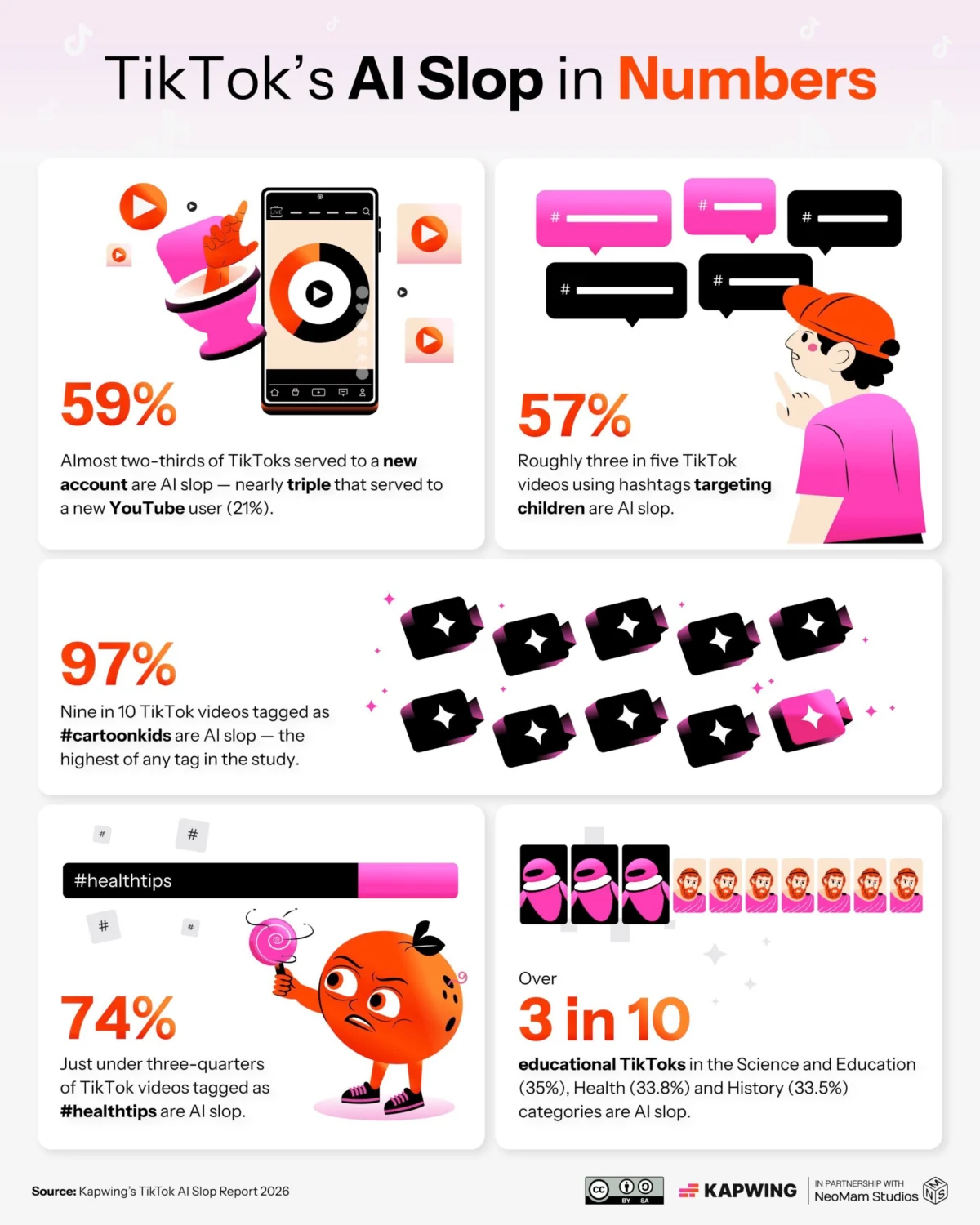
If you have spent any time scrolling through your TikTok "For You" page (FYP) recently, you may have experienced a nagging sense of unreality. Beyond the usual viral dances and trending audio clips, there is an increasing density of content that feels hollow—videos featuring uncanny, AI-generated animations, repetitive voiceovers, and bizarre, synthesized narratives. If you suspect your feed is becoming a landscape of synthetic content, a new investigative report suggests you are not merely imagining it: you are experiencing the digital era’s version of "AI slop."
A comprehensive study conducted by the creative platform Kapwing has revealed that 59% of videos served to a brand-new, neutral TikTok account consist of AI-generated content. To put this in perspective, that rate is nearly three times higher than the density of AI content found on YouTube Shorts, which currently sits at 21%. As generative AI tools become more accessible, the barriers to content creation have collapsed, leading to a tidal wave of low-effort, automated output that is increasingly flooding the platforms we use to navigate the world.
The Methodology: Measuring the Digital Tsunami
To quantify the scale of this synthetic deluge, Kapwing researchers took a granular approach. They established fresh, "blank-slate" accounts on both TikTok and YouTube, ensuring no prior user behavior could influence the recommendation algorithms. They then performed a manual, systematic audit of the first 500 videos served to each account.

The results were stark. On TikTok, 294 out of the 500 initial videos were classified as AI-generated—a staggering 59% majority. Conversely, a similar test conducted on YouTube Shorts yielded 104 AI-generated videos out of 500, resulting in a 21% share.
This data provides a compelling look at the divergence in how different platforms are being utilized by creators and, perhaps more importantly, by automated bot networks. While YouTube has its own issues with "brainrot" content and low-quality automation, TikTok appears to be the current epicenter for this specific strain of synthetic media. To deepen their research, the Kapwing team went further, manually reviewing over 10,000 TikTok videos across 20 distinct content categories, mapping exactly where this "slop" clusters most aggressively.
Chronology: The Rise of the Machine-Made Feed
The proliferation of AI content did not happen overnight. The timeline of this shift mirrors the rapid advancement and democratization of generative AI models.

- 2023: The Early Wave: Following the public release of advanced Large Language Models (LLMs) and video-generation tools, creators began experimenting with automated voiceovers and AI-generated image sequences. Initially, this was viewed as a creative shortcut.
- Early 2024: The Proliferation of Automation: As specialized AI tools for video production (such as those that can turn a script into a full video with a digital avatar) became cheaper and faster, the barrier to entry plummeted. This allowed individual "creators" to churn out dozens, if not hundreds, of videos per day.
- Late 2024: The "Slop" Tipping Point: By November, the scale of the issue became undeniable. TikTok itself publicly disclosed that it had labeled over 1.3 billion videos as AI-generated. This massive figure signaled that synthetic content had moved from the fringe of the app to its very core.
- 2025–2026: The Algorithmic Feedback Loop: With the introduction of sophisticated recommendation engines, AI content that garners even a baseline level of engagement is being amplified by the algorithm, creating a feedback loop where "slop" is rewarded with reach, encouraging further production.
The "Kids Content" Crisis
Perhaps the most alarming finding in the Kapwing report is the targeting of younger demographics. The study found that content categorized as "Kids’ Content" had the highest rate of AI-generated material of any category surveyed.
Within the 2,000 videos reviewed under the children’s entertainment umbrella, a massive 57% were found to be AI-generated. The situation is even more dire when looking at specific hashtags; in the #cartoonkids category, an astonishing 97 out of 100 videos were confirmed to be synthetic. This represents a significant shift in digital media consumption for the next generation, where traditional, human-led storytelling is being replaced by repetitive, algorithmically optimized, AI-generated visuals that often lack the nuance and moral structure of human-crafted animation.
Categorical Breakdown: Where the Slop Clusters
The study highlighted a clear pattern: AI slop is not distributed evenly across the platform. Instead, it clusters in areas where production costs are typically higher, and where AI can effectively—if superficially—mimic human expertise.

1. Education and Science (33%–35% AI)
Categories like Science, History, and Health are heavily impacted. These sectors often rely on voiceover narration and stock footage to explain complex concepts. AI tools can now generate a script, record a voiceover, and stitch together relevant (if sometimes inaccurate) visuals in minutes, effectively replacing educational content that was once vetted by human experts.
2. The Human-Centric Defenses: Fashion, Music, and Fitness
Interestingly, some categories remain largely untouched by the AI wave. Fashion, Music, and Fitness content showed an AI-slop rate of below 2%. The common thread here is the requirement for "human presence." Users in these categories generally want to see real people, real movements, and authentic reactions. Because these genres rely on on-camera personality and physical skill, they currently serve as a bastion against the tide of synthetic content.
Implications for the User Experience
The implications of this shift are profound. When 59% of a feed is synthetic, the nature of "social" media changes. The platform is no longer a place for human connection; it becomes a marketplace for automated content designed to exploit the human brain’s desire for novelty and quick stimulation.

For the average user, the burden of "curation" has shifted entirely to them. While TikTok has introduced tools to allow users to dial back AI content in their settings, these are often opt-in features that the average user—especially a child—may not know how to navigate. As it stands, the default experience on TikTok is one where artificiality is the baseline, and authenticity is the exception.
The Broader Landscape of Digital Safety
The rise of AI slop does not exist in a vacuum. It is part of a larger conversation regarding the safety and integrity of social media platforms. Recent studies, such as those from the Molly Rose Foundation, have highlighted that despite legislative efforts like the UK’s Online Safety Act, harmful content remains rampant.
When AI is used to generate content at scale, it also becomes a vehicle for misinformation and harmful tropes. If a user is served a feed that is 60% synthetic, they are effectively operating in an environment where the "ground truth" of what they are seeing is obscured. Whether it is deepfaked historical facts or AI-generated cartoons that may contain subtle, unintended biases, the lack of human oversight is a growing regulatory concern.

Official Responses and Future Outlook
TikTok has consistently stated that its goal is to provide a safe and authentic environment for users. The company has rolled out various labeling requirements for AI-generated content and has promised to improve its recommendation algorithms to demote low-quality, repetitive, or "spammy" content. However, the sheer volume of AI content—1.3 billion videos and counting—suggests that manual or even traditional automated moderation is insufficient to stem the tide.
As Meta and other competitors also struggle with AI integration—such as Facebook’s recent introduction of AI-powered search "genies"—the industry is at a crossroads. Platforms must decide if they will prioritize the high-engagement, high-volume nature of AI content, or if they will pivot to protect the human-to-human connectivity that made these apps popular in the first place.
For now, the advice for users is simple but demanding: be skeptical of what you consume. In a world where the feed is increasingly written, directed, and produced by machines, the most valuable tool a user has is their own ability to distinguish between a genuine human voice and the echoing, synthetic hum of the algorithm. As the digital landscape continues to evolve, the distinction between the organic and the synthetic may become the defining challenge of our online lives.


 Jia Lissa
 Ammar Sabilarrohman