Dwi Wanna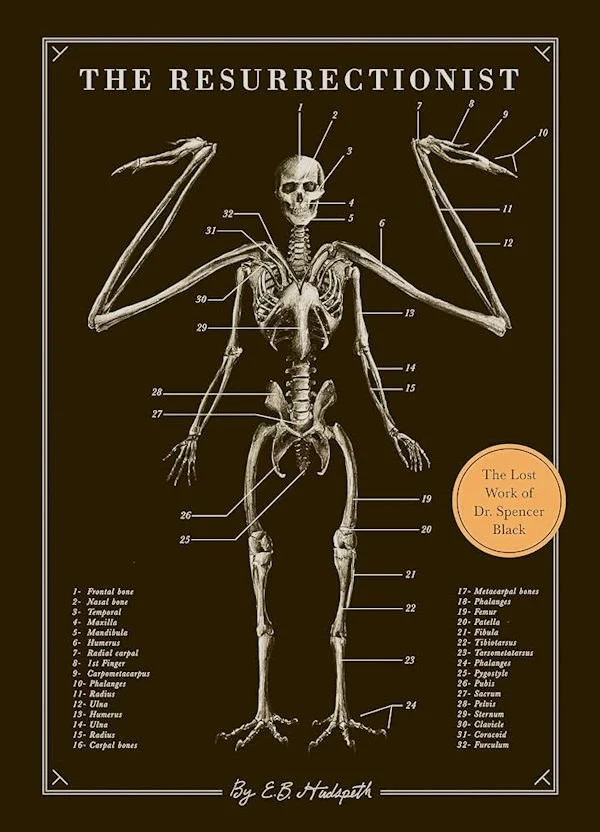
In the landscape of contemporary speculative fiction, few works manage to bridge the gap between the macabre and the academic as effectively as E.B. Hudspeth’s The Resurrectionist. Set against the atmospheric, gas-lit backdrop of late 19th-century Philadelphia, the narrative functions not merely as a novel, but as a meticulously crafted artifact—a piece of "fictional non-fiction" that challenges the reader to distinguish between historical record and the fever dreams of a brilliant, fractured mind.
At the center of this narrative is Dr. Spencer Black, a surgeon whose pedigree—the son of a notorious grave robber—informs his clinical, albeit unorthodox, approach to the human form. Hudspeth’s work is a dual-layered experience: the first half is a biographical account of a man’s descent into madness, while the second half serves as the Codex Extinct Animalia, a collection of anatomical illustrations that serve as the "proof" of Black’s radical evolutionary theories.
Main Facts: The Surgeon and the Myth
Dr. Spencer Black, as presented by Hudspeth, is a figure of tragic ambition. Educated at the prestigious Academy of Medicine in Philadelphia, Black is introduced as a prodigious talent in the field of surgery. However, his academic training acts only as a foundation for his true life’s work: the pursuit of a hypothesis so radical it threatens the very fabric of Darwinian biology.
Black posited that mythological creatures—mermaids, satyrs, sphinxes, and centaurs—were not the products of ancient folklore or divine whim, but were, in fact, the evolutionary ancestors of humanity. To Black, the "monstrosities" of the past were simply branches of the human family tree that had withered away. His hypothesis, while dismissed by the medical establishment of his time, became the driving force of his life, transforming him from a celebrated surgeon into an obsessed seeker of "lost" anatomy.
The brilliance of Hudspeth’s execution lies in the clinical detachment of the prose. By framing the narrative through the lens of a historical biography, the author invites the reader to consider the possibility that Black was not merely a lunatic, but a man who saw truths that his contemporaries were too fearful to acknowledge.
Chronology of a Descent
To understand the trajectory of The Resurrectionist, one must map the psychological and professional erosion of Dr. Spencer Black. His life can be categorized into three distinct phases:
The Formative Years (The Academy)
During his tenure at the Academy of Medicine, Black is a man of intellectual promise. He is influenced by the proximity to his father’s illicit trade, developing an early, visceral understanding of human anatomy that is both intimate and detached. It is here that he begins to view the human skeleton not as a fixed design, but as a malleable blueprint.
The Period of Obsession (The Private Practice)
Upon entering private practice, the boundaries of Black’s ethical framework begin to dissolve. As he shifts his focus from standard surgery to the "Resurrection" of ancient biological types, he begins to document his findings in secret. This is the era where his brilliance begins to cross the threshold into obsession. He stops treating patients and starts "curing" them—or rather, altering them to fit his theories.
The Final Unraveling (The Carnival and Beyond)
The final stage of Black’s life is defined by his transition from the halls of academia to the fringes of society. He becomes a showman, a carnival exhibit, and eventually a ghost. This stage represents the total collapse of his public identity, as he attempts to manifest his theories through physical experiments, leading to the horrifying conclusions depicted in the latter chapters of the book.
Supporting Data: The Codex Extinct Animalia
The most compelling aspect of The Resurrectionist is the inclusion of the Codex Extinct Animalia. These anatomical plates are rendered with such clinical precision that they demand to be scrutinized. Unlike typical fantasy illustrations, which often lean toward the fantastical or the ethereal, these plates are drawn with the dry, sterile authority of an 1870s medical textbook.
The scientific validity of the art is what makes it so unnerving. One sees the musculature of a centaur’s ribcage or the skeletal structure of a siren’s tail, and the mind instinctively tries to rationalize the mechanics. The detail is relentless—cross-sections of bone, labeled diagrams of nervous systems, and notes regarding the "vestigial" organs of these creatures.
When viewed in isolation, the Codex is a triumph of imagination and artistic skill. However, when viewed through the context of Dr. Black’s biography, these images undergo a chilling transformation. They cease to be merely drawings and become the evidence of a man who was willing to commit unthinkable acts to validate his vision. Each plate is a testament to a life sacrificed at the altar of scientific discovery.
Official Responses and Critical Reception
Since its release, The Resurrectionist has occupied a unique niche in the literary community. Critics have largely lauded Hudspeth for his ability to sustain the "fictional non-fiction" conceit. The book has been frequently cited in discussions regarding the blurring lines between horror, history, and scientific discourse.
However, the response has not been without critique. Many readers have expressed a desire for a more expansive narrative. As one reviewer noted, the descent from a brilliant surgeon to a carnival showman occurs with such velocity that the reader is left wanting more time to inhabit the space of his unraveling. The "middle" of the story, where the psychological shifts are most critical, feels to some like a summary of events rather than a lived experience.
Despite this, the consensus remains that the book is a "perfect" anomaly. It is a work that does not attempt to be a sprawling epic, but rather a focused, claustrophobic study of a singular obsession. The medical community—at least those who have encountered the book—has often praised the technical accuracy of the terminology used, further blurring the line between the reality of the 19th-century medical practice and the fictionalized narrative of Dr. Black.
Implications: The Line Between Genius and Madness
The primary implication of Hudspeth’s work is the question of the "cost of discovery." Dr. Spencer Black serves as a literary proxy for the dark side of the Enlightenment. He represents the danger of empirical observation when stripped of moral constraints.
By grounding the story in the late 1870s, Hudspeth taps into the Victorian fascination with the "hidden" world. It was a time when the world was being mapped and measured, yet the shadows of the unknown still held immense power. Black is a character who refuses to leave those shadows alone. He insists on dragging them into the light of the laboratory, regardless of the destruction it causes to himself and those around him.
The book also forces a reflection on the nature of "truth" in art. By creating an artifact—a book that feels like a real, historical document—Hudspeth proves that the power of a story is not just in the prose, but in the framing. The Codex is beautiful, but it is the tragedy of Dr. Black that gives it its soul. Without the context of the man, the monsters are just curiosities; with the man, they are the ghosts of his own ambition.
Conclusion
The Resurrectionist is a rare achievement. It is a haunting, beautiful, and deeply unsettling look at the pursuit of knowledge at any cost. For those who find themselves drawn to the intersection of the macabre and the scientific, the book offers an experience that is difficult to replicate. It is not merely a read; it is a descent. And for those willing to follow Dr. Spencer Black down into the depths of his anatomical obsession, the journey is one that will linger long after the final page is turned and the book is returned to the shelf.
Whether one views Dr. Black as a victim of his own time, a visionary misunderstood by his peers, or a monster in his own right, the brilliance of E.B. Hudspeth’s creation is that it allows for all these interpretations. It stands as a testament to the idea that some secrets are not meant to be found—but that the search for them is the most human act of all.


 Layla Zulfa
 Ali Ikhwan