Reynand Wu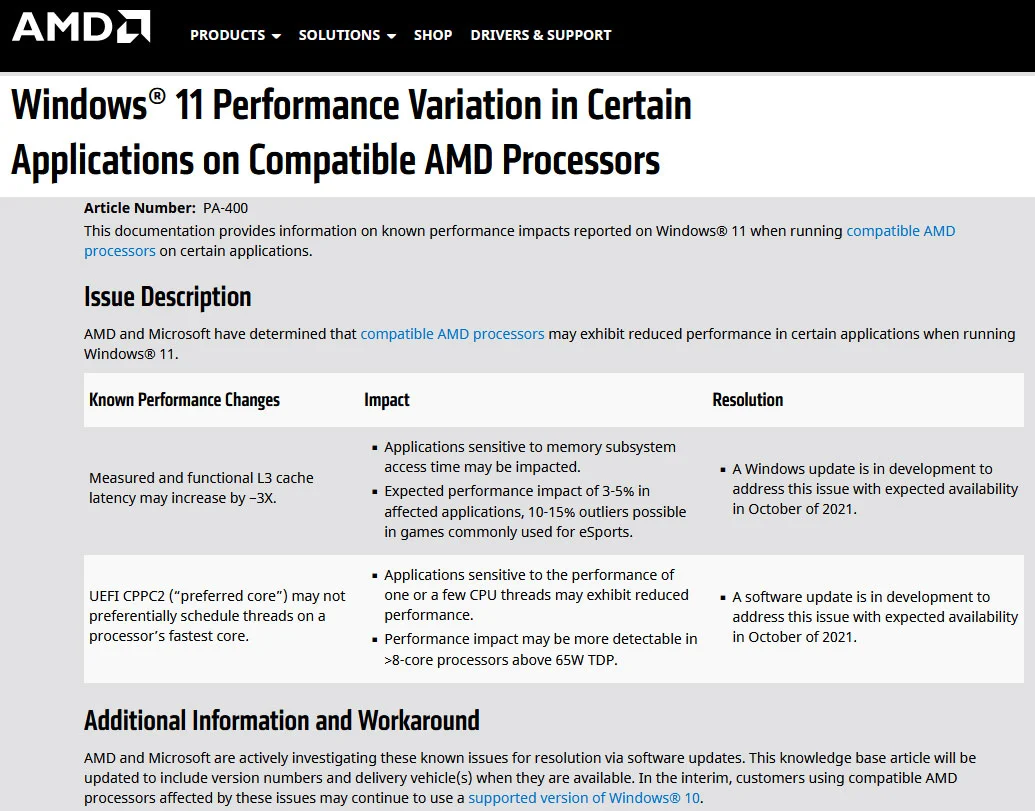
The launch of Windows 11, Microsoft’s latest iteration of its flagship operating system, was intended to herald a new era of performance, security, and productivity. However, for a significant segment of the PC enthusiast and professional community, the transition has been marred by technical hurdles. Shortly after the OS began its global rollout, reports surfaced regarding unexpected performance degradation on systems powered by AMD Ryzen processors.
Following a flurry of user reports and community benchmarking, AMD has officially confirmed that its processors are experiencing compatibility issues with Windows 11. These issues, which primarily involve L3 cache latency and thread scheduling, have created a tangible disparity in performance compared to Windows 10. While both Microsoft and AMD are actively collaborating on a resolution, the current reality for many users is a suboptimal computing experience.
Chronology of the Discovery
The performance issues did not emerge as a singular, catastrophic event, but rather as a cumulative discovery by the enthusiast community.
- Initial Rollout (October 5, 2021): As Windows 11 became available via Windows Update and the Installation Assistant, early adopters began upgrading their systems.
- Community Benchmarking: Within 48 hours of the launch, hardware enthusiasts on platforms like Reddit and various tech forums began reporting lower-than-expected scores in synthetic benchmarks and real-world application tests. Users noted that their Ryzen 5000-series processors were underperforming in specific memory-latency tests.
- AMD Official Acknowledgment: Recognizing the growing concern, AMD published an official support document—FAQ PA-400—on its website. This document served as the first formal confirmation that the performance variations were not anecdotal but rooted in systemic software-hardware interaction failures.
- The "Preferred Core" Revelation: Shortly after the initial confirmation, further investigation into the OS scheduler revealed a secondary issue involving the UEFI CPPC2 (Collaborative Processor Performance Control) protocol, which manages "preferred core" selection.
- The Commitment to Patching: By the end of the first week of October, AMD and Microsoft committed to a timeline for a fix, targeting a software update to be pushed via Windows Update later in the month.
Technical Deep Dive: The Core Issues
AMD has identified two primary culprits behind the performance degradation: a drastic increase in L3 cache latency and a failure of the OS scheduler to correctly assign tasks to the "fastest" cores.
The L3 Cache Latency Crisis
The most critical issue involves the L3 cache. Under normal operating conditions, modern Ryzen processors rely on rapid access to the L3 cache to manage high-speed data processing. Windows 11 appears to interact with this cache in a way that effectively triples its latency.
AMD’s documentation indicates that memory-sensitive applications are the most vulnerable to this bottleneck. When an application requires frequent, high-speed data swaps between the processor and the cache, the increased latency creates a "waiting room" effect, forcing the CPU to sit idle while waiting for data. While this manifests as a 3 to 5 percent performance hit in general productivity software, the impact is significantly more pronounced in gaming.
UEFI CPPC2 and the Scheduling Bug
The second issue pertains to how Windows 11 identifies and utilizes the "preferred cores" of a processor. AMD’s architecture often features cores with varying performance profiles—some are capable of reaching higher boost clocks than others. The UEFI CPPC2 protocol is designed to signal the operating system to prioritize these high-performance cores for demanding, single-threaded tasks.
In Windows 11, this communication channel is currently unreliable. The OS may assign a single-threaded task to a "slower" core while leaving the high-performance cores underutilized. This issue is particularly prevalent in high-core-count processors (those with more than 8 cores) and higher TDP (Thermal Design Power) configurations (above 65W). On these chips, the performance gap between the "fastest" and "slowest" cores is wider, making the scheduler’s error much more visible to the user.
Supporting Data and Performance Impact
The implications of these bugs are not merely theoretical; they are reflected in clear, measurable data points.
Gaming Performance
Gamers, particularly those invested in high-refresh-rate eSports, are the most affected demographic. Titles such as Counter-Strike: Global Offensive, Valorant, and League of Legends are notoriously sensitive to CPU latency and single-core performance. Early reports suggest that these games have seen frame rate drops in the range of 10 to 15 percent. For a competitive player accustomed to hitting 300+ FPS, a 15 percent drop is not just a statistical anomaly—it is a perceptible loss in competitive fluidity.
Productivity and Creative Workloads
For creative professionals, the impact is more nuanced. Applications that are highly dependent on memory bandwidth, such as file compression tools, video encoding software, and large-scale data analysis suites, show a consistent 3 to 5 percent regression. While this may seem marginal in a vacuum, for a workstation running multi-hour render jobs, a 5 percent performance loss translates to significant lost time over a work week.
Official Responses: AMD and Microsoft
The collaboration between AMD and Microsoft has been swift, aiming to mitigate user frustration. AMD’s official stance, as communicated through their support portals, is one of transparency and assurance.
"AMD and Microsoft have identified two issues that may cause performance degradation in certain applications on certain AMD processors," the company stated. "We are working closely with Microsoft to resolve these issues, and a software update is expected to be available later this month."
What is notable about the upcoming resolution is the mechanism of delivery. AMD has explicitly stated that these fixes will be handled entirely via Windows Update. This is a crucial detail for the end-user, as it implies that the fix will not require complex manual intervention, such as flashing a new motherboard BIOS, updating chipset drivers, or adjusting delicate UEFI/BIOS settings. For the average user, this "set it and forget it" approach is the best possible outcome.
Implications and Recommendations for Users
The situation leaves Windows 11 users with AMD hardware in a difficult position. The decision to adopt a new operating system on launch day always carries inherent risks, but the "performance tax" currently being levied on Ryzen users is particularly disappointing for a premium hardware ecosystem.
The "Nuclear Option"
For users whose livelihoods depend on peak performance—such as competitive gamers, streamers, or video editors—the current workaround is drastic: reverting to Windows 10. While Windows 11 offers a refreshed UI and new productivity features, the stability and performance of Windows 10 remain the industry benchmark. Rolling back is, as described, the "nuclear option." It is a time-consuming process that requires a full system wipe and reinstallation, which is often not feasible for users who have already migrated their entire workflow to the new OS.
A Plea for Patience
For the vast majority of users, however, the recommendation remains to "sit tight." The performance degradation, while annoying, is unlikely to render a high-end system unusable. Most general productivity tasks—web browsing, document editing, and media consumption—are not sensitive enough to the L3 cache latency or scheduling bugs to cause a noticeable impact.
As we look toward the promised patch, users should monitor the Windows Update dashboard. It is expected that the fix will arrive in the form of a cumulative update or a specialized driver package. Until then, users are advised to avoid "tinkering" with BIOS settings or third-party overclocking utilities in an attempt to force performance gains, as these could lead to system instability given the current state of the OS scheduler.
Long-term Outlook
This incident serves as a salient reminder of the complexities inherent in modern computing. As CPUs become more heterogeneous—with varying core speeds and complex cache hierarchies—the operating system’s ability to "understand" the hardware becomes the most critical factor in system performance.
The partnership between AMD and Microsoft is long-standing and robust. While this launch-day stumble is regrettable, the speed with which the issue was acknowledged and the simplicity of the proposed fix suggest that this will be a short-lived chapter in the history of Windows 11. By the time the next monthly "Patch Tuesday" rolls around, it is highly probable that the Ryzen platform will return to its expected performance metrics, allowing users to enjoy the features of Windows 11 without the heavy burden of compromised performance.


 Azzam Bilal Chamdy
 Iffa Jayyana