Evan Lee Salim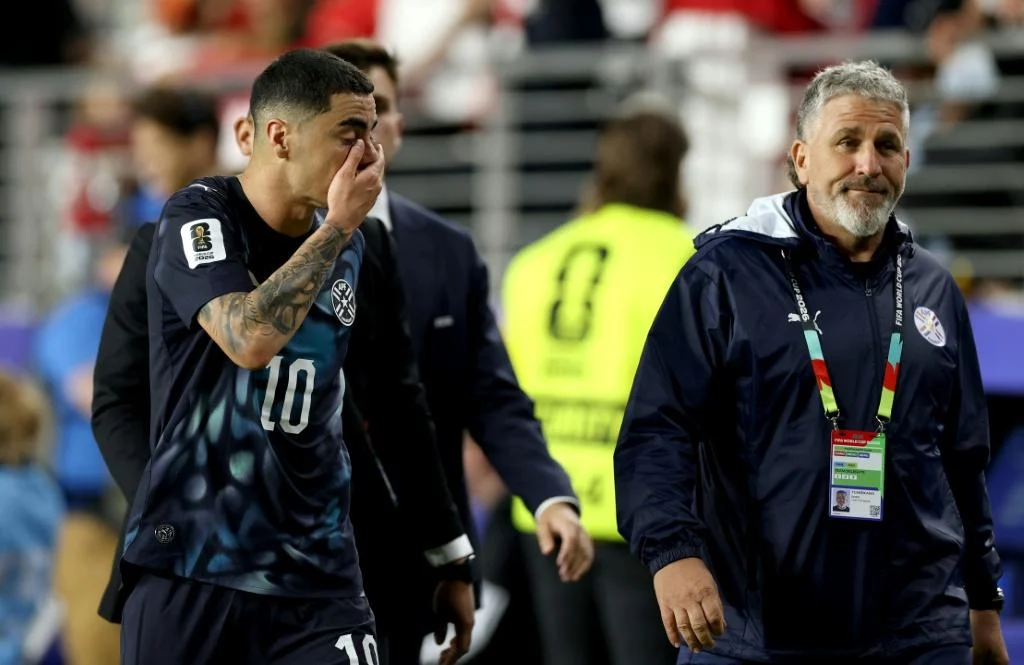
SANTA CLARA, California — In a landmark moment that has sent shockwaves through the global footballing community, Paraguay forward Miguel Almirón has etched his name into the annals of sporting history—though not in the way he would have hoped. During a tense World Cup Group D encounter against Turkey, the former Newcastle United playmaker became the first player ever to be dismissed under FIFA’s newly implemented, stringent "No-Cover" rule, designed to curb on-field verbal abuse and discriminatory language.
The incident, which occurred in the dying embers of the first half, has ignited a fierce debate regarding the balance between privacy, player conduct, and the enforcement of morality on the pitch. As FIFA continues its aggressive crusade to eradicate racism from the beautiful game, the precedent set in Santa Clara marks a significant escalation in the governing body’s disciplinary reach.
The Incident: A Moment of Controversy
With Paraguay holding a slender 1-0 lead and the momentum of the match shifting, an off-the-ball altercation between Almirón and Turkey’s Mert Müldür escalated near the touchline. As the two players squared off in a heated exchange, Almirón was observed instinctively shielding his mouth with his hand—a common tactical habit among footballers attempting to prevent lip-reading by opponents, officials, and television cameras.
Following a brief delay, the match official paused proceedings to consult the Video Assistant Referee (VAR). After a review that lasted nearly three minutes, the referee approached the center of the pitch and produced a straight red card for Almirón. The stadium, filled to capacity, erupted in a mixture of confusion and disbelief. The decision was not based on the content of the words spoken—which remain unverified—but solely on the act of obscuring the mouth during a confrontational interaction.
Chronology of a Regulatory Shift
The dismissal of Almirón is the culmination of a rigorous policy rollout that began in earnest earlier this year. To understand the gravity of the decision, one must look at the timeline of events that led to this radical change in the Laws of the Game.
- February 2026: A high-profile Champions League clash between Real Madrid and Benfica served as a catalyst. Following allegations of racial abuse directed at Vinicius Junior, winger Gianluca Prestianni found himself at the center of a storm. Though he denied the specific charge of racism, he was subsequently handed a six-match ban for "homophobic conduct," exposing the difficulty of proving verbal abuse in the absence of audio evidence.
- March 2026: FIFA President Gianni Infantino addressed the recurring issue of verbal abuse, stating, "If you do not have something to hide, you don’t hide your mouth when you say something. That’s it, as simple as that."
- April 2026: FIFA officially ratified the amendment, mandating that any player who covers their mouth during a confrontation with an opponent or match official would receive an immediate red card. The rule was framed as a transparency measure to ensure that all on-field communication is "auditable and accountable."
- June 2026: The World Cup in North America serves as the primary testing ground for the regulation, with match officials instructed to apply the law with zero tolerance.
The Philosophical Argument: Privacy vs. Transparency
The implementation of this rule has divided experts and players alike. Proponents argue that the "mouth-covering" habit has become a convenient mask for discriminatory language. By forcing players to speak openly, FIFA claims they are creating a more transparent environment where abuse is easily identified by referees and stadium audio sensors.
"Football is a public spectacle," says Dr. Elena Vance, a sports ethics consultant. "If a player is engaging in a professional capacity, the ‘right to privacy’ for their spoken words is inherently limited. If you aren’t saying anything malicious, why the need to hide your speech? This rule removes the ambiguity that has plagued racism investigations for decades."
However, critics argue that the rule is an overreach that penalizes instinctual behavior. Many players cover their mouths simply to prevent their tactical instructions—or even mundane trash talk—from being picked up by broadcast lip-readers. The argument is that a player could be sent off for a harmless comment simply because they acted out of habit, effectively punishing a gesture rather than an offense.
Official Responses and FIFA’s Stance
FIFA’s leadership remains steadfast in its defense of the protocol. In a post-match briefing following the Paraguay-Turkey game, a FIFA spokesperson reiterated that the organization is willing to sacrifice "traditional game flow" to prioritize "human rights and inclusion."
"The game has evolved," the statement read. "For too long, the sanctity of the pitch has been violated by individuals who hide behind their hands to spew hate. We have provided clear guidance to all federations: if you want to play at this level, you must be prepared to speak in the open. The red card is the only way to ensure that players understand the seriousness of this requirement."
Conversely, the Paraguayan Football Association (APF) has expressed "profound disappointment" with the officiating. In a formal letter to FIFA, the APF argued that the dismissal changed the complexion of a crucial group stage match and that the punishment was disproportionate to the action, suggesting that a yellow card or a warning should have sufficed for a first-time offense of this nature.
Broader Implications for the World Cup
The ripple effects of Almirón’s dismissal are already being felt across the tournament. Players in subsequent matches have been observed walking with their hands strictly behind their backs during heated moments, a clear indication that the "Almirón Effect" is changing on-field behavior in real-time.
1. Tactical Communication
Managers are now tasked with training their players to communicate differently. Set-piece instructions, which were previously whispered behind a hand to avoid being "stolen" by opponents, now carry the risk of a red card. This could lead to a decrease in complex tactical maneuvering during high-tension moments.
2. The Burden on Referees
The responsibility placed on the shoulders of the officials has increased exponentially. Referees must now determine not only if a foul occurred but whether a hand-to-mouth gesture was a deliberate act of concealment during a confrontation. This subjective interpretation is likely to lead to further VAR interventions, potentially slowing the game down even further.
3. The Future of Discipline
This rule could be the precursor to even more invasive technologies. With the success of audio-monitoring AI in other sports, there is speculation that FIFA may soon move toward "microphone-equipped" kits for all players. If the "No-Cover" rule fails to deter abuse, the next logical step for a governing body obsessed with "total transparency" might be the complete removal of private speech on the pitch.
Conclusion: A New Era of Scrutiny
Miguel Almirón’s red card is more than just a footnote in the statistics of the 2026 World Cup. It is a defining moment for the sport, signaling a departure from the "what happens on the pitch, stays on the pitch" mentality that defined football for over a century.
As the tournament progresses, the focus will undoubtedly remain on whether this policy effectively reduces instances of racism or if it merely serves to sanitize the game to an unnatural degree. While FIFA celebrates a victory for transparency, the fans, players, and coaches are left to navigate a new landscape where the simple act of talking—even with one’s hand in front of one’s face—could be the difference between glory and an early shower.
Whether this policy survives the test of time remains to be seen. For now, every player at the World Cup knows the stakes: keep your hands down, or risk becoming the next casualty of FIFA’s war on the hidden word. The game has changed, and for better or worse, the silence of the mouth is now the loudest statement on the pitch.


 Neng Nana
 Asro
Asro