Asep Darmawan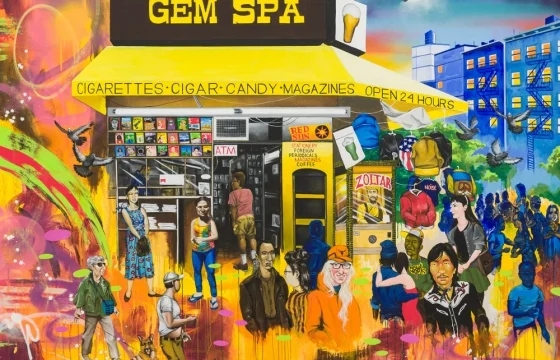
Introduction: The Pulse of a Vanishing Metropolis
New York City has long been a palimpsest—a city defined by the layers of paint, history, and humanity that coat its infrastructure. For Chris “Daze” Ellis, one of the most pivotal figures to emerge from the 1970s graffiti movement, the city is not merely a backdrop; it is the primary subject of a lifelong obsession. Currently, PPOW Gallery is hosting Orchid Rain on the Underground, Daze’s third solo exhibition with the institution. Running through April 25, 2026, the show serves as a sprawling, multimedia love letter to a New York that has largely been erased by gentrification, yet remains vividly alive in the collective consciousness.
By synthesizing the raw, spray-painted spontaneity of his youth with the meticulous, studio-honed discipline of a five-decade career, Daze presents an exhibition that is both a memorial and a manifesto. From large-scale paintings of subway tunnels to a fully immersive, multisensory dance floor installation, Orchid Rain on the Underground invites viewers to reconcile the gritty, dangerous beauty of the 1980s with the evolving creative spirit of the present day.
Chronology: From Subway Tunnels to the Gallery Wall
To understand the gravity of Orchid Rain on the Underground, one must look at the trajectory of Ellis’s life. Born in Brooklyn in 1962, Daze came of age during a period when New York City was on the brink of fiscal collapse, a reality that ironically provided the fertile soil for a cultural explosion.
The Formative Years (1975–1980)
While attending the prestigious High School of Art and Design in the mid-1970s, Daze was exposed to the pioneers of the graffiti movement—visionaries like Blade, Lee Quiñones, and PHASE 2. During this period, the subway system served as the city’s most accessible, albeit illicit, art gallery. Daze began tagging subway cars, treating the transit network as a mobile canvas that traveled from the outer boroughs into the heart of Manhattan. This era was defined by high-stakes adrenaline and the pursuit of “fame,” as writers competed to have their names seen by the widest possible audience.
The Nightlife Crucible (1980–1985)
As the 1980s dawned, Daze’s practice began to migrate from the tunnels to the gallery. This transition was facilitated by the city’s legendary nightlife circuit. Venues such as the Lit Lounge, Danceteria, and the Mudd Club were not merely clubs; they were cross-disciplinary incubators where visual artists, musicians, and writers converged. In these spaces, Daze sharpened his aesthetic, absorbing the energy of the “Downtown” scene—a period where the boundaries between high art and street culture were porous, if not entirely nonexistent.
The Studio Evolution (1985–Present)
By the mid-80s, Daze successfully bridged the gap between the subway yard and the white-cube gallery. His work began to reflect a more deliberate, painterly approach. He traded the fleeting nature of graffiti for the longevity of canvas, allowing him to explore the nuanced textures of urban life. Today, after fifty years of practice, Daze has reached a stage where he functions as both a historian of his own era and an active participant in contemporary dialogue.
Supporting Data: The Aesthetic and Historical Context
Orchid Rain on the Underground is a masterclass in synthesis. Daze’s work operates on several registers, pulling from disparate historical traditions to create a visual language that feels entirely his own.
The Influence of Urban Realism
Daze explicitly cites early 20th-century urban realists as his spiritual predecessors. The influence of John Sloan of the Ashcan School and Reginald Marsh of the WPA era is palpable in his work. Like those artists, Daze finds dignity and drama in the mundane. He renders the grimy details of subway stations—the rusted steel, the flicking fluorescent lights, the rhythmic geometry of tunnel tracks—with the same reverence that a Renaissance painter might afford a cathedral.
Lyrical Abstraction and Gesture
Contrasting the rigid geometry of the urban landscape are the gestural, abstract flourishes that define Daze’s brushwork. He acknowledges the influence of Abstract Expressionists like Joan Mitchell and Willem de Kooning. In pieces where he combines acrylic and spray paint, the result is a tension between the “real” (the train car) and the “ethereal” (the atmosphere of the city). This tension is further amplified by the floral motifs that recur throughout the exhibition. In works like Gem Spa In the 80s (2025), Daze depicts the iconic St. Mark’s Place storefront—once called the “nerve center” of the city by Allen Ginsberg—but surrounds it with technicolor flora. These flowers, a mix of tropical blooms and those found in his current upstate home, represent the persistence of life amidst urban decay.
The Narrative Composition
Daze’s paintings are populated by figures of significance. Gem Spa In the 80s is a standout, featuring recognizable faces such as critic Carlo McCormick and artist Martin Wong. These aren’t just portraits; they are anchors in a shifting landscape, reminding the viewer that the history of New York is a history of people, not just architecture.
Official Perspectives: Inside the Exhibition
The installation at PPOW is designed to be a totalizing experience. By moving from the traditional paintings into a site-specific mural and, finally, a multimedia environment, the exhibition breaks down the barriers between the viewer and the art.
The final room of the gallery is perhaps the most ambitious aspect of the show. By installing actual subway car seats, a working disco ball, and a curated soundscape of house, disco, and early hip-hop, Daze reconstructs the sensory overload of his youth. This installation is a deliberate effort to reclaim the “freedom” that he associates with his formative years. It is an acknowledgment that while the city has changed, the creative spark that fueled the 1980s—the desire to make something beautiful out of limited resources—is a perennial human impulse.
Implications: The Legacy of the “Creative Spirit”
What does it mean to look back at the “gritty” New York of the 1970s and 80s from the vantage point of 2026? The implications of Orchid Rain on the Underground are profound.
The Fight Against Erasure
In an era of hyper-gentrification, where the landmarks of subculture (like Gem Spa) have been replaced by chain stores or glass-and-steel developments, Daze’s work acts as a form of cultural resistance. By placing these sites on canvas, he ensures that their contribution to the city’s identity is not forgotten. He argues that the “creative spirit” of New York was forged in the heat of social and economic inequality, and that this spirit remains the city’s most valuable resource.
The Role of the Artist as Archivist
Daze has positioned himself as an essential archivist. His work suggests that the history of a city is not just found in policy documents or architectural blueprints, but in the graffiti on a subway wall, the crowd at a local candy store, and the music playing in a crowded club. By blending the memorial with the aspirational, Daze pushes the viewer to ask: What are we building today that will be worth remembering tomorrow?
The Continued Relevance of the Underground
Perhaps the most significant takeaway from the exhibition is the argument for the continued relevance of the “underground.” Even as the physical spaces of the 1980s vanish, Daze suggests that the mentality of the underground—the subversion of public space, the communal pursuit of art, and the defiance of mainstream norms—is what keeps the city alive. Orchid Rain on the Underground is not just a look backward; it is an invitation for the next generation of artists to find their own version of the “rain” that nurtured the city’s most vibrant era.
Conclusion
Chris “Daze” Ellis has spent half a century documenting the lifeblood of New York City. Through Orchid Rain on the Underground, he manages to capture the fleeting nature of time while asserting the permanence of art. The exhibition is a testament to the fact that while the city’s skin may change, its heartbeat remains constant. For those who lived through the era Daze depicts, the show will be a poignant, nostalgic journey. For those who arrived later, it provides a vital window into the soul of a city that continues to reinvent itself, one layer of paint at a time. PPOW has provided a sanctuary for this reflection, ensuring that the legacy of the subway writers and the downtown icons remains firmly at the center of the contemporary art world.

 Dwi Wanna
 Asro
Asro