Laily UPN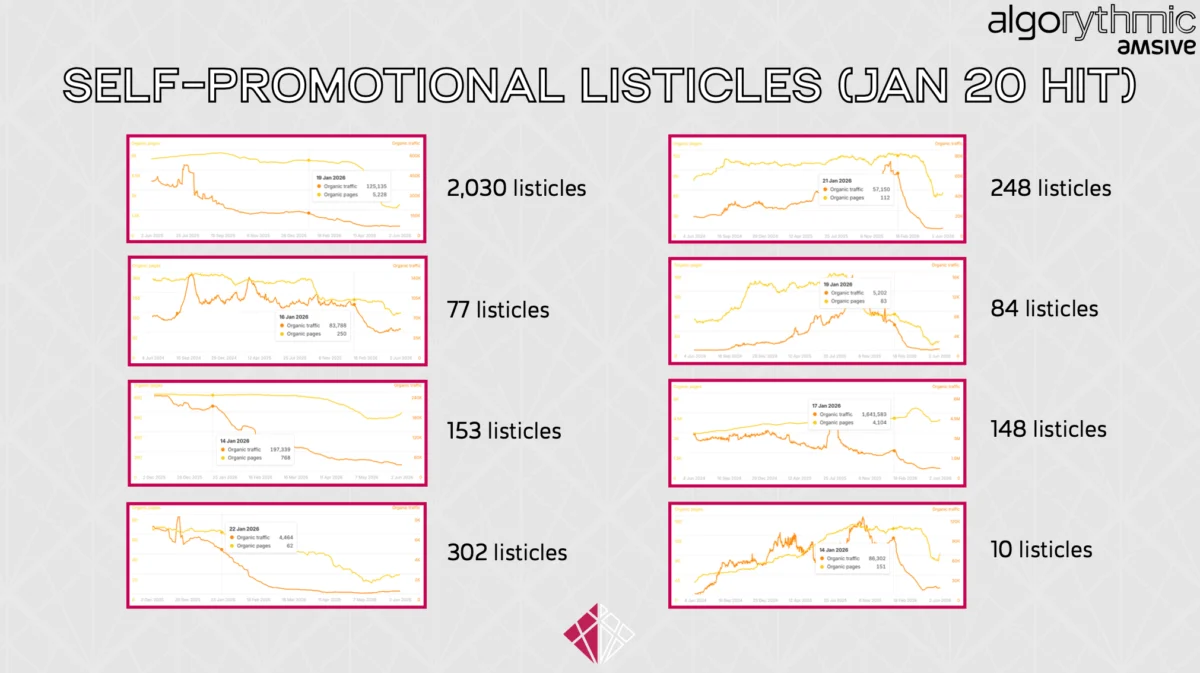
For years, the "listicle"—specifically the "Best [Category] Software" article—has been the gold standard of B2B marketing. It was a simple, high-leverage tactic: publish a piece ranking your own product as the undisputed leader in your industry, optimize it for search engines, and watch the traffic flow. In the early days of generative AI and Google’s AI Overviews (AIO), this strategy reached its zenith. Brands were not only ranking in traditional search; they were successfully manipulating AI models into citing their self-serving content as the definitive answer to consumer queries.

However, a massive shift is underway. New research suggests that the era of the self-promotional listicle is not only ending—it is actively harming the brands that rely on it. By analyzing 100 B2B "best [category]" queries across Google’s AI Overviews between April and June 2026, it has become clear that Google has fundamentally altered how it treats these pages. For many brands, a self-promotional listicle is no longer a path to visibility; it is a liability that acts as a megaphone for your competitors.

The Anatomy of a Failed Tactic: Main Facts
The core premise of the self-promotional listicle is that if you define the criteria for "the best," you can naturally position yourself at the top. This worked effectively because search algorithms—and early LLMs—lacked the sophisticated nuance required to distinguish between objective industry consensus and paid-for, biased content.

But the data tells a different story today. When a B2B brand publishes a "best [category]" listicle that ranks itself as number one, Google’s AI Overviews may still cite that article as a source, but they frequently exclude the publisher from the actual recommendation. In fact, these brands are left out of the final AI recommendation roughly 69% of the time.

Instead, the AI uses the listicle as a data point to identify other industry players. By naming competitors in your own article to appear "neutral," you are essentially providing the AI with a curated list of recommendations to feature instead of you. You earn the citation, but your competitor earns the customer.

Chronology of a Shift: From Exploitation to Enforcement
To understand how we arrived at this point, one must look at the timeline of the "GEO" (Generative Engine Optimization) boom.

- 2024–2025: The Land Grab. As AI search began to gain traction, businesses rushed to fill the "content void." They realized that few reputable publishers were writing "best [software]" guides because it is a biased practice. Brands stepped in to fill this space, and the tactic went viral. Thousands of companies, particularly in the SaaS sector, began churning out hundreds of these pages.
- January 2026: The Algorithmic Crackdown. Google initiated an algorithmic shift that severely impacted the organic visibility of sites heavily reliant on these listicles. This wasn’t just a slap on the wrist; it was a systemic demotion. Many domains saw their organic traffic crater, with the impact spreading from the specific subfolders housing the listicles to the entire site.
- April–June 2026: The AI Refinement. Data collection during this period confirms that Google has refined its AI Overviews to specifically devalue self-promoting content. While citations remain, they are being decoupled from recommendations. The AI is now prioritizing established category leaders—brands that are talked about and linked to by third parties—over those that simply claim their own greatness.
Supporting Data: Why Citations Aren’t Enough
The common metric for success in AI search has long been "citations." However, the industry is beginning to realize that citations are a vanity metric. If a user receives a full, AI-generated summary, the probability that they will click on your cited link is razor-thin. A 2025 Pew Research study found that when an AI summary appears, users click a link within that summary in just 1% of cases.

The real success metric is the recommendation. If your brand is not named as a top solution within the AI’s summary text, your citation is effectively worthless.

The 69% Exclusion Rate
In a rigorous analysis of 100 prompts, 74 returned an AI Overview that cited a self-promoter’s own listicle but completely omitted that brand from the recommended list. For instance, in queries for "best LMS for selling courses" or "best task management software," brands like Oasis LMS or TMetric were cited as the source material for the AI’s answer. Yet, when the answer was generated, those brands were nowhere to be found, while their competitors—who were also listed in the self-promotional articles—were highlighted as the top choices.

This creates a paradox: the more "thorough" a brand is in its listicle by including legitimate competitors to appear credible, the more ammunition it gives the AI to recommend those competitors over itself.

Official Responses and Industry Context
While Google rarely provides a "playbook" for these changes, their public-facing adjustments tell the story. Recent AI Overviews have begun including explicit disclaimers for categories prone to spam. For queries related to "best SEO experts," Google’s AI now warns users that the industry is "saturated with self-proclaimed experts."

This is a direct rebuke of the content-spam model. By labeling these industries as "saturated" or "self-proclaimed," Google is signaling to users that they should distrust the very pages that brands have spent millions to create. Furthermore, other LLMs like Claude are now flagging similar warnings, suggesting that the broader AI ecosystem is moving toward a consensus that "self-promotional" content is synonymous with low-quality, biased information.

Implications: The New Path Forward
The implications for digital marketing teams are severe. If you are currently scaling a strategy based on self-promotional listicles, you are likely:

- Harming your domain’s overall authority. Google is increasingly penalizing sites that use "thin" or "inauthentic" SEO content, which can drag down the visibility of your high-value pages.
- Feeding your competition. You are essentially acting as a content marketing arm for your rivals by providing the AI with the data it needs to recommend them.
- Wasting resources. In the era of voice-assisted AI, where users are listening to an answer rather than reading a page, you cannot "click" your way to a win. If you aren’t in the verbalized recommendation, you don’t exist.
The Shift Toward Genuine Authority
So, what should brands do? The answer lies in true authority signals. The brands that currently win in AI recommendations are those that are discussed favorably across third-party websites, forums like Reddit, and authoritative news outlets.

Instead of writing "Best CRM Software" on your own blog, focus on:

- PR and Brand Mentions: Invest in strategies that get other, high-authority publications to talk about your brand.
- Customer Advocacy: Encourage users to share their experiences on platforms that AI models crawl for sentiment, such as Reddit, G2, or TrustRadius.
- Quality over Quantity: Stop the "listicle factory." A single, high-quality, third-party review or an earned mention in an industry-leading publication is worth more than 50 self-promotional pages.
The "Best [Category]" query is evolving. It is no longer about who can game the search algorithm; it is about who has earned the genuine trust of the industry. Brands that pivot away from self-promotion and toward building real, verified authority will be the ones that dominate the AI-driven search results of the future. Those that cling to the old ways will likely find themselves as nothing more than a footnote—a cited source for a competitor’s victory.


 Neng Nana
 Siti Muinah