Dwi Wanna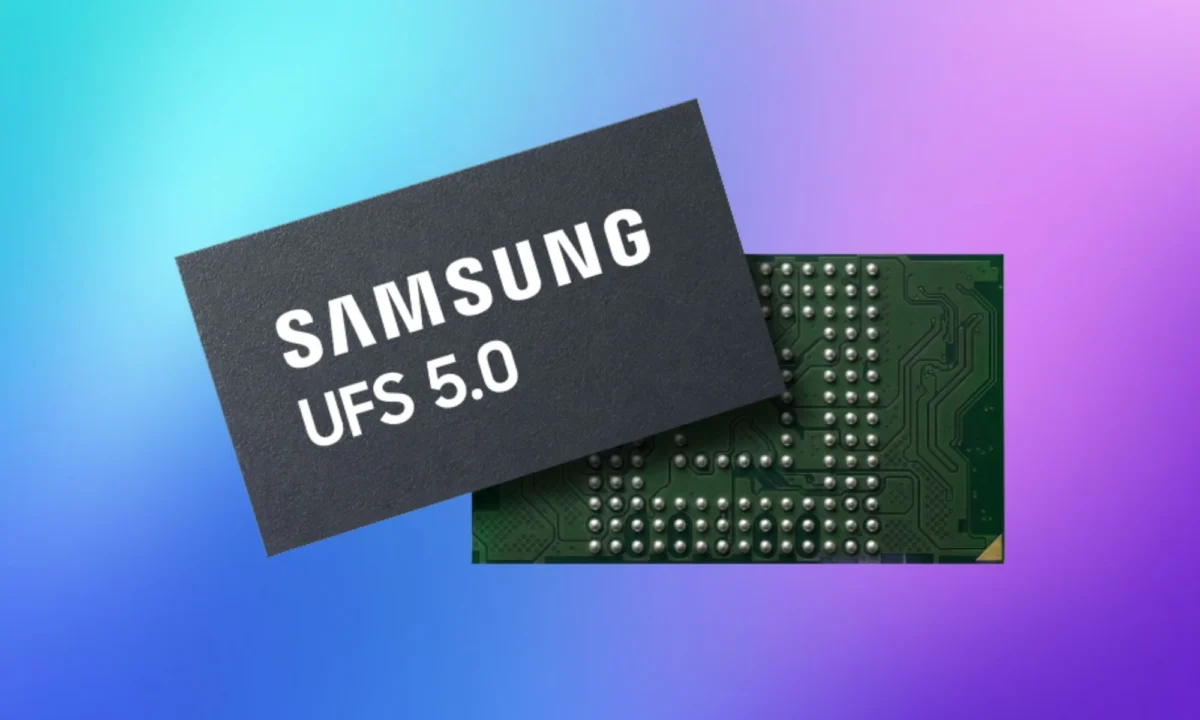
In an era where artificial intelligence is transitioning from massive, cloud-based data centers to the palm of our hands, the bottleneck for innovation has shifted. It is no longer just about the raw processing power of the NPU (Neural Processing Unit) or the sheer clock speed of the mobile processor; it is about how quickly a device can feed data to those systems. Addressing this critical juncture, Samsung has officially unveiled its latest breakthrough: the UFS 5.0 storage solution, a hardware advancement poised to redefine the performance ceiling of next-generation smartphones, wearables, and XR (Extended Reality) headsets.
The Core Innovation: Breaking the 10GB/s Barrier
Samsung’s newly announced UFS 5.0 (Universal Flash Storage) chip marks a significant leap in mobile storage architecture. Designed specifically to accommodate the heavy I/O (Input/Output) demands of on-device AI, the chip achieves a staggering data transfer speed of 10.8GB per second.
To put this into perspective, the jump from the current UFS 4.1 standard—which has been the gold standard for high-end flagship devices for the past year—to UFS 5.0 represents more than a doubling of performance capabilities. While UFS 4.1 was designed for high-resolution video capture and rapid app loading, UFS 5.0 is engineered for "AI-first" workflows. These include real-time language translation, complex generative AI image processing, and persistent, large-scale model interaction that requires near-instantaneous access to localized data.

Chronology of Storage Evolution: From UFS 3.1 to 5.0
The progression of Universal Flash Storage technology has been the unsung hero of the smartphone revolution. To understand why UFS 5.0 is such a milestone, one must look at the rapid cadence of its development:
- The Era of UFS 3.1: For years, UFS 3.1 provided the foundation for flagship performance, offering enough bandwidth to support 5G connectivity and high-refresh-rate displays.
- The UFS 4.0/4.1 Transition: As AI features began to emerge in the software layer, UFS 4.0 and 4.1 introduced significant efficiency gains, allowing for smoother multitasking and better power management for heavy workloads.
- The 2026 Shift to UFS 5.0: With the integration of large language models (LLMs) running natively on mobile hardware, the industry reached a plateau where storage bandwidth could no longer keep up with AI demands. Samsung’s announcement in June 2026 directly targets this limitation, establishing a new foundation for the "AI-native" hardware cycle.
Supporting Data: Efficiency and Miniaturization
While raw speed is the headline feature, the most practical benefit for the end-user may be the newfound power efficiency. Samsung reports that the UFS 5.0 chip delivers a 40% improvement in power efficiency compared to its predecessor. This gain is achieved through a combination of sophisticated "clock gating" and multi-voltage technology.
By optimizing the way the chip consumes electricity during idle and active states, Samsung has effectively mitigated the "AI tax"—the phenomenon where advanced AI features rapidly drain battery life. In the modern smartphone ecosystem, where battery capacity has hit a physical limit due to space constraints, efficiency gains at the component level are the only way to sustain long-term usage for power-hungry AI applications.

Furthermore, the physical footprint of the technology has been reduced. Measuring just 7.5mm x 13mm x 0.9mm, the new chip is 16.7% smaller than previous generations. This reduction is critical for smartphone manufacturers, who are increasingly struggling to fit massive battery cells, advanced camera arrays, and complex vapor-chamber cooling systems into slim chassis. The space reclaimed by the smaller storage module can be repurposed for larger battery capacity or additional thermal management materials.
Official Perspectives and Technical Implications
Samsung has characterized this development not merely as a storage upgrade, but as the creation of "core infrastructure" for the AI era. In official communications, the company highlighted that as users move away from cloud-dependent AI toward localized processing, the storage chip essentially acts as the "buffer" between the AI model and the processor. If the storage is slow, the processor remains idle, waiting for data—a situation known in engineering as an "I/O bottleneck."
By pushing read speeds to 10.8GB/s and write speeds to 9.5GB/s, Samsung has ensured that the storage is no longer a limiting factor. This creates a symbiotic relationship between the storage and the SoC (System on Chip), such as the upcoming Exynos 2700, which is widely rumored to power the next generation of Galaxy devices.

The Broader Impact on Mobile Technology
1. The Rise of "Always-On" On-Device AI
Current on-device AI is often limited to specific tasks like photo editing or simple voice commands. With the bandwidth provided by UFS 5.0, developers can begin to implement more complex, continuous AI agents that monitor and assist with user workflows in real-time. This requires constant reading and writing of data to the storage chip, a task that would have choked older UFS standards.
2. Next-Gen XR and Spatial Computing
Extended Reality (XR) headsets require immense data throughput to render high-fidelity environments without motion-induced latency. The high read speeds of UFS 5.0 will allow for near-instant loading of large 3D assets and high-resolution textures, significantly improving the realism and responsiveness of virtual and augmented reality experiences.
3. Professional-Grade Productivity
The mobile device is increasingly replacing the laptop for creative professionals. With 1TB capacities becoming standard and the high write speeds of UFS 5.0, mobile video editing and 3D rendering will become significantly more viable. Users will be able to capture, edit, and export 8K video content without the stuttering or thermal throttling often associated with sustained heavy data writes.

Looking Ahead: The Galaxy S27 and Beyond
As Samsung prepares to kick off mass production of UFS 5.0 chips in the fourth quarter of 2026, the industry is bracing for a shift in hardware cycles. Rumors regarding the Galaxy S27 suggest that while the company may iterate cautiously on camera hardware, the "under-the-hood" improvements—like the transition to UFS 5.0 and the integration of the Exynos 2700—will define the device’s performance.
This strategy highlights a pivot in the smartphone industry: away from annual gimmicks and toward foundational, performance-based improvements that serve as the bedrock for the artificial intelligence revolution. As software becomes increasingly sophisticated, the hardware must be ready to support it. With the launch of UFS 5.0, Samsung has ensured that the "AI-first" smartphone is not just a marketing slogan, but a technical reality.
Conclusion
The evolution of mobile storage, while often ignored by the average consumer in favor of screen resolution or megapixel counts, remains the single most important factor in the longevity and capability of a device. Samsung’s UFS 5.0 represents a masterclass in engineering, balancing the conflicting demands of extreme speed, power efficiency, and physical space constraints. As we move into the second half of the decade, it is clear that the gadgets of tomorrow will be defined by their ability to "think" locally—a feat made possible only by the rapid, reliable, and efficient storage technologies that sit at the heart of the device.


 Laily UPN
 Azzam Bilal Chamdy