Layla Zulfa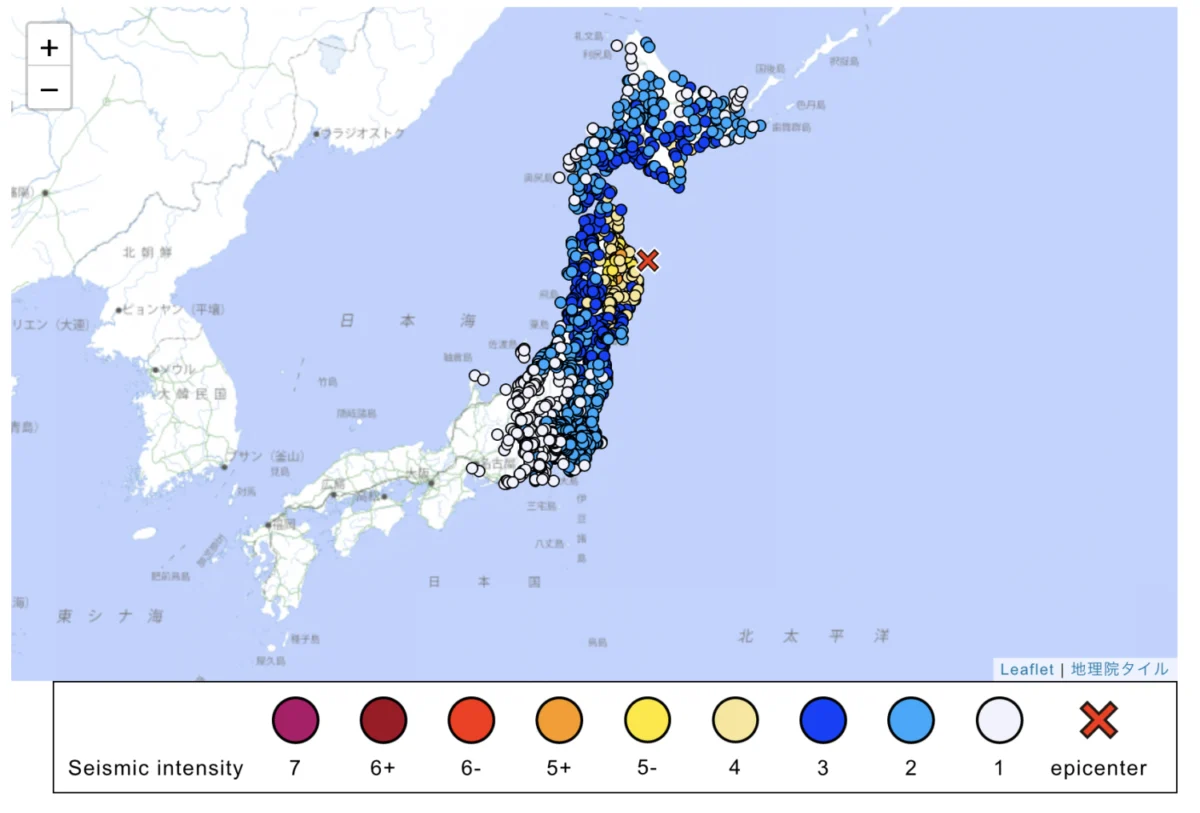
TOKYO – A powerful magnitude 6.9 earthquake struck off the coast of northern Japan on Thursday morning, sending violent tremors through the Tohoku region and prompting an immediate, high-level government response. While the Japan Meteorological Agency (JMA) confirmed that no tsunami warnings were issued, the intensity of the shaking—registering an upper 6 on Japan’s rigorous seven-point seismic scale—has raised significant concerns regarding infrastructure integrity and the potential for secondary tremors.
The earthquake, which occurred at a depth of approximately 50 kilometers, serves as a stark reminder of the region’s volatile seismic history, following a series of significant tremors that have rattled the northern prefectures over the past several months.
Main Facts: The Scope of the Seismic Event
The earthquake struck at approximately [Insert Time] JST, with its epicenter located deep off the coast of Iwate Prefecture. The JMA’s seismic intensity scale, which measures ground motion rather than energy release, recorded an "upper 6" in the town of Hashikami in Aomori Prefecture.
An intensity level of "upper 6" is classified by Japanese authorities as a catastrophic event for infrastructure and human stability. According to JMA documentation, at this level, standing is impossible; individuals can only move by crawling. Unsecured furniture, heavy appliances, and shelving units are highly likely to topple, and wall tiles or windows may shatter.
In addition to the impact in Hashikami, Hachinohe city in Aomori recorded a "lower 6," while several municipalities across Iwate Prefecture reported intensities reaching an "upper 5." The tremor was felt as far south as Tokyo, where residents reported a mild, swaying motion, underscoring the vast reach of the seismic waves generated by the rupture.
Chronology of the Crisis
The unfolding situation began early Thursday morning as the earth began to shake violently across the Tohoku region.
- Initial Impact: The earthquake struck at 50 kilometers beneath the ocean floor, sending shockwaves across the northern coastline. Within minutes, the JMA began analyzing data from its nationwide sensor network.
- Emergency Infrastructure Halt: Almost immediately following the initial tremors, the Tohoku Shinkansen—Japan’s high-speed bullet train network—halted all operations. This protocol is standard for Japanese rail operators to ensure that no trains are derailed while tracks are inspected for structural deformities.
- Government Mobilization: By mid-morning, the Prime Minister’s Office had formally established a task force dedicated to the earthquake. This cabinet-level body serves as the central hub for information sharing between local prefectural governments, the Japan Self-Defense Forces (JSDF), and emergency utility providers.
- Elevator Entrapments: Reports began surfacing through local broadcasters, specifically Fuji TV, suggesting that multiple individuals were trapped in elevators in Hachinohe. As the earthquake’s shaking triggered automatic safety shut-offs, buildings across the region went into emergency lock-down mode.
- Aerial Reconnaissance: Recognizing the potential for hidden structural damage, Defense Minister Shinjiro Koizumi mobilized the JSDF for aerial intelligence-gathering. Helicopters and drones were dispatched to scan for landslides, bridge integrity, and potential cracks in critical infrastructure.
Supporting Data and Seismic Context
The northern region of Japan, particularly the Tohoku coastline, sits atop one of the world’s most active tectonic zones. Thursday’s event is the latest in a troubling pattern of seismic activity that has plagued the area since the spring.
In April, a magnitude 7.7 earthquake hit the same general vicinity, triggering a special advisory that warned residents of the potential for even larger, follow-up quakes. This was followed by a magnitude 6.3 tremor in May, which measured a lower 5 on the JMA scale.
Geophysicists have noted that the repeated stress on the tectonic plates near the Iwate-Aomori border suggests a period of heightened crustal movement. While there is no way to predict earthquakes with precision, the frequency of these events has led the JMA to maintain a "vigilance status" for the entire northern coast. The depth of 50 kilometers is considered "shallow" in geological terms, which explains why the shaking was so intensely felt at the surface, even though the magnitude was not high enough to trigger a tsunami displacement.
Official Responses and Public Safety Measures
Prime Minister Sanae Takaichi addressed the nation in an emergency press conference shortly after the task force was convened. Maintaining a calm but firm demeanor, the Prime Minister explicitly stated there was "no tsunami concern" at this time.
However, her message to the public was one of extreme caution. "I urge all residents in the affected areas to remain vigilant," Takaichi stated. "The possibility of another earthquake of similar or greater magnitude remains in the coming days. Please follow the guidance of local officials and stay away from potentially unstable structures."
Chief Cabinet Secretary Minoru Kihara provided a comprehensive briefing on the status of critical facilities. "As of now, we have received no reports of casualties," Kihara confirmed. "Furthermore, there are no abnormalities reported at any nuclear power facilities in the region."
Japan’s nuclear safety standards have been significantly overhauled since the 2011 Great East Japan Earthquake, and current protocols dictate an automatic "scram" (shutdown) if sensors detect seismic activity exceeding specific thresholds. The fact that all facilities remain stable is a relief to the public, though the lack of power grid failures is also being closely monitored by utility companies.
Implications for Infrastructure and Society
Transportation and Logistics
The suspension of the Tohoku Shinkansen is a major disruption to the regional economy. As a critical artery for business and travel, the halt of the bullet train system necessitates a cascading series of delays. Engineering teams are currently deployed to inspect every kilometer of the track, looking for microscopic fractures that could lead to catastrophe. Until the "all-clear" is given, thousands of commuters and travelers are stranded, forcing a reliance on local bus and taxi services that are already overwhelmed.
Structural Integrity and Urban Resilience
The reports of trapped elevator occupants in Hachinohe raise questions about building safety. While Japan’s construction codes are arguably the strictest in the world, the "upper 6" intensity is the threshold where even modern buildings face significant strain. Local governments are expected to initiate building-by-building inspections over the next 48 hours to ensure that no residential high-rises or commercial centers have suffered structural fatigue that would make them unsafe for occupancy.
Psychological Impact
For the residents of Tohoku, the recent string of quakes has taken a heavy psychological toll. After the traumatic memories of previous seismic disasters, the constant "alert status" creates a sense of perpetual anxiety. Local authorities have begun broadcasting mental health support resources, acknowledging that the fear of a "larger quake" is as taxing as the physical tremors themselves.
Conclusion: A Future of Vigilance
As the afternoon progresses, the task force remains in session. The primary goal of the government is now transition from emergency response to assessment. With the Self-Defense Forces conducting aerial sweeps and the JMA continuing to monitor aftershocks, the region remains in a state of high alert.
While the absence of casualties and tsunami warnings provides a measure of relief, the intensity of the shaking—and the recurring nature of these seismic events—serves as a stark reminder of Japan’s precarious geological reality.
For the residents of Aomori and Iwate, the immediate future will be defined by caution. As Prime Minister Takaichi emphasized, the "vigilance" requested of the public is not merely a formality but a necessary precaution for a population that lives on the edge of a volatile earth. Updates will continue to be provided as the structural inspections conclude and the transportation networks begin the slow process of restoration.
This is a developing story. Further reports will follow as data from field inspections are processed by the central government.


 Neng Nana
 Asro
Asro