Pevita Pearce
Every time a major international sporting event takes place, a familiar media cycle begins. Images of Japanese fans meticulously gathering trash from stadium seats go viral, accompanied by breathless headlines praising “Japanese culture” as inherently fastidious and polite. For years, these images have served as a feel-good spectacle, a visual shorthand for a society defined by order and collective responsibility.
However, a growing chorus of voices within Japan is pushing back against this curated narrative. Leading the charge is Tamada Atsuko, a professor of the 18th-century French Enlightenment and a specialist in the history of women’s status. In a viral social media critique that has sparked national debate, Tamada challenged the romanticization of these stadium cleaners, juxtaposing the performative public tidiness of Japanese men with the stark, often invisible reality of their contributions—or lack thereof—within their own homes.
The Viral Catalyst: “Do It at Home”
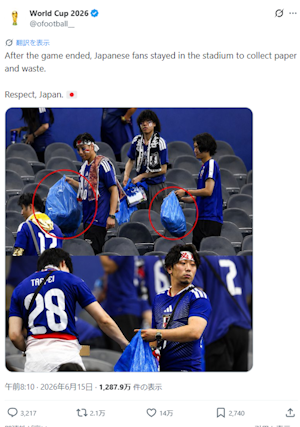
The latest instance of this disconnect occurred during the 2026 FIFA World Cup. Following a hard-fought 2-2 draw between Japan’s “Samurai Blue” and the Netherlands, the official FIFA account shared images of Japanese supporters cleaning the stands. The caption, “Respect, Japan,” was echoed by subsequent videos captioned, “Japanese culture is beautiful.”
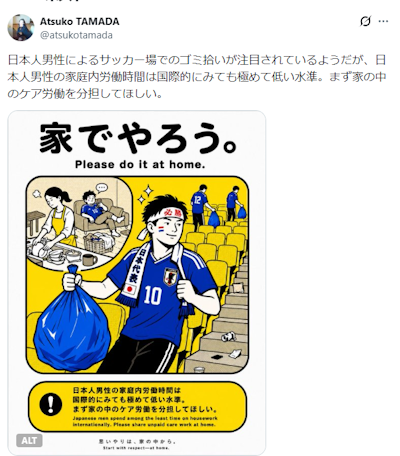
While the international community applauded, the reception in Japan was far more polarized. Tamada Atsuko, unimpressed by the optics, posted an AI-generated image on X that struck a nerve. The graphic depicted a male fan dutifully picking up trash in a stadium, while an inset showed his wife managing the entirety of the domestic labor at home. Her caption was blunt: “Japanese men’s trash-picking at the soccer stadium is getting a lot of attention, but Japanese men’s domestic care-labor hours are extremely low by international standards. I’d like them to start with sharing the work inside the home.”
The post became a lightning rod, garnering 59,000 likes and thousands of reposts. While Tamada restricted comments—a move that likely saved her from the vitriol that often follows feminist discourse on Japanese social media—the response from critics was predictable. Many users, predominantly male, accused her of "ruining" a positive national moment. Yet, for millions of Japanese women, Tamada’s intervention was not an attack on national pride, but a long-overdue spotlight on a systemic inequality that has stifled their personal and professional lives for decades.
A Chronology of Performative Virtue
The debate over the "stadium cleaning" phenomenon is not new, though it has evolved. In 2022, during the Qatar World Cup, the practice faced significant domestic scrutiny. Ikawa Mototaka, the former chairman of Daio Paper, famously derided the behavior as a “slave mentality,” arguing that fans were more concerned with earning the validation of foreigners than addressing the realities of their own society.
Similarly, former Tokyo Governor Masuzoe Yoichi criticized the practice from an economic perspective, suggesting that the "volunteer" cleaning threatened the livelihoods of local stadium sanitation staff. Nonfiction writer Kubota Masaki, writing in Diamond Online, offered a darker interpretation: he posited that the intense international focus on Japanese "morality" is a symptom of national decline, arguing that countries usually rely on such "spiritual" arguments when they lack the economic or political strength to command respect on the global stage.
Tamada’s critique, however, is distinct because it moves the argument away from economics and national honor, centering it instead on gender equity. By reframing the act as "performative," she highlights the dissonance between the public persona of the "polite, responsible Japanese citizen" and the private reality of a domestic sphere where labor is profoundly gendered.
The Data: The Unpaid Labor Gap
The statistics supporting Tamada’s argument are staggering. According to the OECD Time Use Database, the disparity between men and women in Japan regarding unpaid labor—childcare, cooking, cleaning, and elder care—is the widest among all 35 tracked nations.
As of the latest data, Japanese men contribute an average of just 47 minutes per day to unpaid household labor. Their counterparts in South Korea, the next lowest-ranking nation, contribute 49 minutes. By contrast, Japanese women spend 208 minutes per day on the same tasks—a ratio of 4.4 times more than their male partners.
The gap widens significantly in households with children under the age of six. In these families, the burden on women escalates to an average of 414 minutes (nearly seven hours) of unpaid work daily. This "second shift" is a significant driver of the gender pay gap and the "broken ladder" that prevents many Japanese women from pursuing long-term career advancement.
Historically, the situation was even more extreme. In 2016, women performed 5.4 times the amount of unpaid work compared to men. While the gap is narrowing, the pace is glacial. The cultural persistence of the furariimen—a term that trended years ago to describe husbands who linger in bars or offices specifically to avoid returning home to help with chores—speaks to a deep-seated resistance to change.
Structural Hurdles and Institutional Bias
It would be reductionist to blame individual men entirely. The disparity is deeply embedded in the Japanese corporate structure. With an average of 442 minutes (7.4 hours) spent on paid work daily—some of the highest figures in the OECD—the average Japanese employee is often physically and mentally drained by the time they reach home.
The "salaryman" culture demands total devotion to the firm. Even when men attempt to break the cycle, they often face institutional retaliation. Reports of fathers being transferred to distant, rural branches of their companies after requesting paternity leave are not uncommon. These "punitive transfers" serve as a deterrent, reinforcing the idea that domestic responsibility is incompatible with career success.
Furthermore, recent domestic surveys indicate that while most couples verbally agree that housework should be shared equally, the reality remains skewed. The expectation that women are the primary managers of the household remains a structural "default" in the Japanese social consciousness, reinforced by traditional gender roles that have been slow to modernize despite shifts in the national economy.
The "Squeaky Clean" Myth vs. Reality
The international fascination with Japanese cleanliness also ignores internal domestic realities. Despite the global image of pristine streets, local media frequently reports on the aftermath of major festivals, such as the Sumida River fireworks, where trash is left in abundance. In the tourist-heavy district of Shibuya, city statistics have revealed that nearly half of the littering incidents are attributed to domestic residents rather than international tourists.
This contradiction between the "public self" and the "private/domestic self" is the core of the criticism. When fans clean a stadium in Qatar or Germany, they are engaging in a highly visible act that confirms a positive stereotype. When they fail to clean up their own local parks or participate in their own housework, they are merely acting as individuals in a society that lacks a holistic, gender-neutral ethic of care.
Implications for a Changing Japan
The dialogue sparked by Tamada Atsuko signals a potential turning point. By linking the performative nature of stadium cleaning to the systemic inequality in the home, she has challenged the public to reconsider what "respect" really looks like.
If Japan is to modernize, it must move beyond the "soft power" of its image as a polite, clean society. True progress will require a multi-pronged approach:
- Corporate Reform: Ending the practice of punitive transfers and incentivizing genuine, rather than performative, paternity leave.
- Cultural Shift: Challenging the social stigma against men who prioritize domestic life over excessive overtime.
- Valuing Unpaid Labor: Recognizing that the economic stability of the country is built on the unpaid, invisible labor of women—labor that is currently being exploited to maintain a facade of "tradition."
The criticism from voices like Tamada is not an attempt to diminish the value of being clean or respectful; it is a plea for that same level of care to be extended to the people closest to home. Until the "Samurai Blue" can bring the same dedication to the kitchen sink and the nursery that they bring to the stadium, the international praise of "Japanese culture" will continue to ring hollow for those who bear the burden of the status quo.

As the world continues to watch Japan on the global stage, the conversation has finally shifted. The question is no longer just, "Can they keep the stadium clean?" but rather, "Can they build a society where the work of living is truly shared?"


 Neng Nana
 Asro
Asro