

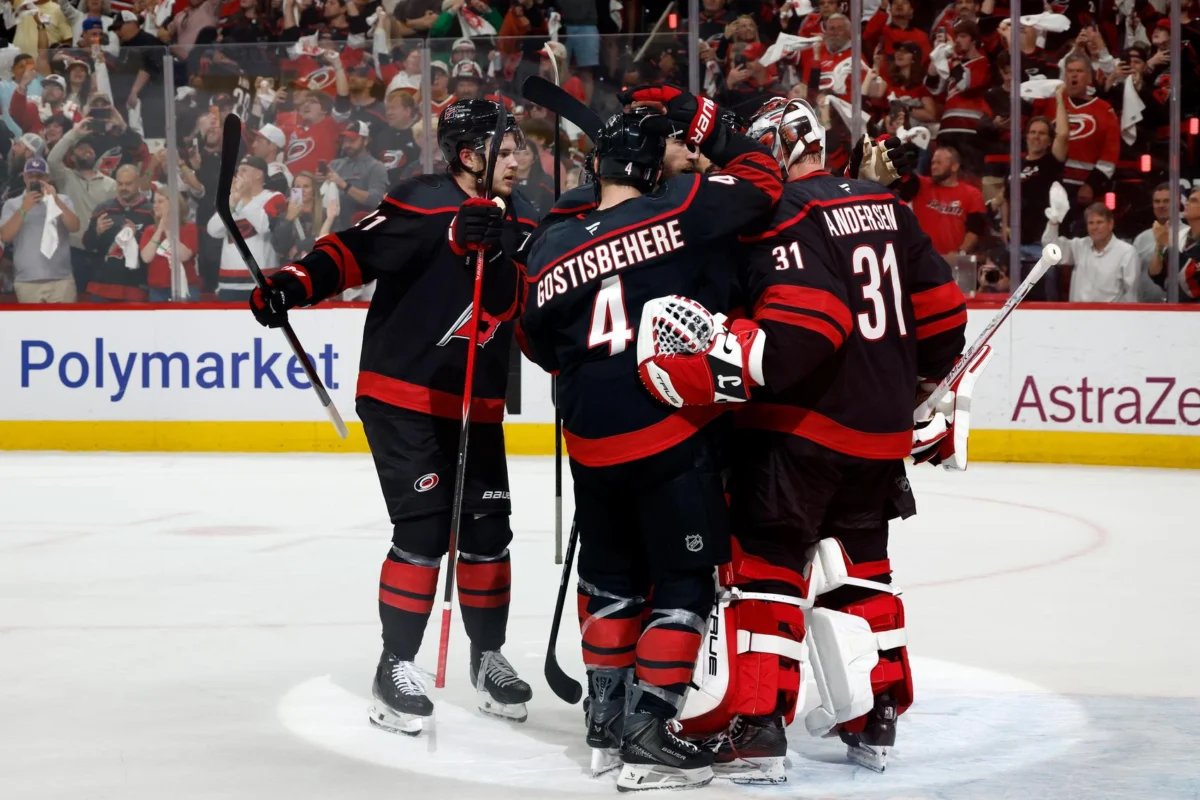
The Final Buzzer and the Embrace of Brotherhood
When the final horn sounded at the arena on Friday night, the scoreboard told a story of dominance: a 6-1 victory over the Montreal Canadiens in Game 5 of the Eastern Conference Final. But for the Carolina Hurricanes, the moment was about far more than punching a ticket to the Stanley Cup Final. It was about rallying around a teammate navigating the most harrowing 36 hours of his professional and personal life.
As the buzzer resonated through the rafters, the Hurricanes did not rush to celebrate with one another at center ice. Instead, the entire roster instinctively converged on the crease. Veteran forward Jordan Martinook reached Frederik Andersen first, wrapping the goaltender in a desperate, cathartic embrace, rhythmically tapping his helmet—a gesture of profound support. Defenseman Jalen Chatfield was close behind, followed by head coach Rod Brind’Amour, who shared a long, silent moment with his goaltender.
The weight of the last two days was visible. Andersen, having backstopped his team to a championship berth, stood in the crease for a heartbeat after the congratulations, bowing his head to collect his composure before stepping into the traditional handshake line. It was the crowning moment of a series defined by a suffocating team defense and a goaltender who, despite personal heartbreak, stood as an immovable pillar.
A Chronology of Resilience
The path to this moment had been anything but linear. The narrative of the 2026 Eastern Conference Final was deeply intertwined with the life and death of Claude Lemieux, the former NHL star and Andersen’s agent.
The Pre-Game Tribute
Just days prior, during Game 3, the atmosphere in Montreal had been electric. Lemieux, a four-time Stanley Cup champion who won his first title with the Canadiens in 1986, served as the team’s ceremonial "torch bearer." For Andersen, seeing his mentor and agent celebrated by the franchise where he first made his name was a moment of pride. "He’s like family," Andersen would later reflect.
The Tragic News
The mood shifted violently on Thursday morning when news broke that Lemieux had taken his own life. The Hurricanes, holding a 3-1 series lead, were preparing for the clincher. Behind the scenes, the coaching staff faced an agonizing uncertainty. Would their starting goaltender, the man who had been the backbone of their postseason run, be able to take the ice?
"To be honest, I wasn’t sure if he was going to be able to play," Brind’Amour admitted in the post-game press conference. "You just don’t know how that’s going to shake out. You’re talking about a human being dealing with a massive loss."
The Performance
Andersen did not just play; he excelled. He entered the game with the mental fortitude of a veteran who understood the stakes. Over 60 minutes, he faced 24 shots, turning aside 23 of them. He maintained a shutout until the third period, by which time the Hurricanes had already built an insurmountable 5-0 lead. His focus remained absolute, his movements fluid, and his presence a calming influence on a team that played with a palpable, protective intensity in front of him.
Supporting Data: The Statistics of a Resurgent Star
Andersen’s performance against Montreal was not an outlier; it was the culmination of a "leveled-up" postseason run that has silenced critics who doubted his role as the starter earlier in the year.
The Statistical Breakdown
- Postseason Dominance: Andersen currently leads all remaining goaltenders in the playoffs with a 1.41 goals-against average (GAA).
- Elite Efficiency: His .931 save percentage places him among the top-tier netminders in the league.
- The Shutout Factor: His Game 3 performance—a 4-0 road victory—served as the turning point of the series, effectively dismantling the Canadiens’ offensive confidence.
The Narrative Arc of the Season
The 36-year-old’s journey to his first career Stanley Cup Final is a testament to perseverance. The season began under a cloud of uncertainty. Andersen struggled with consistency, and at one point, the emergence of waiver-wire acquisition Brandon Bussi suggested a changing of the guard in the Carolina crease.
However, Andersen’s trajectory shifted during an Olympic break. Representing Denmark in the Milan Cortina Games provided the veteran with the mental reset he needed. Upon returning to the NHL, he played with a newfound clarity, finding a rhythm that carried him through the final weeks of the regular season and into a dominant playoff performance.
Official Responses and the Culture of "Family"
The Hurricanes organization has long been defined by the "Storm Surge" culture—a blend of high-intensity play and close-knit brotherhood. Following the Game 5 victory, the sentiment within the locker room was clear: this win was for Andersen.
"I can’t talk enough good things about this team and the way they’ve supported me," Andersen said in an interview with TNT. "It’s been a difficult couple of days, but the way we showed up for each other… it’s been incredible."
Captain Jordan Staal echoed this sentiment, emphasizing that the team felt the emotional weight of their teammate’s loss. "We’re just family here, and we all felt that hurt," Staal said. "We tried to share that burden as best we could, and we tried to play as well as we could in front of him tonight. I thought he played unbelievable."
Coach Brind’Amour, who himself reached the pinnacle of the sport as a captain in 2006, recognized the magnitude of what his goalie accomplished. "He shook it off and battled through it," Brind’Amour said. "You saw the emotion after the game. It’s a tough time for him, but he made us all proud."
Implications: The Road to the Cup
The Hurricanes are now set to face the Vegas Golden Knights in the Stanley Cup Final. For Carolina, the return to the final stage for the first time since 2006 is a milestone for the franchise. For Andersen, it is the realization of a lifelong professional goal.
Strategic Outlook
The Hurricanes’ suffocating style of play has been the hallmark of their postseason success. By winning puck battles in the corners and maintaining a relentless forecheck, they have consistently limited the number of high-danger chances their goaltender has had to face. This structural integrity, combined with Andersen’s elite-level goaltending, makes them a formidable opponent for the Western Conference champions.
The Emotional X-Factor
Sports psychology often highlights the power of a team playing for a "higher purpose." While the Hurricanes were already a favorite entering the series, the tragedy surrounding their goaltender has galvanized the locker room. The team is no longer just playing for the trophy; they are playing for the man in the crease.
As the team transitions into the final preparations for the Stanley Cup Final, the focus will remain on maintaining their defensive structure. However, the emotional narrative of Frederik Andersen—the veteran who navigated grief to reach the summit of his sport—will undoubtedly serve as the primary storyline as the hockey world turns its attention to the final series.
The Hurricanes are not just heading to the Stanley Cup Final; they are riding a wave of emotional resilience that may be their greatest asset against a Vegas team known for its own high-octane offensive pressure. The quest for the Cup has truly begun, and for the Carolina Hurricanes, the bond between the players has never been stronger.












No comments yet. Be the first to join the conversation!