Azzam Bilal Chamdy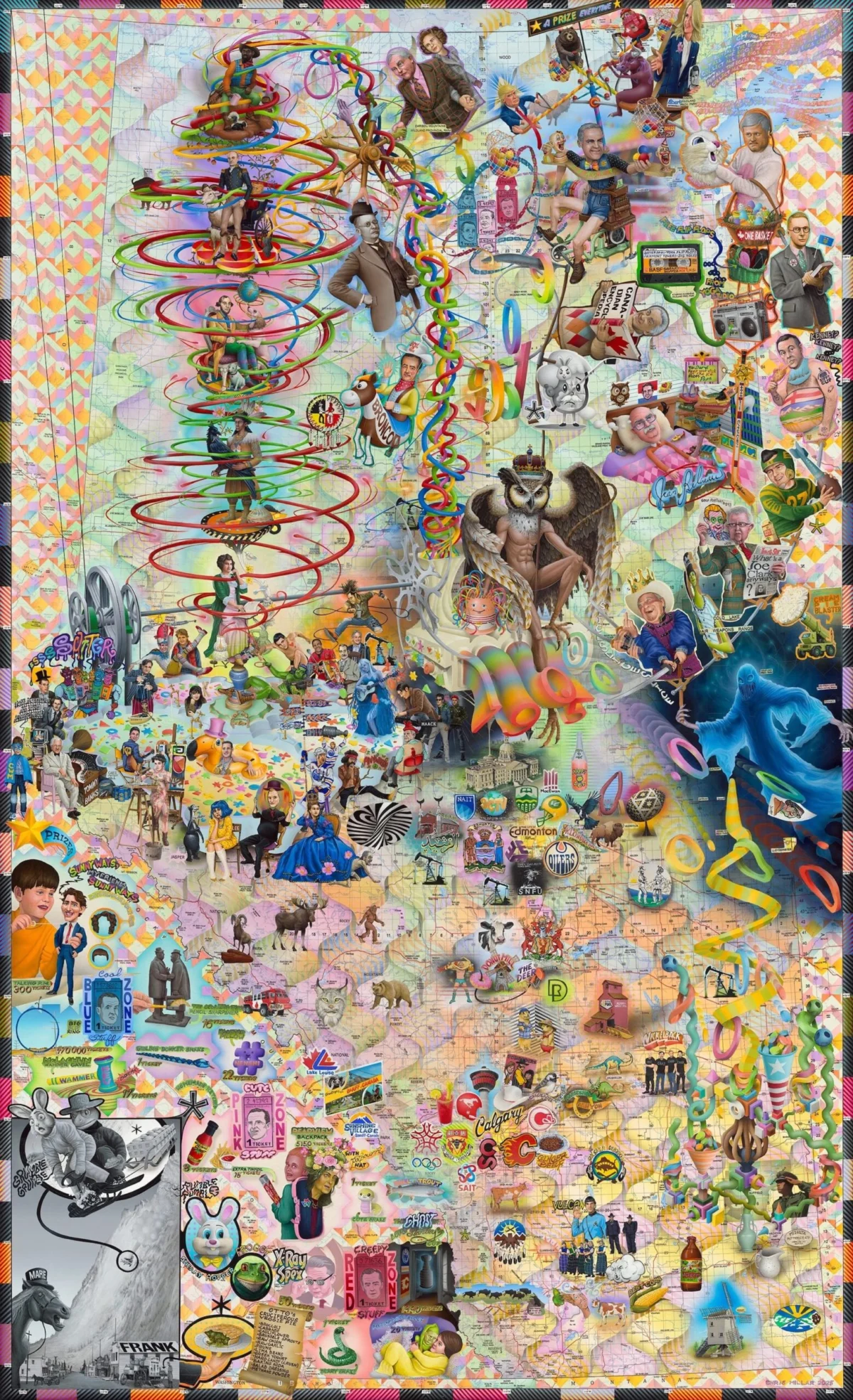
Canadian artist Chris Millar has long commanded attention for his ability to translate the vastness of the human experience into the palm of one’s hand. Renowned for his painstakingly intricate mixed-media sculptures, Millar has carved a distinct niche in the contemporary art world by challenging the traditional viewer’s relationship with scale. His latest works, Loom Beneath the Loam and A Prize Every Time, serve as a masterclass in detail-oriented craftsmanship, demonstrating that whether through physical construction or brushwork, the artist’s primary tool is the microscopic lens through which he views the world.
The Architectural Imagination: Loom Beneath the Loam
At the heart of Millar’s recent creative output is Loom Beneath the Loam (2026), a wall-mounted sculpture that functions less as a static object and more as a mechanical curiosity. Composed of acrylic paint, resin, brass, and steel, the piece measures a modest 8.5 by 10.25 inches, yet its density is staggering.
The work is a hybrid entity: a brass-framed apparatus that plays host to eight miniature paintings and two relief sculptures. The composition is punctuated by cartoonish pendants, vignettes featuring humanoid faces, and organic, branch-like tendrils that seem to pulse with a hidden vitality. The craftsmanship is so precise that the sculpture evokes the aesthetic of an enigmatic, Victorian-era contraption. There is a palpable sense of kinetic potential; one feels that if a hidden lever were pulled, the entire assembly would begin to tick, shift, or rotate.

This sense of "potential motion" is a hallmark of Millar’s practice. By integrating industrial materials like brass and steel with the softer, more illustrative elements of resin and acrylic, he bridges the gap between engineering and fine art. The sculpture acts as a narrative vessel, forcing the observer to lean in close—perhaps too close—to decode the disparate elements, rewarding the patient viewer with a wealth of textures and tiny, cryptic stories embedded within the frame.
A Cartography of Memory: A Prize Every Time
In a striking departure from his sculptural work, Millar’s A Prize Every Time shifts the focus toward the two-dimensional, though he refuses to abandon his signature obsession with complexity. This acrylic painting is a grand, vertical undertaking that functions as a stylized map of Alberta, the artist’s home province.
The piece is a visual encyclopedia of the region, rendered with the obsessive quality of a "look-and-find" children’s book. It features approximately 90 portraits of notable figures—politicians, athletes, musicians, and historical figures—integrated seamlessly into the geography of the province. The work successfully mimics the aesthetic of a tourist map while subverting its function, transforming a geographical guide into a dense social commentary.

Millar acknowledges the niche nature of the content. "To an American audience, a lot of the Alberta-centric easter eggs will go over their heads," he admits. However, the success of the painting lies in its universal appeal. Even without a working knowledge of Alberta’s intricate history or its specific cultural geography, the viewer is drawn into a visual game of identification and discovery. Prominent figures like Michael J. Fox and Joni Mitchell appear as recognizable landmarks, anchoring the viewer in a landscape of cultural celebrity and local heritage.
Chronology of Development: From Object to Narrative
To understand the evolution of Chris Millar’s current works, one must look at the trajectory of his career over the last decade.
- 2018–2020: The Formative Years of Miniaturization. During this period, Millar focused heavily on standalone mixed-media pieces that emphasized the "toy-like" quality of art. He experimented with resin casting and the inclusion of clockwork elements, moving away from traditional sculpture toward "object-narrative."
- 2022: The Shift Toward Storytelling. Millar began incorporating portraiture and figurative elements into his sculptures, moving away from purely abstract, mechanical shapes. This period saw the birth of the "vignette" style, where small, contained scenes were framed within larger, structural armatures.
- 2024: The Synthesis of Media. The artist began to blur the lines between his paintings and his sculptures. He started applying the same level of detail found in his brushwork to the physical construction of his sculptural frames.
- 2026: The Current Zenith. With Loom Beneath the Loam and A Prize Every Time, Millar has achieved a synthesis of his skills. The former represents the height of his sculptural complexity, while the latter shows an unprecedented expansion of his narrative scope through painting.
Supporting Data: The Mechanics of Detail
The complexity of Millar’s work is not merely a stylistic choice; it is a technical challenge. In Loom Beneath the Loam, the inclusion of eight separate paintings within a single sculpture requires a rigorous spatial plan. The brass frame acts as a skeleton, a necessity when dealing with delicate resin and steel components that would be unstable if not anchored properly.

Regarding A Prize Every Time, the sheer volume of 90 portraits within a single canvas creates a unique problem of "visual noise." To prevent the image from becoming illegible, Millar utilizes color-coding and topographical shifts in the landscape to segment the portraits. This technique, often used in cartographic design, allows the eye to travel across the painting in a controlled, rhythmic fashion.
The technical specifications of these pieces—such as the dimensions of the brass framing and the layering process for the resin—suggest an artist who spends as much time in the workshop as in the studio. Millar’s process is intentionally slow; by choosing to render these figures in acrylic, he ensures that every stroke is deliberate, avoiding the "painterly" blur that might obscure the fine details of his portraits.
Official Responses and Curatorial Perspectives
Critics have frequently noted that Millar’s work exists in a "liminal space" between art and artifact. Curators who have showcased his work often remark on the "compulsive viewing" it generates. In a digital age where images are consumed in milliseconds, Millar’s work demands a temporal commitment.

One curator noted, "Millar’s pieces act as a filter. They filter out the distracted viewer and reward those who are willing to stand for ten minutes in front of a ten-inch frame. It is an act of resistance against the high-speed consumption of visual media."
Millar’s own comments reflect this philosophy. He views his work as a dialogue with the past—a tribute to the era of cabinet curiosities and natural history dioramas. By populating his works with specific, often local, cultural references, he grounds his abstract, dreamlike constructions in a tangible reality.
Implications for Contemporary Mixed-Media Art
The implications of Millar’s work for the broader art community are significant. As technology allows for the mass production of hyper-detailed images, the value of the "hand-made" detail becomes increasingly precious. Millar’s ability to imbue his work with such intense focus serves as a reminder of the power of the singular, human-crafted object.

The Role of the "Easter Egg" in Modern Art
Millar’s use of "easter eggs"—the hidden, small-scale references within his work—is not just for show. It represents a shift toward interactive art where the viewer is tasked with becoming an investigator. By inviting the audience to look for Michael J. Fox in a map of Alberta, or to trace the connection between a brass gear and a painted face, Millar changes the viewer from a passive observer to an active participant.
The Future of Scale
As Millar continues to push the boundaries of what can be captured in a miniature format, he raises questions about the necessity of size in art. Does a massive canvas hold more weight than an eight-inch sculpture? Millar’s work argues that density of information, rather than physical scale, is what truly defines a "monumental" work of art.
Conclusion
Chris Millar’s recent contributions to the contemporary art scene stand as a testament to the power of detail. Through Loom Beneath the Loam and A Prize Every Time, he has demonstrated that the most expansive narratives are often found in the most compressed spaces. Whether he is mapping the cultural geography of his home province or crafting the impossible mechanics of a miniature sculpture, Millar continues to redefine the boundaries of his craft.

For those interested in following his ongoing explorations, his digital presence on platforms like Instagram offers a window into the messy, precise, and deeply personal world of his studio. As he continues to evolve, one thing remains certain: in the world of Chris Millar, there is always more to see, provided one is willing to look close enough.

 Siti Muinah
 Evan Lee Salim