Reynand Wu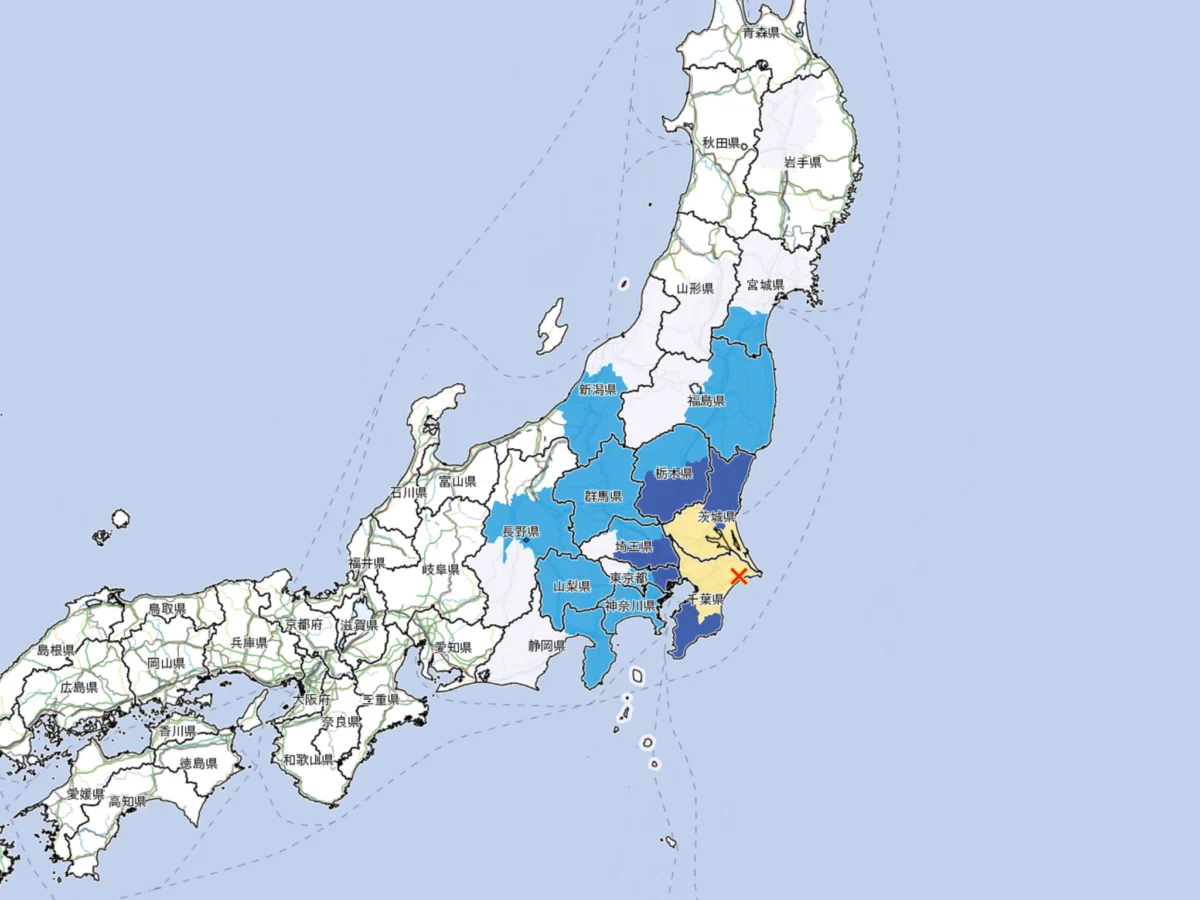
Updated: June 26, 2026
Executive Summary: A Sudden Tremor
At approximately 12:46 p.m. local time on Friday, a significant earthquake with a magnitude of 5.8 struck the Kanto region of Japan, centered in the northwestern portion of Chiba Prefecture. The seismic event caused widespread tremors across the Greater Tokyo Area, prompting a brief suspension of daily routines for millions of residents and commuters. According to the Japan Meteorological Agency (JMA), the quake reached a seismic intensity of 4 on Japan’s seven-level Shindo scale in parts of Chiba, while Tokyo experienced varying intensities ranging from 2 to 3.
While the suddenness of the event caused momentary alarm, authorities confirmed that there was no risk of a tsunami, and initial reports suggest that major infrastructure remains largely intact. This event serves as a stark reminder of the volatile tectonic environment of the Japanese archipelago and the critical importance of public preparedness.
Chronology of the Seismic Event
The earthquake occurred during the early afternoon, a time when public transportation systems and business districts were operating at peak efficiency.
- 12:46 p.m.: The earthquake originated at a depth of approximately 50 kilometers, with the epicenter located in northwestern Chiba Prefecture, in the vicinity of Sosa City.
- 12:47 p.m. – 12:50 p.m.: Automated earthquake early warning systems (EEW) were triggered throughout the Kanto region, providing residents with several seconds of advance notice. Mobile devices across Tokyo and Chiba broadcasted urgent alerts, leading many to duck under desks or move away from windows.
- 12:55 p.m.: The Japan Meteorological Agency (JMA) issued its initial seismic assessment. They confirmed the magnitude at 5.8 and clarified that there was no danger of a tsunami, as the epicenter was land-locked and the displacement of the ocean floor was insufficient to trigger a surge.
- 1:15 p.m.: Local municipal governments in Chiba and Tokyo began initial damage assessments. While utility companies monitored power grids and rail operators paused trains for mandatory safety inspections, no widespread power outages or structural collapses were reported.
Supporting Data and Seismic Context
To understand the impact of Friday’s quake, one must interpret the JMA’s Shindo scale. Unlike the Richter scale, which measures the energy released at the epicenter, the Shindo scale measures the actual intensity of shaking at a specific location.
A rating of 4 on the seven-level scale—which was recorded in parts of Chiba—is significant. The JMA defines a Shindo 4 event as one that is "felt by most people walking" and is strong enough to wake those who are sleeping. In terms of physical damage, ornaments and loose fixtures are prone to falling, and residents may feel a swaying sensation for several seconds.
In Tokyo, the intensity was recorded as a 2 to 3. At a Shindo 3, most people indoors feel the shaking, and hanging objects like lamps swing noticeably. While these levels are common in the seismically active Kanto plain, the cumulative effect of frequent, moderate earthquakes often leads to "seismic fatigue" among the populace, necessitating constant vigilance regarding building codes and emergency supplies.
The depth of 50 kilometers is considered a "shallow-to-intermediate" earthquake. Shallow quakes are typically more destructive because the energy does not dissipate as much as it travels through the earth’s crust before reaching the surface. The fact that the epicenter was inland near Sosa City likely mitigated the risk of a tsunami, which generally requires submarine displacement.
Official Responses and Public Safety Measures
In the wake of the tremors, the Tokyo Metropolitan Government and local authorities in Chiba immediately activated their disaster response protocols. Government agencies shifted their focus toward monitoring for aftershocks and verifying the safety of essential lifelines, including water, gas, and electricity.
The Role of Digital Infrastructure
The Tokyo Metropolitan Government has placed a premium on digital resilience. Recognizing that mobile networks can become congested during a crisis, they maintain a dedicated Disaster Prevention Homepage that serves as the "single source of truth" for evacuation orders, shelter locations, and emergency medical support.
Essential Tools for Residents
The Japan Tourism Agency and various technology partners have developed robust digital tools to ensure that both residents and international visitors are informed in real-time. Key applications recommended by officials include:
- Safety Tips: Developed by the Japan Tourism Agency, this application provides multilingual alerts for earthquakes, tsunami warnings, and volcanic activity. It is specifically designed to provide evacuation guidance for those who may not be fluent in Japanese.
- NERV Disaster Prevention: Highly regarded for its accuracy and speed, the NERV app utilizes data from the JMA to provide real-time visualizations of shaking. It is particularly useful for visualizing the "propagation" of waves, helping users understand where the strongest shaking is moving in real-time.
Implications: Living with the "Big One"
The June 26, 2026, earthquake was a moderate event, yet it serves as a sobering reminder of Japan’s tectonic reality. Situated at the intersection of four major tectonic plates—the Pacific, North American, Eurasian, and Philippine Sea plates—Japan is responsible for roughly 20% of the world’s earthquakes of magnitude 6.0 or greater.
Infrastructure and Resilience
Japan’s building codes are among the most stringent in the world. Since the 1995 Great Hanshin Earthquake, the country has invested billions in seismic isolation technology. Friday’s event—while causing momentary panic—demonstrated the efficacy of these measures, as modern high-rises in Tokyo are designed to sway rather than crack, absorbing the energy of a 5.8 magnitude tremor with minimal structural fatigue.
Psychological Preparedness
Beyond the physical infrastructure, the primary goal of the Japanese government is to maintain a high level of "disaster culture." This involves:
- Bousai (Disaster Prevention) Training: Schools and workplaces conduct regular drills.
- Emergency Kits: Households are encouraged to maintain a "Go-Bag" containing three days of water, food, medical supplies, and portable batteries.
- Communication Protocols: The government encourages families to establish a primary meeting point and a secondary communication method, as cellular networks are often the first to fail during major disasters.
The Future of Forecasting
While scientists have made significant strides in early warning technology, precise earthquake prediction—forecasting the exact time, location, and magnitude of an event—remains scientifically impossible. Consequently, the focus in Japan has shifted from prediction to mitigation. By investing in sensors that detect the "P-waves" (the faster, non-destructive primary waves) before the "S-waves" (the slower, destructive secondary waves) arrive, the JMA can provide the critical 10 to 30 seconds of warning that saves lives.
Conclusion: Moving Forward
As of the latest reports, life in Chiba and Tokyo is returning to normal. Rail lines that were halted for inspections have resumed service, and no injuries of a serious nature have been reported. However, the event serves as a mandatory "reset" for residents to check their emergency kits and review their evacuation routes.
In a region defined by its geological instability, resilience is not just a policy—it is a way of life. The 5.8 magnitude earthquake of June 26, 2026, was a test of the systems designed to protect the millions who call this densely populated region home. While the infrastructure held firm, the psychological impact of such events remains a constant factor in the Japanese experience. As we look ahead, the continued integration of AI-driven warning systems and the ongoing commitment to public education remain the best defenses against the inevitable tremors of the future.
For real-time updates and additional resources on emergency preparedness, please consult the Tokyo Metropolitan Government’s official Disaster Prevention Guide.


 Neng Nana
 Asro
Asro