Nana Wu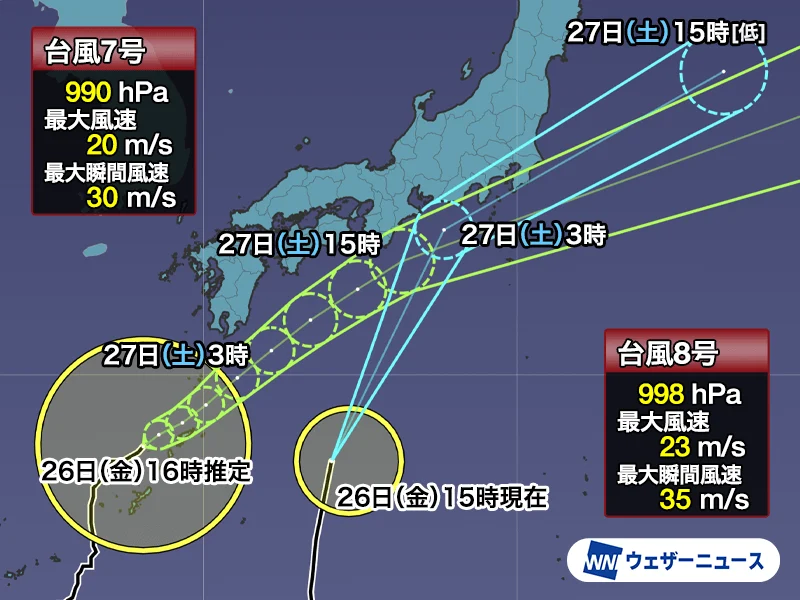
TOKYO — Japan is facing a perilous meteorological crisis this weekend as the Japan Meteorological Agency (JMA) issued urgent warnings regarding a dual-typhoon threat. The nation is currently grappling with a severe weather system characterized by torrential rainfall, triggering widespread flooding and landslides across western and eastern regions. With over two million people under evacuation orders, the government is mobilizing emergency services to mitigate what officials describe as a "critical situation."
The dual atmospheric pressure systems—Typhoons Higos and Mekkhala—are converging on the Japanese archipelago, creating a volatile environment that has already seen record-breaking precipitation levels. As the storms approach, authorities are emphasizing that the primary danger extends beyond wind speeds, pointing to the catastrophic risk of soil saturation and subsequent geological instability.
The Core Crisis: A Dual-Front Weather Assault
The JMA has been tracking the progression of Typhoon Higos and Typhoon Mekkhala with increasing alarm. Typhoon Higos, currently advancing from the Pacific, is expected to make landfall as early as Saturday. Simultaneously, Typhoon Mekkhala has been churning near the Amami region in Kagoshima Prefecture, with its projected path placing it on a collision course with the Kanto region—the nation’s most populous area, which includes Tokyo.
While meteorologists expect both systems to downgrade into extratropical cyclones shortly after their respective landfalls, the JMA warned that the transition does not signal an end to the danger. "The weakening of these systems does not equate to a decrease in the intensity of rainfall or the risk of wind-driven damage," an agency spokesperson stated during a Friday morning briefing. "The public must remain vigilant, as the saturation of the earth from days of prior rainfall significantly elevates the probability of landslides and flash flooding."
Chronology of the Weather Event
The current crisis began as a localized weather front earlier in the week, which rapidly intensified into the current dual-typhoon situation.
- Tuesday through Thursday: Persistent, heavy rainfall began to impact the Kyushu region. Areas including Goto in Nagasaki, Aso in Kumamoto, and Ureshino in Saga experienced unprecedented precipitation, with accumulated rainfall totals exceeding 500 to 600 millimeters in less than 72 hours.
- Friday, 7:00 a.m.: The Fire and Disaster Management Agency (FDMA) reported that evacuation orders had been issued for over 2 million residents across 13 prefectures in the Kinki and Kyushu regions.
- Friday, Morning: A landslide in Seika, Kyoto Prefecture, prompted the issuance of a Level 5 emergency safety alert—the highest level on Japan’s five-tier warning scale. This alert signified that the threat to life was imminent, mandating that residents take immediate action to seek safety.
- Friday, 11:00 a.m.: Typhoon Mekkhala was tracked moving northeast at a speed of 15 kilometers per hour, positioned off the coast of Kume Island, Okinawa.
- Friday Afternoon/Evening: Meteorological models indicated that as Typhoon Higos tracks northward off the southern coast, the rainfall intensity is expected to surge in the Tokai and Kanto-Koshin regions, creating a compounding effect as the two weather fronts begin to influence each other.
Supporting Data and Meteorological Analysis
The sheer volume of water dumped on Japan over the past few days has pushed local infrastructure to its breaking point. In Goto, Nagasaki Prefecture, the JMA recorded a staggering 600 mm of rain between Tuesday and Friday morning. To put this in perspective, such levels of rainfall in a short duration are sufficient to overwhelm municipal drainage systems, even in cities with advanced flood mitigation technology.
Similar figures were recorded in Kumamoto and Saga, where 500 mm of rain was measured. The atmospheric conditions driving these storms are complex. The interaction between the moist air mass brought by the typhoons and the mountainous topography of central Japan is expected to trigger "orographic lift," where air is forced upward, leading to even more intense, concentrated precipitation.
Looking ahead to Saturday, the JMA forecasts indicate:
- Tokai Region: Expected to receive up to 300 mm of rainfall by noon.
- Kanto-Koshin Region: Expected to receive up to 150 mm, as the storm systems interact with regional topography.
The combination of sustained rainfall and the arrival of these typhoons means that the ground is no longer capable of absorbing further moisture, turning hillsides into mudslides and urban streets into torrents.
Official Responses and Emergency Measures
The Japanese government has adopted a proactive, albeit cautious, stance. With 2 million people under evacuation orders, the focus has shifted from disaster monitoring to life-saving operations.
Evacuation Protocols
The evacuation orders are not uniform; they are categorized by the JMA’s alert levels. Level 5 alerts, such as the one issued in Seika, are reserved for situations where a disaster has already occurred or is in the process of occurring. Residents under such orders are advised that evacuating to a designated center might be more dangerous than moving to a higher floor of their current building or a nearby sturdy structure.
Coordination with Local Authorities
The FDMA is currently working in tandem with the Self-Defense Forces (SDF) to monitor levee integrity and assist in the evacuation of the elderly and vulnerable populations. Emergency response teams have been deployed to the Kinki and Kyushu regions to provide sandbags and assist in debris removal.
Government officials are urging the public to refrain from "wait-and-see" behavior. In past disasters, many fatalities occurred when residents attempted to evacuate after the roads had already become impassable or when bridges were washed out. "Do not wait for an official order to leave if you feel your surroundings are becoming unsafe," the Cabinet Office advised in a press conference.
Implications for Society and Infrastructure
The broader implications of this weather event are significant, impacting everything from national infrastructure to economic stability.
Vulnerability of Infrastructure
The recurring nature of these extreme weather events has reignited the debate regarding Japan’s disaster-resilient infrastructure. While Japan possesses some of the world’s most sophisticated flood-control systems, including massive underground discharge channels and sea walls, the intensity of recent typhoons is testing the limits of these designs. The landslide in Seika is a grim reminder that even in developed areas, geological shifts can occur without warning.
Economic and Transportation Disruptions
The approaching storms have already begun to disrupt travel and commerce. Major railway operators are expected to suspend services on multiple lines across the Tokai and Kanto regions as a precautionary measure. Similarly, regional airports are anticipating flight cancellations, and maritime transport in the Pacific and East China Sea has been severely curtailed due to high swells and gale-force winds.
Long-term Climate Outlook
Meteorologists and climatologists are observing a concerning trend: the increasing frequency of intense typhoons striking Japan later in the season, often with greater moisture capacity due to rising sea surface temperatures. This suggests that the current emergency, while acute, is part of a larger, systemic shift in the climate patterns affecting the Asia-Pacific region.
Conclusion: A Nation on High Alert
As the sun sets on Friday, the mood across Japan is one of tense anticipation. The residents of the Kanto and Tokai regions, in particular, are preparing for a difficult night. With the threat of Typhoon Higos and the encroaching influence of Typhoon Mekkhala, the danger is far from over.
The JMA continues to update its forecasts hourly, and the government’s emergency messaging systems remain active. The priority for the next 24 to 48 hours is clear: life safety. The massive evacuation efforts currently underway across 13 prefectures demonstrate the scale of the threat.
As Japan navigates this dual-typhoon scenario, the resilience of its communities and the effectiveness of its disaster response mechanisms will once again be put to the ultimate test. For now, the message from the authorities remains steadfast: stay informed, monitor local alerts, and prioritize safety above all else until the skies clear and the storm fronts have safely dissipated.
(c) KYODO


 Neng Nana
 Asro
Asro