Ammar Sabilarrohman
The World Cup represents more than just a tournament; for apparel titans Nike and Adidas, it is the ultimate commercial arena. As the 2026 sporting summer unfolds, these two rivals find themselves locked in a high-stakes struggle for market dominance. While Nike is currently navigating a period of internal strategic repositioning, Adidas is aggressively capitalizing on the momentum of the tournament to close the global gap and expand its footprint within the United States.
For the casual observer, the tournament is a festival of sport. For investors and industry analysts, however, it is a definitive test of brand equity, distribution strategy, and cultural relevance. As the data rolls in, the results reveal a fascinating divergence: Nike is playing for massive, cross-cultural reach, while Adidas is betting on deep, sport-specific engagement to secure its future.
The Strategic Landscape: A Tale of Two Philosophies
The current competitive climate is defined by the contrasting objectives of the two brands. Under the leadership of CEO Björn Gulden, Adidas has adopted a bold, expansionist mindset. During the company’s fourth-quarter earnings call in March, Gulden outlined an ambitious roadmap for the brand: to double its American business while simultaneously gunning for the number one spot in the global soccer apparel market.
The strategy appears to be paying early dividends. Adidas reported a 14% revenue increase in the first quarter of 2026, paired with improving margins. "All responsible people should have the ambition of being No. 1," Gulden stated. "It is important now that we keep the leadership where we have it, and in addition to that, we specifically target the American consumer."
Conversely, Nike’s approach remains rooted in its identity as a diversified sporting giant. According to eMarketer analyst Sky Canaves, the World Cup is but one component of a broader summer portfolio for the Oregon-based behemoth, which also balances interests in marathon running and professional tennis. "Nike has a much broader presence across sports," Canaves noted. "For Adidas, the World Cup is a lot more significant for its brand and its sales."
Chronology of the Campaign Launch
The lead-up to the tournament saw both brands unveil cinematic, star-studded campaigns, each reflecting their unique brand DNA.
- Early June: Nike launched "Rip the Script," a high-energy, chaotic narrative featuring a massive roster of global superstars, including Cristiano Ronaldo, Vinicius Junior, and Erling Haaland. The film was designed to disrupt the status quo, utilizing a frenetic pace meant to capture the attention of a wide-ranging, younger demographic.
- Mid-June: Adidas debuted "Backyard Legends." This campaign opted for a more narrative-driven, storytelling approach. By enlisting cultural icons such as Timothée Chalamet and Bad Bunny alongside soccer legends like Lionel Messi, Adidas positioned itself at the intersection of sport, fashion, and global pop culture.
- Late June: Commercial data began to emerge, signaling that Adidas had captured early momentum. According to M Science, spending on Adidas apparel surged by 70% in May compared to the previous year, a trend that maintained its strength well into the early weeks of the tournament.
Supporting Data: By the Numbers
The effectiveness of these campaigns can be parsed through three distinct lenses: social listening, distribution volume, and Earned Media Value (EMV).
Social Listening and Talent Strategy
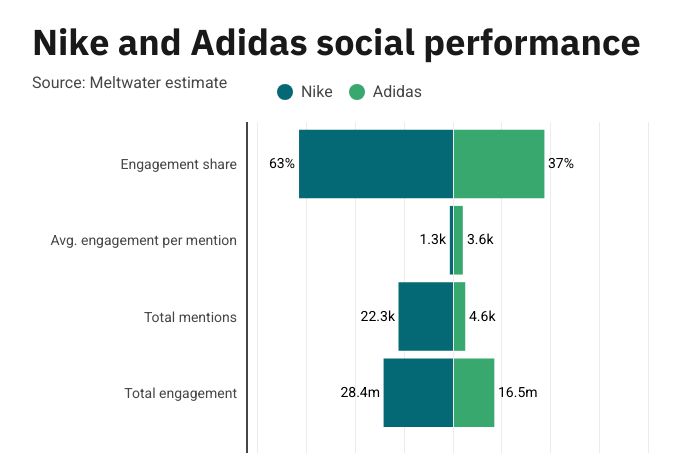
Data from the social monitoring firm Meltwater highlights the divergence in casting strategies. Nike’s campaign was designed as a cross-sports cultural vehicle. By including figures like LeBron James and BLACKPINK’s Lisa, Nike successfully broadened the conversation. Meltwater’s analysis showed that within discussions about the Nike campaign, Lisa was mentioned in 30% of posts and LeBron in 20%.
In contrast, Adidas maintained a strict focus on the sport of soccer. Their data reveals that 54% of discourse around their campaign centered on non-sports actor Timothée Chalamet, while 40% focused on soccer legend Lionel Messi. This confirms that while Nike leveraged "celebrity power" to cross over into entertainment, Adidas utilized its roster to reinforce its authority as a soccer-first brand.
Distribution and Engagement Rates
The distribution strategies revealed a difference in tactical execution. Tubular reported that in the weeks following its launch, Nike produced 217 videos—a smaller, more concentrated library of content. Adidas, however, took a "blitz" approach, publishing nearly 1,000 clips.
Despite the lower volume, Nike’s content achieved higher overall reach, generating 400 million cross-platform views. However, the quality of engagement tells a different story. Sprout Social data from June 5–17 shows that while Nike’s hero post on Instagram secured 2.4 million likes and 58.7 million views, Adidas’s post, while having fewer views (7 million), secured 2.56 million likes. This suggests that while Nike wins on sheer scale and visibility, Adidas is generating a higher "heat" or loyalty rate per interaction.
The Bottom Line: Earned Media Value (EMV)
Ultimately, the most critical metric for the C-suite is financial impact. CreatorIQ’s estimates provide the most striking contrast. In the first three weeks of the campaign, Adidas generated $48.9 million in EMV across 6,700 posts involving 3,000 creators. Nike, meanwhile, generated $28.9 million in EMV from a smaller footprint of 4,400 posts.
Official Responses and Corporate Stance
The leadership at both firms remains tight-lipped regarding specific short-term sales projections, but their public rhetoric speaks volumes. Adidas executives are clearly buoyed by the data suggesting their soccer-focused strategy is resonating with a core, high-intent audience. They view the current surge in U.S. spending as validation of their long-term investment in the American soccer market.
Nike, meanwhile, is maintaining a stoic, "long-game" approach. As the company prepares for its next quarterly earnings call, analysts are waiting to see if the "Rip the Script" campaign’s broad, pop-culture appeal can translate into the concrete sales figures that define their market position. The company’s leadership has emphasized a commitment to innovation and brand-wide consistency, suggesting that their focus remains on the entire sporting ecosystem rather than a singular tournament outcome.
Implications for the Future of Sports Marketing
The divergence between Nike and Adidas during this World Cup marks a pivot point in modern sports marketing.
- The Rise of Niche Authority: Adidas has demonstrated that in a fragmented media landscape, focusing on a specific sport—and owning that narrative completely—can yield higher engagement and more "earned" loyalty than attempting to capture the attention of the general public through cross-industry celebrity.
- The Power of Scale: Nike’s campaign remains the gold standard for "reach." By casting a wide net, they ensure that the brand remains culturally ubiquitous. The challenge for Nike, however, is conversion: ensuring that a teenager interested in K-pop or basketball feels the same emotional urgency to purchase a soccer jersey as a die-hard football fan.
- The U.S. Soccer Paradox: Both brands are acutely aware that the United States is the new frontier for soccer. The surge in Adidas sales in the U.S. suggests that the American consumer is responding to soccer-specific branding, which could force Nike to reconsider its broader, more diluted marketing approach in the U.S. market in the coming years.
As the tournament moves toward its conclusion, the industry will be watching the sales data closely. The "summer of sport" is far from over, and both brands have ample opportunity to modulate their strategies. Whether Nike’s massive reach will eventually yield higher conversion or Adidas’s high-engagement model will lead to a sustained market shift remains to be seen. What is certain, however, is that the rivalry between these two giants continues to drive innovation in how we consume, view, and interact with the sports we love.

 Rifan Muazin
 Lina Irawan