Pevita Pearce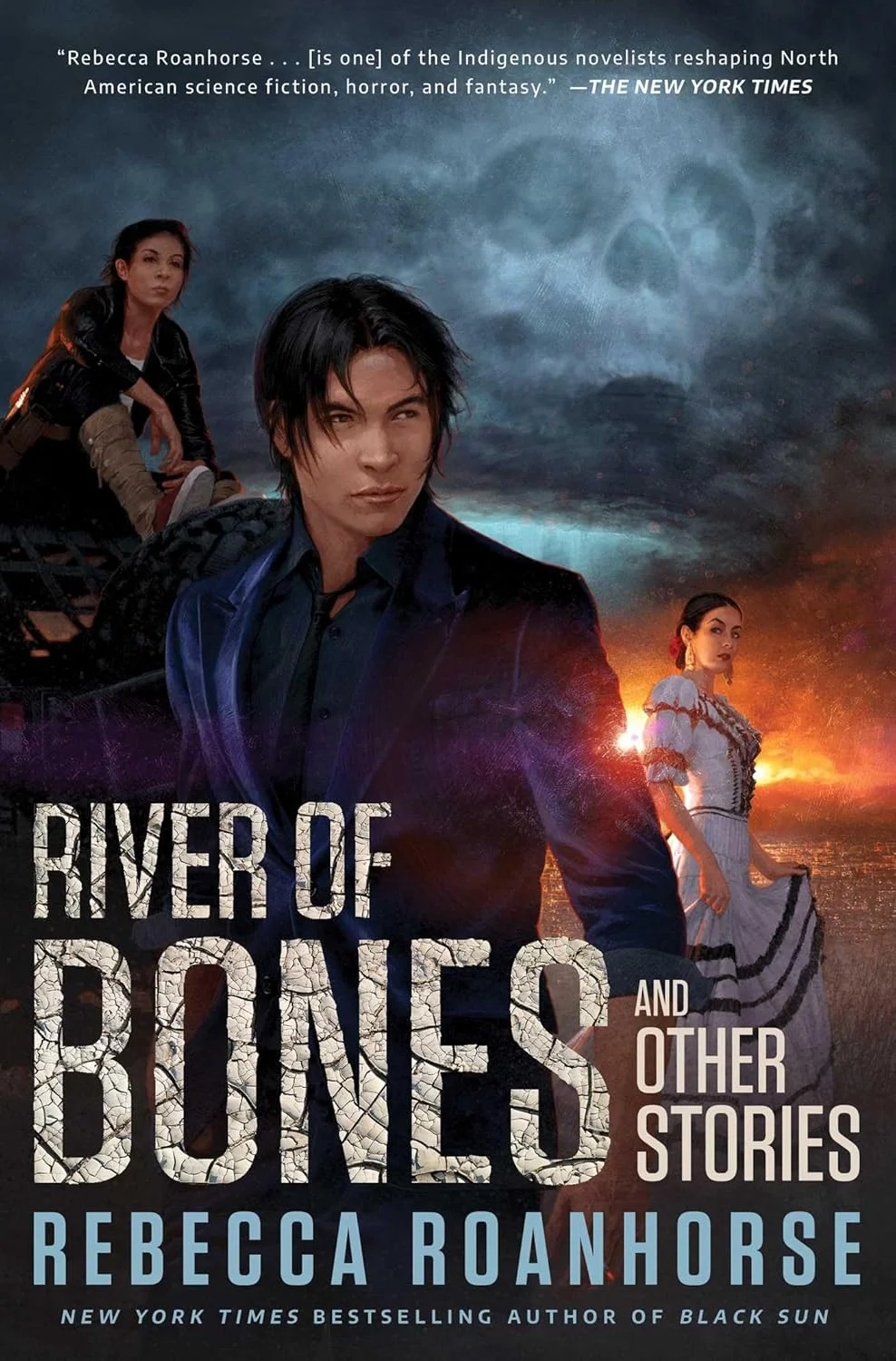
In the landscape of contemporary speculative fiction, few voices have resonated with the visceral urgency of Rebecca Roanhorse. Following the massive success of her Between Earth and Sky trilogy (2020–2024)—which secured the 2025 Hugo Award for Best Series—Roanhorse has returned to her roots in short-form fiction. Her latest collection, River of Bones, serves as a career-spanning retrospective that bridges the gap between her breakout urban fantasy origins and the sweeping, pre-Columbian-inspired epics that solidified her place in the literary canon.
River of Bones is more than a mere anthology; it is a profound exploration of the liminal spaces between cultures, the corrosive nature of systemic oppression, and the agonizing moral calculus required when one is forced to choose between personal survival and communal integrity.
A Legacy of Myth and Modernity: The Chronology of a Career
To understand the significance of River of Bones, one must view it as a map of Roanhorse’s evolution as a writer. The collection pulls from various stages of her bibliography, beginning with her earlier works that established her reputation for blending traditional Indigenous knowledge with sharp, modern genre tropes.
Central to this is her connection to The Sixth World universe, which debuted with the 2018 novel Trail of Lightning. The collection concludes with a brand-new novella set within this same world, featuring the character Kai Arviso. This inclusion provides a sense of narrative closure, showing how Roanhorse’s themes have matured from the high-stakes, action-oriented pacing of her debut to the more introspective, character-driven moral dilemmas that define her current work. By anchoring the collection with a return to the Navajo-inspired practices of The Sixth World, Roanhorse invites readers to see the continuity of her craft—from her early, punchy investigations of identity to the sophisticated, structural critiques found in her later trilogies.
The Performance of Authenticity: Deconstructing "The Indian Experience"
The collection opens with the Hugo and Nebula-winning short story "Welcome to Your Authentic Indian Experience." Using a haunting second-person narrative, the story places the reader in the shoes of a VR performer at a resort catering to tourists who hunger for an "authentic" Native American experience.
In this story, the protagonist is systematically replaced—both professionally and personally—by a white man who performs a sanitized, stereotypical version of Native identity that is more palatable to the tourists than reality itself. This narrative functions as a masterful critique of "hyperreality." As Jean Baudrillard theorized, our modern society often prefers the signifier over the signified; the tourists in Roanhorse’s story do not want to encounter actual Indigenous people, as that would force them to grapple with the realities of colonialism and contemporary existence. Instead, they crave the comfort of the caricature.
This story sets the stage for the collection’s primary inquiry: What does it mean to be "authentic" in a world that has already decided what your identity should look like? Roanhorse forces the reader to confront the uncomfortable reality that for many, identity is not a birthright but a performance, often policed by the very people who seek to exploit it.
The Devil’s Bargain: Allegiances and Impossible Choices
A recurring motif throughout River of Bones is the "devil’s bargain"—the moment when a character is forced to trade their ethics for safety, status, or revenge. Roanhorse is uninterested in simple moral binaries; instead, she populates her stories with characters standing on the edge of ethical abysses.
The Blur of In-Group Politics
In "The Boys from Blood River," the reader is introduced to Lukas, an Indigenous, gay teenager struggling with the dual pressures of local bigotry and his mother’s terminal illness. His discovery of a supernatural ally group—vampire boys bonded by their shared history of surviving racially motivated hate crimes—creates a chilling allegory for the allure of radicalized vengeance. When Lukas is forced to choose between the safety of his newfound "vampire family" and the life of his white friend, the story moves beyond mere genre fiction into a harrowing interrogation of the limits of solidarity.
The Cost of Assimilation
In "White Hills," the cost of privilege is laid bare. The story follows a white-passing Native American woman who has clawed her way into wealth, only to be threatened with exile when her mother-in-law discovers her true heritage. Here, Roanhorse examines the "passing" experience—not just as a way to hide, but as a mechanism for survival that eventually turns into a cage. The ultimatum presented to the protagonist—sever ties to the past or lose the security of the present—is a sharp, brutal distillation of the pressures placed on marginalized individuals in elite spaces.
The Rot of Colonialism
Perhaps the most potent use of allegory appears in "Wherein Abigail Fields Recalls Her First Death, and, Subsequently, Her Best Life." When the protagonist trades a second chance at life for a promise of revenge against the sheriff who murdered her father, she finds that her target is already decaying. This imagery reflects the post-colonial theory of Frantz Fanon: the oppressor is often just as dehumanized by their own cruelty as those they oppress. Abigail’s struggle is no longer about the act of killing, but about the weight of the revenge itself and whether the victim truly wants to participate in the cycle of violence.
Sociopolitical Speculation: The Power of the "Falling Body"
One of the standout narratives, "Falling Bodies," represents the apex of Roanhorse’s sociopolitical speculative fiction. Set in a future where an alien race, the Genteel, has colonized Earth, the story follows Ira, a human boy adopted by a Genteel senator.
Ira is a character caught in a permanent state of exile: he is a tool of the colonizers and a traitor to the resistance. By utilizing an alien-colonizer framework, Roanhorse avoids the constraints of a one-to-one historical mapping, allowing the story to function as a universal exploration of generational trauma. It asks the reader: When you are a product of both the oppressor and the oppressed, where do you belong? The brilliance of this story lies in its refusal to offer a resolution, mirroring the lived experiences of many in the modern diaspora who find themselves perpetually caught between worlds.
Implications: The Ethics of Reading
The central achievement of River of Bones is its refusal to provide the reader with a moral safety net. As noted in the introduction, Roanhorse observes that while her stories are rooted in her specific identity as a person of Indigenous and African American descent, they have resonated deeply with readers from diverse marginalized backgrounds.
This is because the themes are not merely descriptive; they are prescriptive in their inquiry. By presenting characters who make fundamentally different choices—some choose the path of comfort, others choose the path of destruction, and some choose the path of radical empathy—Roanhorse demands that the reader look inward.
The implication for the literary genre is significant: speculative fiction is at its best when it acts as a mirror rather than an escape. River of Bones suggests that our identity is not a static definition, but a series of choices we make under duress. Whether we are facing the "fake" authenticity of a VR resort or the "real" rot of a colonizing power, we are all, like Kai Arviso or Ira, forced to decide what we are willing to sacrifice for the sake of our own humanity.
Conclusion: A Challenge to the Reader
River of Bones is a challenging, necessary addition to Rebecca Roanhorse’s body of work. It is a collection that does not seek to comfort the reader with easy answers or moral superiority. Instead, it invites us to sit with the discomfort of our own complicity and the complexity of our own allegiances. For those who have followed Roanhorse’s rise to prominence, this collection is an essential companion. For those new to her work, it serves as an uncompromising introduction to one of the most vital, insightful, and courageous voices in modern literature. As the final page turns, the questions remain—not because they are unanswerable, but because they are the questions we must continue to ask ourselves.


 Azzam Bilal Chamdy
 Raul Delapena Setiawan