Evan Lee Salim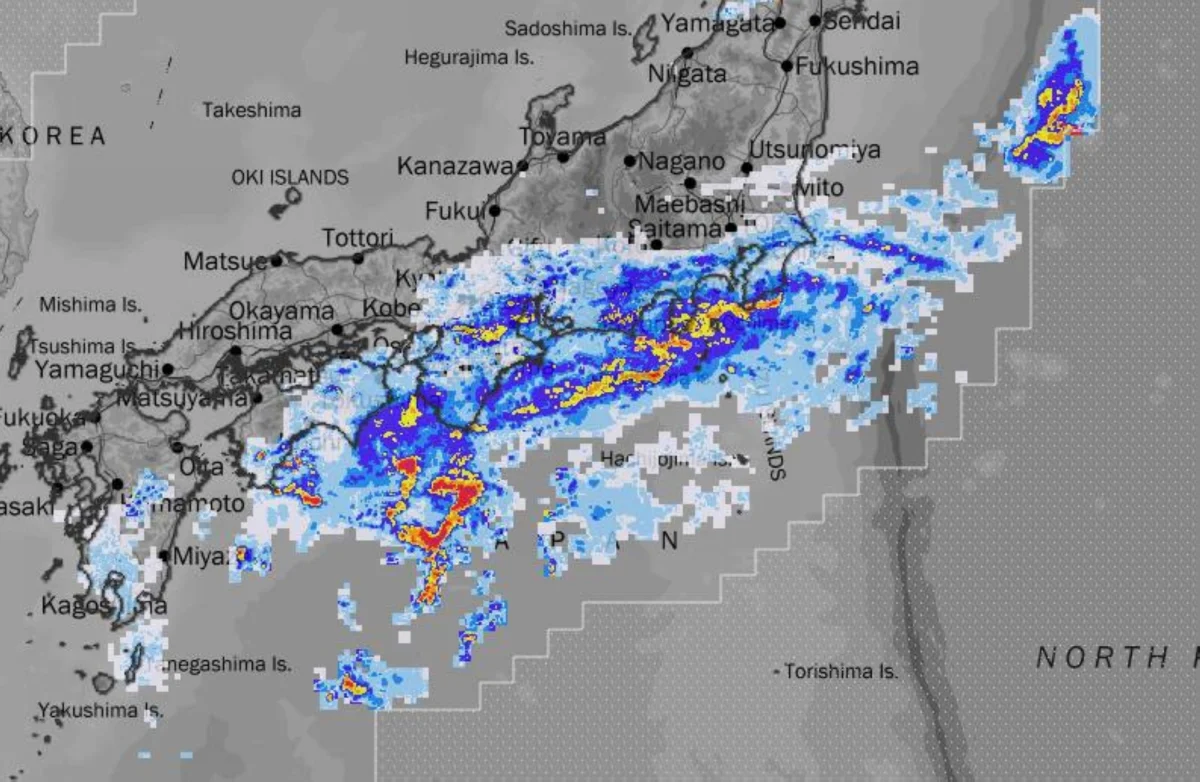
Overview: A Country Under Siege
Japan, a nation uniquely accustomed to the caprices of nature, found itself grappling with a chaotic convergence of natural disasters this weekend. Within the span of 24 hours, the country endured a powerful magnitude 5.6 earthquake followed by a relentless onslaught of torrential rainfall brought on by two back-to-back tropical storms.
The double-threat of Tropical Storm Mekkhala and Tropical Storm Higos forced authorities to issue urgent evacuation orders across the Kanto region, with high-level landslide warnings issued for Shizuoka, Kanagawa, and Chiba prefectures. This "black weekend" has left emergency services stretched to their limits, as the ground—already loosened by the seismic activity on Friday—became increasingly vulnerable to the deluge that followed.
Chronology of a Tumultuous 48 Hours
Friday: The Earth Trembles
The series of events began at 10:29 p.m. on Friday, when a magnitude 5.6 earthquake jolted the Yamanashi Prefecture. The tremors were felt intensely across the Kanto plain, including the sprawling Tokyo metropolitan area.
The Japan Meteorological Agency (JMA) reported that the epicenter was located at a depth of 20 kilometers. The impact was severe in localized areas: the town of Fujikawaguchiko registered a "lower 6" on the Japanese shindo seismic intensity scale. Under this level, it is physically difficult for people to stand, and heavy, unsecured furniture is likely to topple. Nearby, the city of Otsuki reported an "upper 5," while parts of Shizuoka and Kanagawa felt a "lower 5."
Saturday: The Deluge Begins
As residents in the quake-affected regions were still assessing structural damage and recovering from the shock, the skies opened up. Tropical Storm Higos arrived first, tracking along the waters south of Chiba. It was soon followed by Tropical Storm Mekkhala, which mimicked the trajectory of its predecessor.
By Saturday morning, the cumulative effect of the rainfall prompted the JMA to issue "Level 4" landslide warnings—the second-highest alert level in the Japanese system. This designation is a clear signal that the risk of landslides is imminent and that residents should immediately evacuate to safer ground. It was only by late Saturday evening, as both storms skirted the coast and headed into the Pacific, that these high-level warnings were downgraded, though officials cautioned that the threat of flooding remained high.
Supporting Data: Shattered Records
The rainfall associated with these tropical systems was historic. According to JMA data covering the 24-hour period ending at 8:30 p.m. on Saturday, several locations in eastern and southern Chiba Prefecture saw their June rainfall records completely obliterated.
Key Rainfall Statistics:
- Choshi: 232 mm
- Kimitsu: 195 mm
- Kyonan: 183 mm
- Mobara: 170 mm
- Kamogawa: 167 mm
These figures represent a significant deviation from historical averages for late June. The rapid accumulation of water in such a condensed timeframe created a perfect storm for infrastructure failure, particularly in regions where the soil stability had already been compromised by the seismic activity of the previous night.
Official Responses and Public Safety
The Japan Meteorological Agency (JMA) maintained a high-alert posture throughout the weekend, urging the public not to be complacent as the storms moved offshore. The primary concern for authorities was "secondary disasters"—landslides occurring on slopes already weakened by the earthquake, and the risk of flash flooding in low-lying residential areas.
"The soil is saturated," said a spokesperson for the local disaster management office. "When you combine the vibration of the earthquake with the massive volume of water, the margin for error disappears. We are urging citizens to prioritize their lives over their property and to heed all evacuation notices without delay."

Municipal governments in the affected prefectures opened dozens of evacuation centers, prioritizing schools and public halls. In many areas, volunteers and local fire departments were deployed to check on elderly residents, who are statistically the most vulnerable during such rapid-onset events.
Implications: The Interplay of Seismic and Meteorological Threats
The "Compound Disaster" Scenario
The weekend serves as a sobering reminder of the "compound disaster" risks that Japan faces. Seismic events do not occur in a vacuum; they leave behind structural weaknesses in buildings, bridges, and geological formations. When extreme weather—be it typhoons or seasonal "rainy season" fronts—follows a quake, the resilience of the local infrastructure is tested to the breaking point.
The shindo 6 earthquake caused damage to residential structures and public infrastructure. While the full extent of the damage is still being assessed, the initial reports of cracked foundations and shifted roof tiles indicate that the region’s built environment is currently in a state of fragile recovery. The subsequent heavy rain poses a direct threat to these weakened structures, as water infiltration into cracks can cause further instability.
Economic and Logistical Challenges
Beyond the immediate threat to life, the dual impact has disrupted local supply chains and transportation. Several train lines in the Chiba and Yamanashi prefectures were suspended on Saturday as a precautionary measure against track instability and flooding. For a region that serves as a vital corridor for the Tokyo metro area, these interruptions ripple through the economy, delaying shipments and forcing commuters to find alternative routes in treacherous conditions.
The Climate Change Factor
Meteorologists are increasingly pointing to the changing nature of Japan’s rainy season (tsuyu). While the interaction between tropical storms and seasonal fronts is not entirely unprecedented, the intensity of these storms—and their ability to deliver record-breaking rainfall in such a short window—is consistent with trends linked to climate change. As sea surface temperatures rise, tropical storms are capable of carrying more moisture, leading to the kind of "guerilla rain" that has become a recurring nightmare for Japanese disaster planners.
Looking Ahead: Recovery and Resilience
As of Sunday morning, the immediate danger from the storms has passed. The skies over Chiba and Yamanashi are beginning to clear, and emergency crews have begun the arduous process of clearing mudslides and assessing structural integrity.
However, the psychological impact on the residents of these regions is significant. Having spent Friday night in fear of the earth shaking, they spent Saturday in fear of the rising water. The government is expected to announce aid packages for the affected prefectures, particularly for those whose homes suffered structural damage during the earthquake.
The events of this weekend underscore the necessity for continued investment in disaster-resilient infrastructure. Japan’s building codes are among the strictest in the world, and its early-warning systems are second to none, but even the best-prepared nation faces limits when hit by a compounding set of natural disasters.
In the coming weeks, a detailed investigation will likely be conducted to determine how the combination of the quake and the rains affected local slope stability. For now, the focus remains on the safety of those in the evacuation zones and the restoration of essential services. Japan, as it has done so many times before, moves toward recovery, but this weekend will be remembered as a stark warning of the volatility of the natural world in a changing climate.
Final Advisory
The JMA continues to monitor the ground conditions. Even as the storms dissipate, residents in mountainous areas are advised to remain vigilant. The danger of landslides can persist for several days after heavy rainfall, as water continues to permeate deep into the soil. Residents are encouraged to monitor local news broadcasts and follow the guidance of their municipal disaster prevention divisions until the authorities declare the situation fully stabilized.


 Neng Nana
 Asro
Asro