Azzam Bilal Chamdy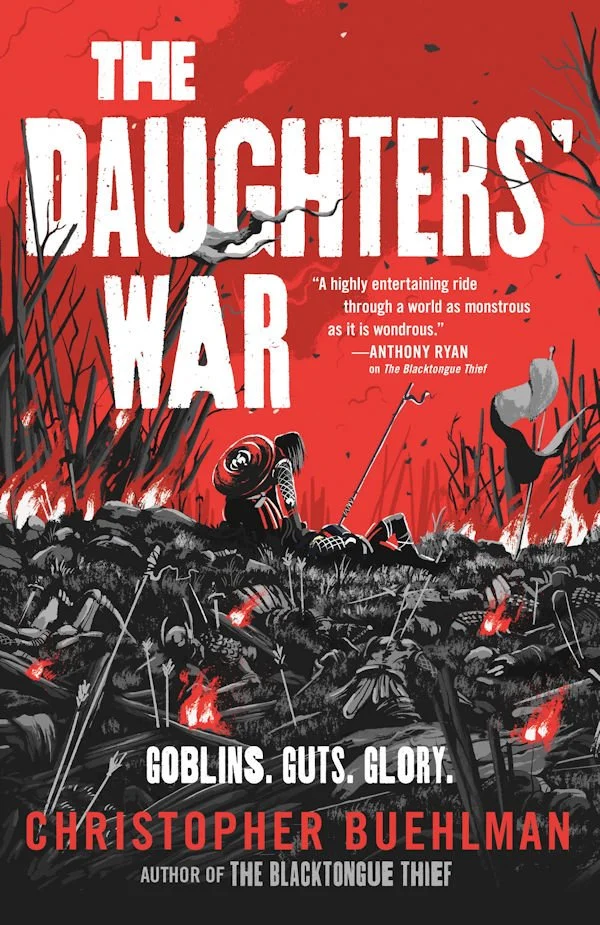
The landscape of modern fantasy has long been populated by tales of epic heroism and grand destiny. Yet, Christopher Buehlman, the acclaimed author behind the cult-classic The Blacktongue Thief, eschews these traditional tropes in his latest masterwork, The Daughters’ War. Serving as a harrowing, unflinching prequel to his established series, the novel plunges readers into a continent besieged by a grotesque, existential threat: the Biters.
As the goblin horde systematically dismantles human civilization—treating the survivors, or "kynd," as little more than livestock—the traditional structures of power collapse. Into this void steps Galva, a scion of the noble Dom Braga family, who chooses the blood-soaked reality of the front lines over the safety of her birthright. Joining the Raven Knights, an experimental all-female unit tethered to magically engineered, predatory corvids, Galva’s journey is one of survival, heartbreak, and the brutal cost of defiance.
The Architecture of Conflict: A Chronological Look at the Front
The narrative of The Daughters’ War functions less as a traditional epic and more as a visceral eyewitness account of a world being consumed. To understand the gravity of the story, one must look at the progression of the conflict as established by Buehlman’s world-building:
- The Collapse of the Old Order: The novel begins with the total devastation of the human military apparatus. Horses, the backbone of medieval warfare, have been systematically slaughtered by the goblin advance, leaving the human resistance in a state of terminal decline.
- The Rise of the Raven Knights: Desperation forces the hand of the ruling powers. The creation of the Raven Knights represents a radical shift in strategy. By fusing the tactical prowess of an elite female infantry with the terrifying aerial dominance of giant, magically forged war birds, humanity attempts to reclaim the skies and the battlefield.
- The Deepening Campaign: As Galva traverses the continent, the story moves from the initial recruitment and training phases into the grueling reality of prolonged, asymmetrical warfare. Each chapter serves as a marker of the attrition faced by the unit.
- The Climax: The narrative reaches a fever pitch as the Raven Knights march toward a fallen, once-beautiful city. The final act of the novel acts as a psychological and physical breaking point, where the true costs of the war—both personal and global—are extracted in full.
The Anatomy of the Threat: The Biters
A primary pillar of the novel’s success is Buehlman’s terrifying reimagining of the goblin race. In The Daughters’ War, the "Biters" are not the comic-relief minions found in common fantasy derivatives. They are nightmare-fueled creatures drawn from the darkest veins of folklore.
The Logic of the Predator
The horror of the Biters lies in their utter indifference to human sentience. They do not fight for territory in a political sense; they fight for consumption. They view humanity as cattle—creatures to be caged, harvested, and butchered. This dehumanization creates a persistent, suffocating sense of dread that permeates every page. For the reader, the threat is never abstract; it is immediate, grotesque, and deeply unsettling.
Characterization and the Human Condition
While the war provides the stakes, the heart of the novel lies in the character development of Galva. At the outset, she may appear to the reader as a stoic, almost one-dimensional soldier. However, this is a deliberate choice by the author. By stripping away her noble background and exposing her to the unvarnished realities of the "killing grounds," Buehlman allows her to evolve in a way that feels organic and deeply earned.
The Role of Amiel
The narrative utilizes a dual-perspective structure to provide contrast. While the bulk of the story is told through Galva’s resolute, harsh perspective, her younger brother, Amiel, contributes through intermittent journal entries. His voice is more sensitive, introspective, and romanticized, acting as a foil to the cold reality of the battlefield. This juxtaposition serves to ground the reader, reminding them of the idealism that was lost long before the first arrow was fired.
Tactical Brilliance: The Corvids
Central to the military strategy—and the emotional core of the novel—are the corvids. These giant, intelligent birds, born of dark magic, serve as both weapon and companion. The bond formed between the Raven Knights and their birds is the only source of genuine hope in a landscape defined by hopelessness.
These creatures represent the duality of the war effort: they are the only reason humanity has a chance at survival, yet they are inherently dangerous, unpredictable, and born of the same dark arts that threaten to destroy the world. The uncertainty surrounding these creatures mirrors the uncertainty faced by the protagonists at every turn.
Critical Analysis: Pacing and Atmosphere
One of the most notable aspects of The Daughters’ War is Buehlman’s mastery of pacing. Unlike modern blockbusters that demand a constant, breathless acceleration of action, Buehlman employs a "measured approach."
- The Power of Stillness: By inserting quiet, reflective moments between the visceral carnage of battle, the author allows the reader to process the emotional toll of the conflict. This prevents "battle fatigue," a common issue in war-centric literature, and ensures that when the violence occurs, it hits with the weight of a physical blow.
- Visceral Combat: The fight scenes are not concerned with technical diagrams or grand strategies; they focus on the immediate, terrifying reality of close-quarters combat. It is authentic, gory, and often difficult to read, which only reinforces the stakes of the struggle.
Implications: A New Foundation for the Series
As a prequel to The Blacktongue Thief, this novel serves a dual purpose. First, it stands alone as a complete, harrowing narrative of survival. Second, it provides the necessary context to transform the reader’s understanding of Galva. Her temperament, her motivations, and the trauma she carries in the later books are given profound weight here.
For those familiar with the series, the book invites a re-evaluation of previous events. For new readers, it serves as a masterclass in grimdark world-building. The novel concludes on a note of raw intensity, blending terror with elation in a way that is profoundly satisfying.
The Road Ahead
The cultural impact of The Daughters’ War is underscored by the fervor of its fanbase, who are already anticipating the next installment in the series. As the story concludes, the reader is left with the haunting refrain: "Short life, bloody hand." It is a mantra that defines the resilience of the characters and the uncompromising nature of Buehlman’s prose.
With the release of The Thrice-Bound Fool approaching in October, the momentum generated by this prequel is palpable. Buehlman has succeeded in creating more than just a prequel; he has built a cornerstone for a fantasy world that is as disturbing as it is compelling. By focusing on the intimate, human costs of a war that cares nothing for the individual, The Daughters’ War cements its place as a essential entry in the genre, leaving an impression on the reader that is as indelible as the blood on the battlefield.
It is, at its core, a story about the impossible weight of hope in a world designed to extinguish it. Whether or not that hope is justified remains one of the most compelling questions in contemporary fantasy.


 Laily UPN
 Nana Muazin