Basiran
For decades, the mention of "Arch Linux" has served as a litmus test for a user’s technical prowess. Renowned for its "keep it simple, stupid" (KISS) philosophy and a rolling-release model that keeps software at the bleeding edge, Arch Linux offers unparalleled control. However, that control has traditionally come at the cost of a notoriously steep learning curve. The installation process, a rite of passage involving manual partitioning, command-line configuration, and meticulous package selection, has long acted as a gatekeeper.
As of June 29, 2026, the barrier to entry has lowered once again. With the release of Archinstall 4.4, the Arch Linux project continues its quiet, steady march toward broader accessibility without compromising the core tenets that make the distribution a favorite among power users. By introducing an intelligent, color-coded diagnostic system, the community has effectively bridged the gap between manual precision and user-friendly automation.
The Core Facts: What is Archinstall 4.4?
Archinstall is not a "distro-within-a-distro," nor is it a GUI-based installer in the vein of Calamares, which is found in more user-friendly distributions like Manjaro or EndeavourOS. Instead, it is a Python-based library and menu-driven script included directly within the official Arch Linux installation media.
The 4.4 update represents a significant maturity milestone. The primary improvement in this iteration is the Installation Summary and Validation Engine. Previously, users would configure their system—selecting their drive, filesystem, desktop environment, and network settings—and pray that their choices were compatible. If a critical error was made, the user often wouldn’t discover it until the installation failed halfway through or, worse, until they rebooted into a broken system.
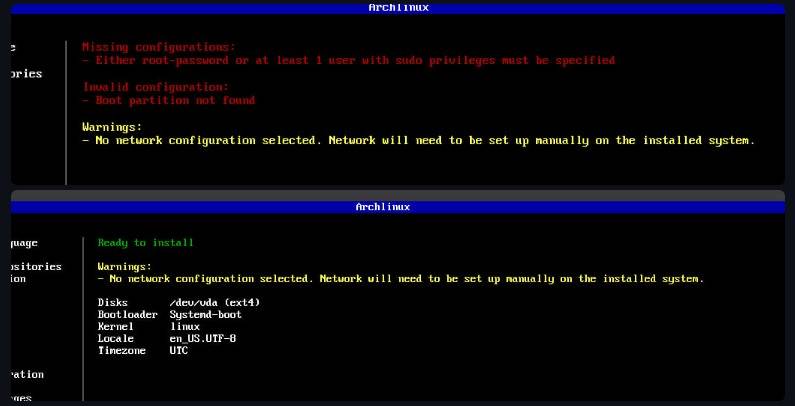
Version 4.4 changes this by introducing a "Pre-flight Check" phase. Before the installation script begins writing to the disk, it now performs a rigorous audit of the user’s selected parameters. If a configuration is invalid, logically inconsistent, or likely to result in an unbootable system, the installer halts and provides specific, color-coded feedback to the user.
A Brief Chronology: From Manual Scripts to Intelligent Automation
To understand why Archinstall 4.4 is a big deal, we must look at the evolution of the Arch installation experience.
- The "Manual Era" (2002–2021): For nearly two decades, the only way to install Arch was via a series of manual shell commands. This ensured that the user understood the system architecture, but it effectively excluded anyone who wasn’t comfortable with command-line partitioning and chroot environments.
- The Introduction of Archinstall (April 2021): The inclusion of the
archinstallscript in the official ISO marked a paradigm shift. It didn’t replace the manual way; it provided an alternative for those who understood the components but wanted to skip the repetitive task of typing out base system commands. - Maturation (2022–2025): Throughout these years, the community added support for various desktop environments (GNOME, KDE Plasma, Sway), disk encryption, and multiple filesystem types (BTRFS, XFS, EXT4).
- The Precision Update (June 2026): Archinstall 4.4 introduces the first truly "intelligent" layer of the installer. It transforms the script from a passive tool that blindly executes commands into an active assistant that validates the user’s intent.
Supporting Data: Why "Guardrails" Matter
The transition from a passive installer to an active validator is rooted in a fundamental shift in the Arch user base. According to recent telemetry and community surveys, the average Arch user is no longer necessarily a kernel developer or a systems engineer. Many are enthusiasts, developers, or gamers who value the performance and modularity of Arch but lack the time to manually troubleshoot a bootloader configuration on a Sunday afternoon.
Data from the Arch Linux project suggests that the vast majority of "failed" installations reported on the forums stemmed from human error: misconfigured mount points, incompatible filesystem flags, or missing firmware packages.
By implementing the color-coded warning system:
- Red Warnings: Indicate critical failures. These are "hard stops" where the installer prevents the user from proceeding until the conflict is resolved (e.g., trying to install a bootloader on a partition that isn’t mounted).
- Yellow Warnings: Indicate potential misconfigurations or non-standard choices that, while technically valid, might lead to a suboptimal user experience (e.g., choosing a filesystem that isn’t optimized for the specific drive type).
- Green Status: Confirms that the configuration is solid and ready for deployment.
This validation layer acts as a pedagogical tool. By explaining why a configuration is wrong, the installer teaches the user the underlying principles of the system, rather than just hiding the complexity behind a "magic button."

Official Perspectives and Community Response
The Arch Linux community is historically protective of its "do-it-yourself" culture. When archinstall was first introduced, there was vocal opposition from those who feared that making the OS "too easy" would bring in users who wouldn’t learn how the system works.
However, the tone has shifted significantly with the 4.4 release. The consensus among the lead developers is that accessibility does not equal "dumbing down." The lead maintainers of the archinstall project have emphasized that the tool is designed to be transparent.
"We aren’t trying to make Arch a ‘click-to-install’ experience for people who don’t care about their OS," one contributor noted in a developer mailing list. "We are trying to make it a more efficient experience for people who value their time. The 4.4 update provides the feedback loop that was missing; it keeps the user informed rather than leaving them in the dark."
The reception from the broader Linux community, including outlets like Linuxiac, has been overwhelmingly positive. The consensus is that by reducing the "friction of entry," Arch is able to retain users who might have otherwise abandoned the project due to a frustrating initial setup experience.
The Broader Implications: Arch Linux in the Modern Ecosystem
The success of Archinstall 4.4 has broader implications for the Linux ecosystem at large.
1. The Rise of "Arch-Based" Distros
Many distributions, such as EndeavourOS and Garuda Linux, rely on the underlying Arch repositories. By improving the core Arch installer, the upstream benefits all downstream projects. These distros can now focus their development efforts on polish and theming, knowing that the foundation—the installation process—is becoming increasingly robust and reliable.
2. A Shift in Perception
The "intimidating" reputation of Arch is, to some extent, a self-fulfilling prophecy. As the installation process becomes more transparent and less prone to "black box" failures, the psychological barrier to entry decreases. We are seeing a move toward a middle ground: an OS that remains fully modular and transparent for those who want to dive deep, but one that is no longer hostile to those who just want a stable, high-performance system.
3. The Future of Linux Desktop
The long-term goal of the Linux community has always been to gain market share on the desktop. While Arch Linux will likely never be a "plug-and-play" distro for the casual web-browsing user, its increased accessibility makes it a viable candidate for professionals and gamers who want a custom-tailored environment. The 4.4 release is a clear indicator that Arch is not retreating into obscurity; rather, it is refining its interface with the world.
Conclusion
Archinstall 4.4 is more than just a software update; it is a declaration of intent. It proves that a distribution can maintain its status as the pinnacle of customization and control while simultaneously embracing the modern necessity of a reliable, user-friendly setup process.
For the "mere mortals" who have long admired Arch from afar, the 4.4 update offers an invitation to participate. It provides the guidance needed to avoid common pitfalls, the feedback required to understand the system, and the confidence that, should something go wrong, the installer will have your back. As we look toward the future, the Arch Linux project stands as a testament to the idea that power and accessibility are not mutually exclusive—they are, when done correctly, the ultimate combination.

 Asep Darmawan
 Iffa Jayyana