

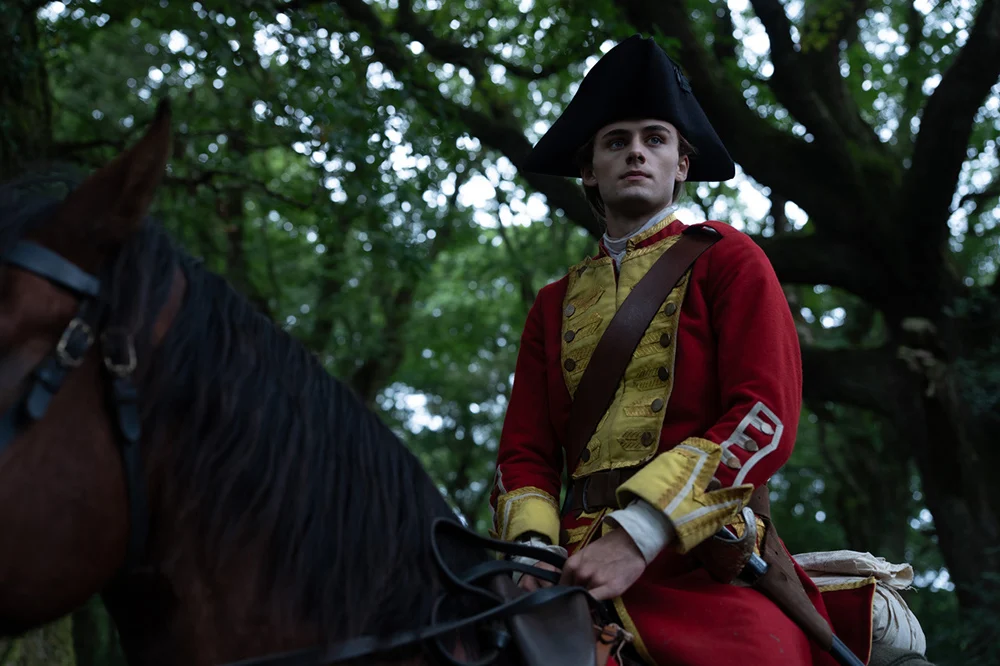
In the pantheon of American iconography, few figures occupy as much psychic real estate as George Washington. Often reduced to the marble bust or the stoic face on the dollar bill, the "Father of his Country" is rarely afforded the vulnerability of youth. Released by Angel Studios as a Fourth of July centerpiece, Young Washington—directed by Jon Erwin—attempts to bridge this gap, presenting a "great-man" biography that mirrors the earnest, neo-traditionalist narratives found in grade-school history books.
While the film serves as intentional counter-programming in today’s polarized cinematic landscape, it offers a surprisingly gritty look at the crucible that forged a revolutionary leader. By focusing on the 23-year-old Washington before he became the myth, Erwin’s military adventure film invites audiences to reconsider the sheer difficulty of the man’s ascent.
The Crucible of 1755: A Chronology of Conflict
The narrative core of Young Washington is anchored in the year 1755, a pivotal moment at the dawn of the French and Indian War. At this juncture, the audience encounters a Washington vastly different from the later, powdered-wig statesman. He is an ambitious, if green, officer in the British Army, tasked with a mission that his more seasoned peers wisely avoided: leading a ragtag militia of 150 volunteers into the volatile Ohio Territory.
The film’s historical sequence follows Washington’s efforts to assert British claims over land being actively colonized by the French. The initial engagements are depicted with unflinching brutality. In the film’s opening battles, the militia is decimated by musket fire, their lack of combat experience laid bare in a chaotic, bloody sequence.
As the film progresses, it tracks Washington’s evolution through several distinct stages:
- The Formative Loss: A flashback to Washington’s childhood reveals the death of his father, an event that stripped him of his formal education and left him the modest tenant of Mount Vernon.
- The Mentorship: The guidance of his half-brother, Lawrence, provides the film with its central philosophy: "Even a pawn can take the king." This chess-based mantra becomes the driving force behind Washington’s tactical patience.
- The Political Labyrinth: Washington must navigate the icy, snobbish corridors of British colonial administration, engaging with figures like the haughty Robert Dinwiddie (Ben Kingsley) and his eventual benefactor, the wealthy Lord Fairfax (Kelsey Grammer).
- The Baptism of Fire: The final act culminates in Washington serving as aide-de-camp to General Braddock (Andy Serkis), where the protagonist transitions from a mere officer to a combat leader capable of commanding in the chaos of guerrilla warfare.
Characterization and the Myth of the ‘Plaster Saint’
Casting is the heartbeat of any biographical epic, and Young Washington takes a bold, if controversial, approach. William Franklyn-Miller, cast in the titular role, possesses a model-handsome aesthetic that feels distinctly modern—a "Jacob Elordi for the colonial era," as some might describe him.
While this choice risks distancing the audience from the historical reality of the 18th century, Franklyn-Miller delivers a performance that leans into Washington’s simmering temper and his instinctive, burning desire for justice. He is not the distant, static statue of history; he is a man constantly bumping against the ceiling of his own ambition.
Supporting performances ground the film’s narrative stakes. Ben Kingsley’s portrayal of Robert Dinwiddie is a masterclass in bureaucratic arrogance, providing the necessary friction to Washington’s idealism. Conversely, Andy Serkis brings a blustery, doomed bravado to General Braddock, serving as a cautionary tale of what happens when traditional, rigid military thinking meets the brutal reality of the American wilderness.
Perhaps the most poignant performance comes from Ryan Begay, who plays the Seneca leader Tanacharison. Begay brings a somber, haunting gravitas to the role, serving as a constant reminder of the indigenous perspective that the British and French often chose to ignore. His warning—"While you kill each other, we wait to reclaim it"—serves as the film’s most enduring irony.
Supporting Data and Historical Context
The film functions as a cinematic study of the shift in military doctrine that eventually allowed the American colonies to challenge the British Empire. Young Washington effectively highlights the contrast between the British obsession with the "open field" and the tactical necessity of survival in the New World.
The transition of the American soldiers from standard military attire to the practical blue uniforms—designed specifically to blend into the landscape—serves as a powerful visual metaphor for the shift toward guerrilla warfare. This was not just a fashion choice; it was the birth of a new military philosophy. The British, bedecked in their highly visible redcoats, remained wedded to an archaic, aristocratic view of warfare. The Americans, out of necessity, began to innovate.
Furthermore, the film explores the irony of Washington’s early allegiance. While he famously led a revolution against the Crown, the younger Washington was, in many ways, an Anglophile. He hungered for a commission in the British Army and sought validation from the very aristocratic system that would eventually drive him to rebellion.
Official Responses and Industry Reception
Angel Studios has positioned Young Washington as "neo-traditional" counter-programming. In the context of the modern film industry, this is a calculated move. By focusing on themes of patriotism, individual agency, and traditional heroism, the studio is tapping into an audience segment that feels alienated by contemporary mainstream cinema.
Critical reception, however, remains nuanced. While the film has been praised for its "watchable, stolid" production value—often compared to the high-quality, mid-budget historical dramas of the early 2000s—some critics argue that its commitment to the "plaster saint" narrative of Washington obscures the more complex, contradictory elements of his life.
The studio has emphasized that the film’s intent is not to provide a definitive, academic account of Washington’s life, but rather to inspire a sense of historical wonder. "It’s the crisp tug of schoolkid patriotism," noted one critic, acknowledging that while the film may not satisfy the rigorous demands of a historical biographer, it succeeds in creating a visceral, emotional connection to the figure of the hero.
Implications: The Intersection of History and Myth
The ultimate implication of Young Washington is the ongoing tension between "feel-good" heroism and the nuanced lessons of history. By framing Washington as a figure who is "mystically protected"—a narrative thread woven into the dialogue by the indigenous characters—the film flirts with hagiography.
This approach forces a question for the modern viewer: Is it possible to find inspiration in the myths of our founders without ignoring the darker realities of the era?
The film succeeds when it leans into the friction. Washington’s initial military failures are not sugar-coated; they are depicted as essential learning experiences that hardened his resolve. The film suggests that the "Great Man" of American history was not born with a sword in his hand, but was instead forged in the failures, the insults of British bureaucrats, and the desperate, bloody skirmishes of the Ohio Valley.
As an piece of cinema, Young Washington is a competent, well-crafted exploration of the formative years of a revolutionary. It offers a glimpse into the internal life of a man who would go on to shape a nation, reminding us that even the most formidable figures in history were once just pawns in a much larger game, waiting for their moment to take the king.
For those seeking an educational deep-dive, the film may leave some stones unturned. But for those looking to engage with the American story through a lens of classic, adventurous storytelling, Young Washington serves as a poignant reminder that the foundations of liberty were built on the backs of the young, the inexperienced, and the remarkably determined.










