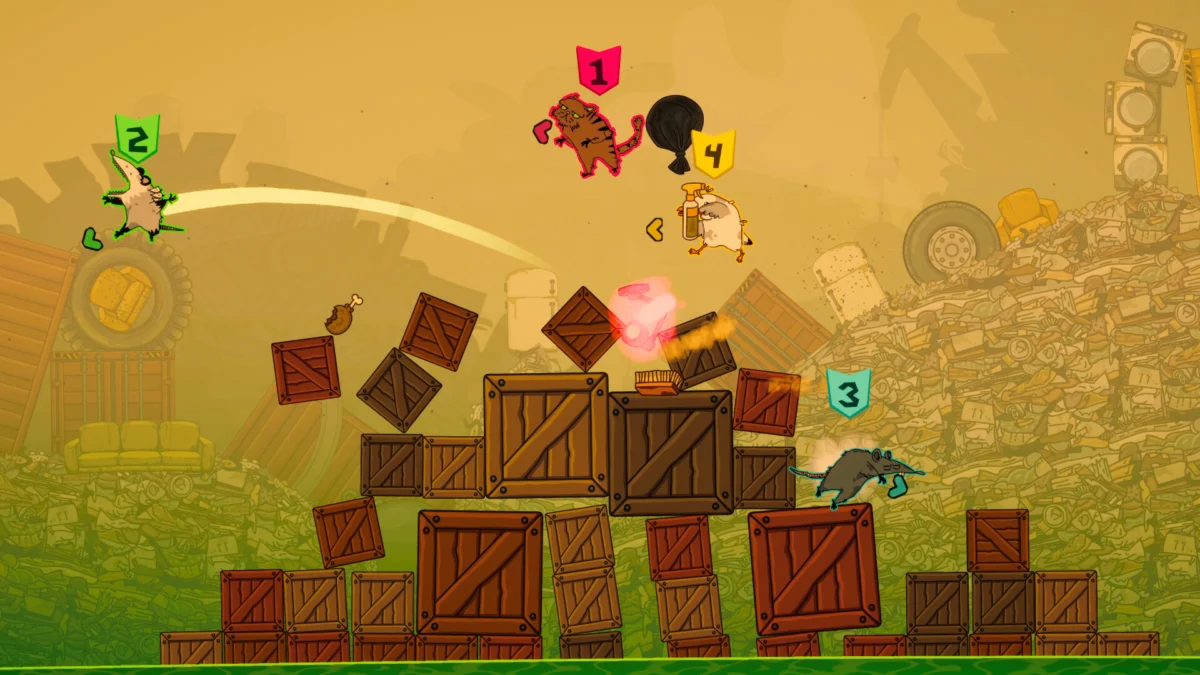
In the ever-expanding landscape of digital party games, it is becoming increasingly difficult for new titles to carve out a niche. The genre is dominated by giants like Super Smash Bros., Worms, and Gang Beasts. However, Royal Vermin—the latest title to hit the scene—has arrived with a refreshing, if somewhat chaotic, proposition: what if the arena itself was as dangerous as your opponents?
By blending high-stakes platforming, physics-based slapstick, and a vibrant aesthetic, Royal Vermin manages to capture the fleeting, high-octane energy required for a successful couch co-op experience. While it may not possess the competitive depth of professional eSports titles, it excels as a social lubricant, promising an evening of laughter, accidental sabotage, and the inevitable destruction of friendships.
The Core Concept: Where Physics Meets Mayhem
At its heart, Royal Vermin is a physics-based brawler that pits a roster of anthropomorphic, goofy critters against one another in a desperate race for survival. The premise is disarmingly simple: players are dropped into arenas that are inherently unstable. As the clock ticks down, the environments begin to collapse, crumble, and shift, forcing players to adapt on the fly.
A Hybrid of Proven Formulas
The game draws clear inspiration from established pillars of the genre. From Worms, it takes the environmental destruction and the tactical use of terrain; from Smash Bros., it adopts the goal-oriented combat of knocking opponents out of the ring; and from modern "wonky physics" games, it inherits the hilariously imprecise movement that makes every jump a potential disaster.
The result is a loop where skill is important, but adaptability is paramount. A player might master the combat mechanics, but if they fail to anticipate the floor falling out beneath them, their technical prowess matters little.
Chronology of Development and Design Philosophy
While the studio behind Royal Vermin has kept its internal development timeline relatively quiet, the release trajectory suggests a project focused heavily on community playtesting. Early builds reportedly emphasized the "feel" of the physics engine, with developers iterating on the weight of the characters and the structural integrity of the environments.
- Phase One: The Prototype. The core focus was the "collapsing arena" mechanic. Early testers found that standard, static stages were too predictable, leading the team to introduce procedural hazard generation.
- Phase Two: Character Roster. The design team moved toward a "goofy critter" aesthetic to ensure the game felt accessible and lighthearted, even when the gameplay became intense.
- Phase Three: Balancing and Accessibility. Realizing that the game’s chaotic nature could alienate casual players, the developers introduced the "Dynamic Difficulty" system, allowing for a more inclusive environment during social gatherings.
- Phase Four: Launch. The game officially entered the marketplace with a focus on local multiplayer, prioritizing the couch co-op experience over online competitive play.
Supporting Data: Why It Works
The Mechanics of Engagement
One of the most praised aspects of Royal Vermin is its commitment to keeping players engaged even after they have been "eliminated." In many brawlers, being knocked out early leads to boredom for the player sitting on the sidelines. Royal Vermin mitigates this through interactive hazards that eliminated players can trigger or influence, ensuring that the "dead" players remain the loudest ones in the room.

Accessibility Metrics
The game features a simplified control scheme, stripping away complex combo strings in favor of intuitive movement and interaction. According to player feedback, this low barrier to entry is what allows the game to shine during parties. When a group of mixed skill levels—from veteran gamers to those who rarely pick up a controller—can all participate without feeling hindered by the interface, the game’s utility as a party title skyrockets.
Official Developer Responses and Community Feedback
In recent communications, the developers have emphasized that Royal Vermin was never intended to be a "serious" eSports contender. When asked about the lack of robust online matchmaking, a representative for the studio noted:
"Our goal with Royal Vermin was to recapture the magic of being in the same room as your friends. We wanted to see the expressions on people’s faces when their entire platform gives way because of an accidental shove. While we hear the requests for online competitive play, we believe the game’s soul is in the local, face-to-face interaction."
The community response has been largely positive, albeit tempered by the acknowledgment that the game is a "niche" party experience. Players have praised the vibrant, cartoon-style visuals for providing visual clarity even when the screen is crowded with collapsing debris and scrambling critters.
Implications for the Party Brawler Genre
Royal Vermin serves as an interesting case study for the current state of indie development. As the market becomes increasingly crowded, developers are finding success by leaning into "micro-genres"—small, focused experiences that do one thing extremely well.
The Trade-off: Depth vs. Fun
The primary criticism leveled against Royal Vermin is its lack of longevity for solo players. Without a deep single-player campaign or a competitive online ladder, the game’s lifespan is tied directly to the frequency of the user’s social gatherings.
However, this is not necessarily a failure. By choosing not to compete with the "titans" of the industry, Royal Vermin avoids the "feature creep" that often plagues larger games. It provides a specialized service: an evening’s worth of entertainment that is easy to pick up, impossible to master, and guaranteed to produce memorable, hilarious moments.

The Luck vs. Skill Debate
There is an ongoing discussion within the community regarding the game’s reliance on randomness. Some players feel that the procedural hazards make it impossible to truly master the game. Conversely, others argue that this randomness is the "great equalizer." In Royal Vermin, the most skilled player can be taken down by a lucky chain reaction from a novice, a dynamic that keeps the game from becoming a stale, predictable sweat-fest.
Future Outlook: Can the Chaos Last?
Whether Royal Vermin will have a lasting legacy remains to be seen. In the age of live-service games, titles like this often struggle to maintain a player base if they aren’t constantly updated with new content. If the developers intend to keep this title relevant, they will likely need to introduce:
- Expanded Map Variety: To keep the "unpredictable" nature of the arenas fresh.
- Customizable Rulesets: Allowing players to tweak the severity of the physics or the speed of the collapses would add significant replay value.
- Community-driven Content: Giving players the tools to build their own arenas could extend the game’s lifespan exponentially.
Despite these potential hurdles, Royal Vermin stands as a testament to the enduring appeal of the couch co-op genre. In a gaming world that often prioritizes graphical fidelity and massive, sprawling worlds, there is still a massive, underserved demand for games that prioritize pure, unadulterated joy.
Final Assessment: Should You Play It?
If you are looking for a game to grind, climb a ranked ladder, or lose yourself in for hundreds of hours of solo play, Royal Vermin is likely not for you. It is not a replacement for the high-octane competitive nature of Super Smash Bros. Ultimate or the strategic depth of Worms W.M.D.
However, if you are a host looking for the perfect game to throw on during a game night, a party, or a rainy afternoon with friends, Royal Vermin is an essential addition to your library. Its vibrant, cartoonish aesthetic masks a surprisingly deep physics engine that rewards clever improvisation over rote memorization.
The game does not aim for the stars; it aims for the living room couch. By keeping its focus narrow and its tone consistently lighthearted, it achieves a level of success that many larger, more ambitious titles fail to reach. It is a reminder that sometimes, the best gaming experiences aren’t the ones that demand your total dedication, but the ones that demand you simply show up, have a laugh, and embrace the chaos.
In summary, Royal Vermin is a chaotic, colorful, and utterly charming brawler that proves you don’t need a complex narrative or a massive budget to create a lasting memory. You just need a group of friends, a few controllers, and a stage that is just about ready to fall apart.