

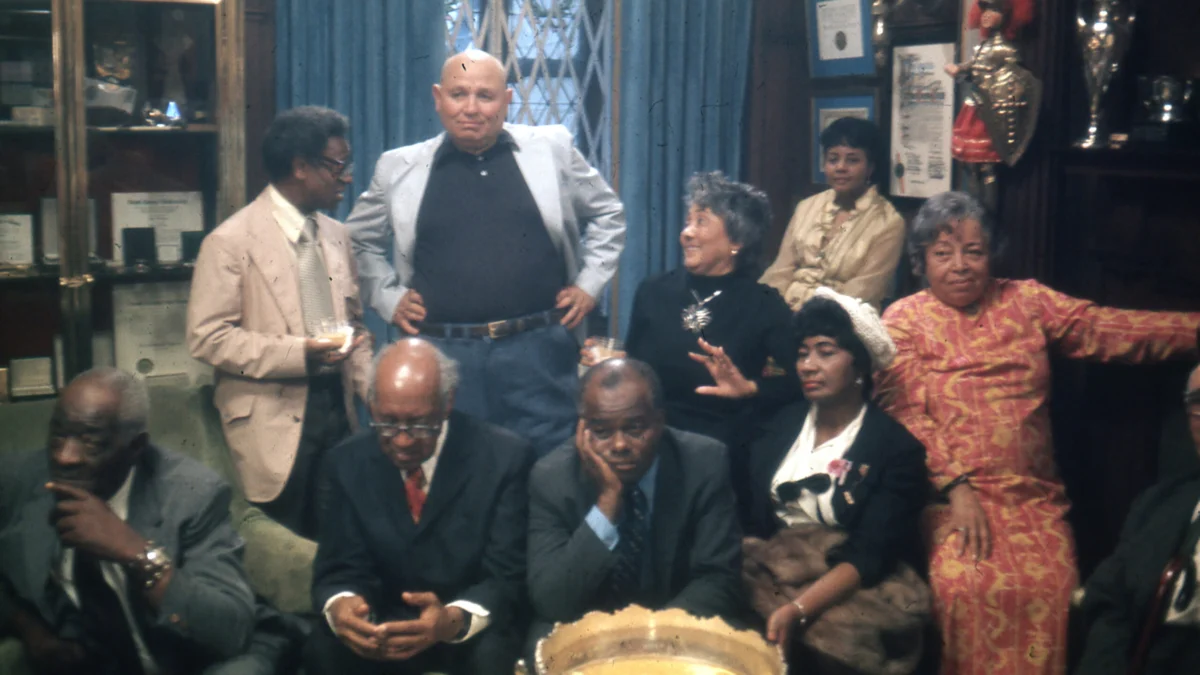
In the annals of documentary filmmaking, few concepts possess the elegant, almost miraculous simplicity of William Greaves’ 1980s endeavor: gather the surviving titans of the Harlem Renaissance within the hallowed walls of Duke Ellington’s home and let the cameras roll. It was a project that sought to bottle lightning, capturing the collective memory of a generation that redefined Black American identity. Yet, for decades, the footage remained a "lost" treasure—a sprawling, unfinished mosaic of history that proved too ambitious for even its visionary creator to synthesize.
Now, Once Upon a Time in Harlem, the completed film spearheaded by William’s son, David Greaves, arrives as both a historical document and a profound act of familial stewardship. During the 2026 Cannes Film Festival, David Greaves sat down at The American Pavilion—presented by IndieWire—to discuss the arduous, emotional journey of transforming his father’s "most important" footage into a cohesive cinematic experience.
The Genesis of an Idea: A Gathering of Giants
The Harlem Renaissance was not merely a movement; it was the bedrock of 20th-century American intellectual and artistic life. By the time William Greaves—a filmmaker whose own body of work, including the seminal Symbiopsychotaxiplasm: Take One, had already left an indelible mark on nonfiction cinema—conceived of this project, he recognized that time was running out. The figures who had shaped the literature, music, and social philosophy of the 1920s and 30s were aging.
William’s strategy was rooted in cinéma-vérité. He eschewed the artificiality of formal interviews in favor of a naturalistic approach. He utilized three 16mm cameras, positioning them strategically throughout the Ellington residence to capture the unscripted, spontaneous interplay between the luminaries. "He wanted to capture these people who made that time so special," David Greaves explained to the audience at the American Pavilion. "It’s unusual to have people who actually created an era all together in one place and talking about the time that has become legendary in the Black community."
Chronology of a Decades-Long Project
The history of Once Upon a Time in Harlem is a testament to the complexities of artistic vision. Following the initial filming, William Greaves and his wife and creative partner, Louise Archambault Greaves, began an editing process that would stretch far beyond their original expectations.
The Expanding Scope (1980s–2014)
Initially, the project was intended to be more than just a party. As David notes, his stepmother, Louise, continued to film in Harlem for over a decade after the initial gathering. The original treatment was gargantuan in scale, envisioning a multi-layered documentary that would feature narration by the legendary Sidney Poitier. It was designed to bridge the gap between the 1920s and the 1980s, exploring how the Black Arts Movement emerged as a direct descendant of the Harlem Renaissance.

However, the weight of the material began to stifle the production. William Greaves, despite his prolific output, found himself unable to reconcile the vast amount of contemporary footage with the intimate, vintage atmosphere of the party at Ellington’s house. When William passed away in 2014, the film remained an unfinished, albeit brilliant, archive.
The Stewardship of David Greaves (2014–2026)
Following the death of his father, the responsibility of the project fell to David. The task was not merely to edit, but to interpret. The process was further shaped by the passing of Louise Archambault Greaves in 2023, which served as a final catalyst for David to bring the work to completion.
"I had said to Louise, after he passed, ‘Dad couldn’t finish the film because he had to be a part of it,’" David recalled. This realization became the cornerstone of the final cut. David spent years immersed in his father’s personal library, poring over books annotated with William’s own notes, seeking to understand the intellectual framework that underpinned the project. By stripping away the bloated, sprawling narrative that had been planned in the 80s and focusing on the core footage of the party, David achieved a clarity that his father had been unable to reach.
Supporting Data: The Craft of Memory
The finished version of Once Upon a Time in Harlem is a feat of editorial restraint. David Greaves made the bold decision to whittle down hours of footage into a focused narrative that honors the specific energy of the gathering.
Technical and Thematic Integration
- Cinematographic Style: By utilizing the raw, unvarnished 16mm footage, the film maintains a visceral, "you-are-there" quality that would have been lost with more modern digital polish.
- The Inclusion of the Filmmaker: Perhaps the most significant deviation from the original treatment is the intentional inclusion of William Greaves on screen. David uses his father’s presence as a narrative frame, bookending the film with images of the creator himself. This choice effectively highlights the lineage of the movement: William wasn’t just documenting the Renaissance; he was a product of it.
- Intellectual Archiving: The film incorporates the elder Greaves’ margin notes and personal inspirations, effectively making the act of filmmaking a character within the story.
Official Perspectives: Reflections from the Pavilion
At the Cannes Film Festival, the reception of the project was electric. Industry professionals and festival attendees alike were struck by the film’s ability to act as a time machine. The "official" perspective offered by David Greaves is one of humble duty. He views himself not as an auteur rewriting his father’s work, but as a curator honoring a legacy that was "so influenced by [the Renaissance] that I felt that he had to be an integral part of it."
When asked why the project was the "most important" of his father’s career, David emphasized the rarity of the event. To have the architects of an era in one room, speaking in their own voices, is a singular historical occurrence. "The idea, frankly, is to make sure that you were able to understand that this guy did this incredible thing," David said, referring to his father’s foresight in capturing the footage before the opportunity vanished.

Implications: The Legacy of the Harlem Renaissance
The release of Once Upon a Time in Harlem, slated for a theatrical run by NEON this October, arrives at a moment when the cultural and political discourse surrounding Black identity is particularly focused on historical continuity.
Preserving the Intellectual Lineage
The film’s primary implication is the solidification of the Harlem Renaissance as a living, breathing entity rather than a static historical chapter. By connecting the 1920s to the 1980s, and now through the lens of 2026, the film demonstrates that culture is not stagnant. It is a baton passed from one generation of artists to the next.
A Blueprint for Future Nonfiction
Beyond its historical value, the film serves as a masterclass in documentary completion. It provides a template for how the archives of deceased filmmakers can be handled with integrity. Rather than attempting to "finish" a film exactly as the creator might have wanted—a task that is often impossible—David Greaves chose to evolve the film to reflect the changed context of the present. He honored the source material while acknowledging the passage of time.
In the end, Once Upon a Time in Harlem is more than a film; it is a bridge. It connects the audience to a room full of giants, through the eyes of a master filmmaker, and into the hands of a son who understood that to preserve the history of the movement, he had to preserve the history of the man who captured it. As the lights go down in theaters this October, viewers will not just be watching a party; they will be witnessing the culmination of a lifelong dialogue between a father, his son, and the cultural history of a nation.











No comments yet. Be the first to join the conversation!