

For over four decades, Michael Dinner has occupied a rare space in the pantheon of American directors. He is a stylistic chameleon, a filmmaker whose career trajectory reads like a syllabus for the evolution of modern television. From the whimsical comedy of Off Beat to the high-stakes medical urgency of Chicago Hope and Grey’s Anatomy, and through the nostalgic warmth of The Wonder Years, Dinner has never stayed in one lane. However, it is his mastery of the modern Western—seen most notably in the gritty, pulse-pounding world of Justified and its sequel, City Primeval—that has cemented his reputation as a director capable of elevating any genre.
Now, Dinner has embarked on his most ambitious chapter yet: the high-concept, claustrophobic science fiction of Apple TV+’s hit series, Silo. As he transitions into the role of producer and director for the show’s later seasons, Dinner brings the weight of his vast experience to a story about the fragility of truth and the weight of memory.
A Legacy of Versatility: The Career of Michael Dinner
"I’ve done a little bit of everything," Dinner remarked during a recent recording for the Filmmaker Toolkit podcast. "I sometimes joke that I practice the great American pastime of reinventing myself."
This "reinvention" is not merely a hobby; it is the cornerstone of his creative philosophy. Dinner’s career spans the transition from the golden age of network television to the prestige streaming era. His work on Justified—where he forged a deep, symbiotic partnership with showrunner Graham Yost—showcased his ability to balance character-driven drama with taut, atmospheric action.
When Yost approached him to join the production of Silo in London for its second season, the invitation felt like a natural extension of their long-standing creative shorthand. What was originally pitched as a six-month commitment blossomed into a three-year odyssey. Having shepherded the series through Season 3 and now wrapping production on Season 4, Dinner has become the backbone of the Silo creative team.
The Genesis of ‘Silo’: Trusting the Narrative
The allure of Silo for Dinner was not initially rooted in the genre of science fiction, but in the strength of his professional relationship with Graham Yost. "I committed without even seeing or reading anything, because of Graham," Dinner admitted.

Once he arrived in London and immersed himself in the source material—Hugh Howey’s acclaimed Silo novels—the director found himself captivated by the series’ core premise: 10,000 people living in a massive underground silo, governed by strict rules, unaware of the history that led them there or the true state of the world outside.
The series is defined by its mystery. In the current season, the stakes have shifted. The narrative has fractured into two compelling threads: one follows the underground protagonist Juliette Nichols (Rebecca Ferguson) as she struggles to piece together her own identity after a traumatic memory wipe; the other serves as a sweeping origin story, revealing the harrowing political and societal machinations that necessitated the construction of the silos in the first place.
The Cinematic Language of Political Thrillers
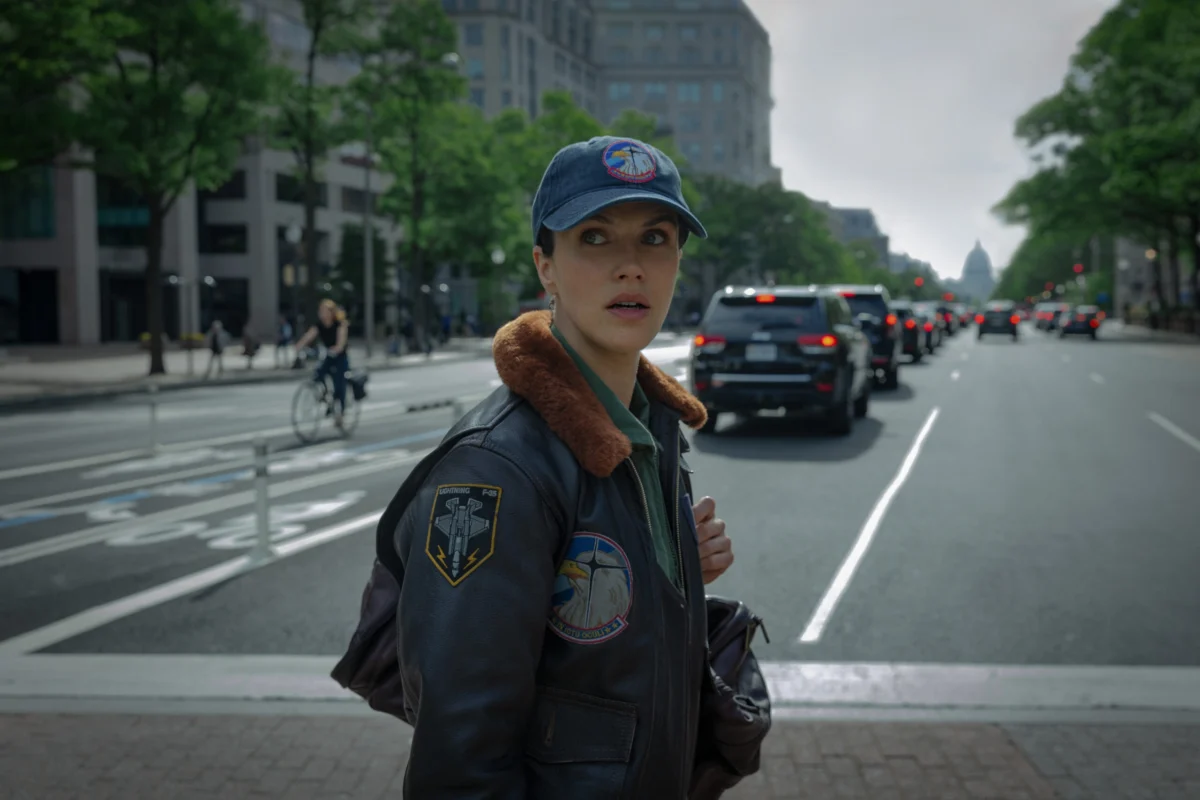
While Silo is fundamentally a sci-fi series, Dinner’s visual approach is heavily influenced by the masters of 1970s American cinema. The origin story, set in present-day Washington, D.C., gave him the canvas to experiment with the aesthetic of political thrillers that defined his formative years as a viewer.
"I don’t want to date myself, but those are some of the movies that made me want to do what I do," Dinner said. He recalls visiting the Esquire or Bluebird Theater as a youth, soaking in the work of legends like Alan Pakula, Francis Ford Coppola, and Sydney Pollack.
Dinner consciously avoided a direct, frame-by-frame homage to films like The Conversation or All the President’s Men. Instead, he allowed the "DNA" of those films to inform the mood of Silo. By employing a subtle, grounded visual language, he ensures that the political intrigue in Washington feels as urgent and paranoid as the life-or-death struggles happening 300 years in the future.
Crafting the Visual Aesthetic: Instinct Over Calculation
One of the most intriguing aspects of Dinner’s process is his resistance to over-stylization. In an era where many directors lean heavily on prescriptive, color-coded visual palettes to differentiate timelines, Dinner prefers an organic approach.

"I didn’t want to overthink it," he noted. "At first I was worried—did there need to be some kind of stylized visual component where the two storylines were meshing together? I kind of dumped that and said to the other directors, ‘Trust the script. It will mesh together.’"
This trust extends to his camera work. He utilized handheld camerawork to capture the frantic, lived-in reality of the underground, contrasting it with more controlled, fluid movements from dollies and Steadicams in the D.C.-based scenes. Rather than adhering to a rigid manifesto, these choices were born from the emotional frequency of the scenes themselves.
The true unifying force of the series, according to Dinner, is the score. He credits composer Atli Örvarsson with creating a sonic tapestry that threads the disparate timelines together, providing a consistent emotional through-line that allows the viewer to navigate the show’s complex temporal shifts with ease.
Thematic Resonance: The Fragility of Memory
At its heart, Silo is a detective story. Whether it is Juliette fighting to recover her stolen memories or the character of Billings (Chinaza Uche) investigating a disappearance within the silo’s hierarchy, the show is obsessed with the act of seeking truth in a world built on lies.
Dinner finds this theme particularly fertile ground for exploration. "Both stories are detective stories," he explains. "It’s about memory and how it can be manipulated." By positioning these narratives as mysteries, Dinner and the writing team maintain a consistent tension that keeps the audience hooked. The manipulation of history—whether by a government in the present or an unknown authority in the future—serves as a cautionary tale about the importance of objective truth.
Implications for the Future of ‘Silo’
As Silo continues to unfold, the involvement of a veteran director like Michael Dinner signals a commitment to character depth over mere spectacle. By anchoring the high-concept premise in the traditions of 70s political drama, the show avoids the common pitfall of becoming too cold or technical.

The success of the series, which is currently streaming its latest season on Apple TV+, underscores a growing appetite for "prestige sci-fi" that demands active participation from its audience. For Dinner, the process of helming these seasons has been a career highlight—a chance to apply decades of craft to a story that is as intellectually challenging as it is visually arresting.
For fans of the series, the future looks expansive. With the origin story now running parallel to the central mystery, the scope of the world is widening. If the first two seasons were about surviving the silo, the current trajectory suggests the coming chapters will be about understanding the architects of that survival.
Conclusion
Michael Dinner’s journey from the character dramas of the 80s to the intricate, world-building complexities of Silo is a testament to the endurance of a true filmmaker. He remains a student of the craft, someone who views every project not as a repetition of past successes, but as a new puzzle to solve.
In Silo, he has found the perfect intersection of his interests: mystery, political intrigue, and the indomitable human spirit. As he continues to steer the ship through the upcoming seasons, his influence ensures that no matter how strange or futuristic the setting, the humanity at the center of the story will always remain the most compelling element.
Michael Dinner’s deep dive into his career, his collaboration with Graham Yost, and his work on ‘Silo’ will be featured on an upcoming episode of the ‘Filmmaker Toolkit’ podcast. To ensure you don’t miss the conversation, subscribe to the show on Apple Podcasts, Spotify, or your preferred streaming platform.










