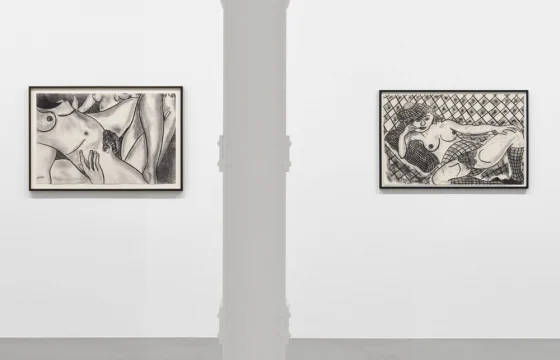
Galerie Max Hetzler in Berlin has announced the opening of X-Rated (1972–1974), a definitive solo exhibition dedicated to the paintings and works on paper of William N. Copley. Marking the fourth presentation of the artist’s work at the gallery, this expansive show will remain on view until April 22, 2026. Bringing together a collection of works that once challenged the moral boundaries of the American art scene, the exhibition offers a rare opportunity to engage with a pivotal chapter in Copley’s career—one that dared to treat the prohibited imagery of pornography as a playground for formal invention, psychological exploration, and unbridled, joyful expression.
A Life of Surrealist Influence: From Gallery Owner to Iconoclast
William N. Copley, who famously adopted the pseudonym "CPLY," arrived at the canvas from a non-traditional path. Before he was a painter, he was a writer and a gallerist. In the late 1940s, he operated the Copley Galleries in Beverly Hills alongside his brother-in-law, John Ployardt. This brief but transformative venture served as a conduit for the European avant-garde; it brought Copley into the orbit of Surrealist titans such as Man Ray, Max Ernst, and Marcel Duchamp.
It was the encouragement of these exiled masters—and the dealer Alexander Iolas—that pushed Copley to pick up the brush. After closing his gallery, Copley debuted his own art in a Los Angeles bookstore in 1951, shortly before relocating to France. Though he was a generation younger than the pioneers of Surrealism, Copley was their spiritual heir. His work absorbed the movement’s fascination with humor, the unconscious, and the erotic, yet he filtered these interests through an American lens defined by the sharp lines of comic books and the vibrant color palettes of Pop Art.
The “X-Rated” Series: Breaking the Barrier of Pornography
The centerpiece of the current exhibition is the "X-Rated" series, a prolific body of work created between 1972 and 1975. The series first premiered in 1974 at the New York Cultural Center. During an era when the commercial sale of hardcore pornography was still largely illegal in the United States, Copley engaged in a radical act of appropriation. He sourced images from "adult magazines"—often purchased discreetly under the counter—and transformed them into sophisticated, figurative narratives.
Copley’s stated ambition for the series was to "break through the barrier of pornography into the area of joy." Rather than succumbing to the degradation often associated with his source material, Copley infused his compositions with a surprising range of emotional tones. Works such as The Seven Year Itch (1973) exhibit a tender intimacy, while Viridiana (1973) pulses with exuberance. Almost all of the works in the series are marked by a distinct, irreverent humor, reflecting Copley’s belief that the ambiguity of sex was its greatest asset. "That’s what makes sex so much fun," he once remarked, "since nobody really understands it, the possibilities for originality are endless."
Technical Rigor: The Architecture of Desire
A significant highlight of the exhibition is the inclusion of preparatory drawings alongside completed paintings, providing a window into Copley’s creative process. The artist typically worked in two distinct stages: an initial, small-scale study followed by a larger, more refined version that prioritized pictorial dynamism. By juxtaposing these sketches with the final canvases—such as the pairing of Calcutta (1973) and its counterpart Untitled (1973)—the exhibition demystifies the "slapdash" aesthetic of his finished works.
While his figures were often treated with a loose, schematic hand, the construction behind them was meticulous. The backgrounds of his scenes, frequently filled with vivid colors and bold geometric patterns, serve to neutralize the potentially sordid nature of his subject matter. Critic James R. Mellow famously observed that these compositions were almost "too artful to be libidinous, let alone lascivious." This stylistic approach, combined with the attenuated limbs and contorted bodies of his subjects, has often led critics to compare Copley to Henri Matisse. However, where Matisse used suggestion and idealization to frame the nude, Copley offered a direct, unvarnished look at the sexual act, stripping away the veil of traditional art-historical modesty.
Pop Culture and the Logic of Disjunction
Copley’s engagement with the "X-Rated" series was also deeply rooted in his dialogue with contemporary culture. He frequently titled his works after iconic Hollywood films, such as Les Quatre Cent Coups (The 400 Blows), The Exorcist, and Tobacco Road. In keeping with Surrealist principles, these titles rarely share a literal connection to the content of the painting. Instead, they serve as a catalyst for a cascade of associations in the viewer’s mind, bridging the gap between high art and the popular vernacular.
The term "X-rated" itself was a loaded signifier in the 1970s, serving as the official film-classification rating for adult-only cinema in the United States. By adopting this nomenclature, Copley signaled a confrontational stance toward moralistic censorship. Despite the potential for controversy, the 1974 exhibition at the New York Cultural Center—curated by the progressive director Mario Amaya—was a critical triumph. Peter Schjeldahl, writing for Art in America, praised the show as "uniformly gorgeous" and a "highly satisfying development" in Copley’s practice, effectively validating the artist’s move into more transgressive territory.
Implications: A Subversive Legacy in the Modern Era
In the context of the contemporary art world, the "X-Rated" series holds a unique position. It was a singular departure from the prevailing minimalist and conceptual trends of the early 1970s, standing apart as a testament to the power of the individual voice. Today, in an age defined by the digital saturation of images and the constant debate surrounding the boundaries of the gaze, Copley’s canvases retain a potent, subversive charge.
The exhibition at Galerie Max Hetzler serves as a timely reminder that art is not merely a tool for representation, but a weapon against moralistic constraints. By merging the erotic with the playful and the formal with the narrative, Copley refused to accept the notion of artistic neutrality. He championed a form of "radical joy" that demanded the viewer confront their own preconceptions about pleasure and the body.
For visitors to Berlin, this exhibition offers more than just a historical survey of a forgotten series. It provides a glimpse into the mind of an artist who understood that the most effective way to challenge conservative norms was not through protest alone, but through the creation of something so vibrant, so humorous, and so unmistakably human that it rendered the taboos of the day obsolete. As the art world continues to grapple with the politics of representation, William N. Copley’s "X-Rated" works remain as daring and relevant as the day they were painted.