In the evolving landscape of contemporary art, few practitioners bridge the chasm between the tactile intimacy of textiles and the structural permanence of sculpture as fluidly as Susan Maddux. Her work, which defies easy categorization, operates at the intersection of painting, weaving, and architecture. By manipulating raw canvas and acrylic paint, Maddux creates wall-bound sculptures that pulse with the rhythm of human movement and the history of her own multifaceted cultural identity.
The Intersection of Heritage and Artistic Innovation
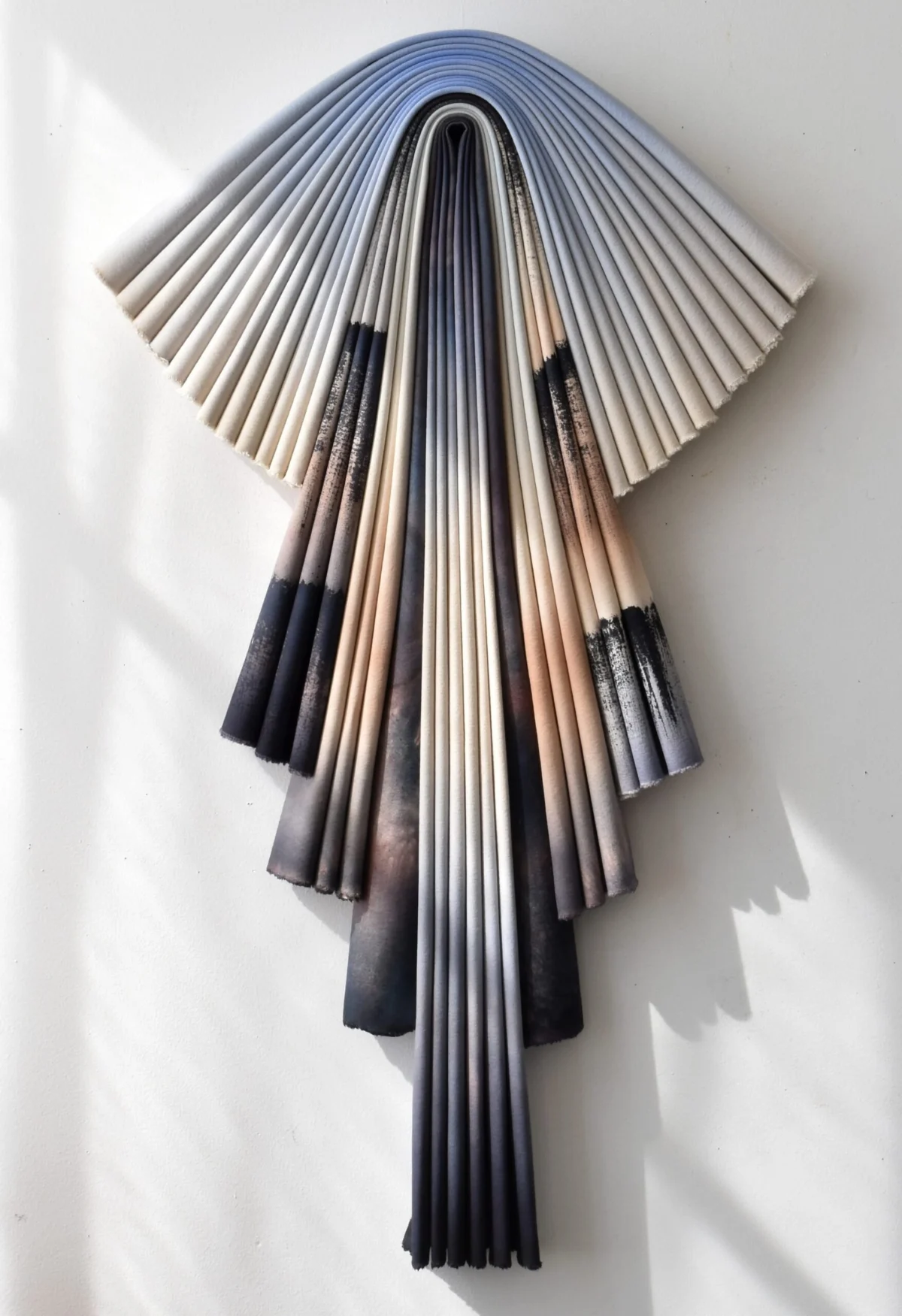
Susan Maddux’s practice is deeply rooted in an upbringing that spans the Pacific, drawing heavily from her Hawaiian childhood and her Japanese ancestry. This dual heritage is not merely a thematic backdrop; it is the structural framework of her work. Her pieces, which often cascade down the wall, echo the silhouette of a kimono or the layered complexity of traditional garments.

To observe a Maddux piece is to engage with a "frozen" kinetic object. Her works are not static paintings; they are sculptural interventions that demand the viewer contemplate the nature of fabric—both as a functional shroud and a medium for artistic expression. She treats canvas with a reverence usually reserved for high-fashion tailoring, folding, creasing, and stacking the material until it takes on a life of its own.
Chronology: A Path to Three-Dimensionality
Maddux’s trajectory into this niche of sculptural painting was not instantaneous. It began with a long-standing career in textile design, a field that provided her with a profound understanding of how fabric reacts to tension, light, and gravity.

- Formative Years: Early in her career, Maddux focused on the two-dimensional possibilities of textile design, exploring color theory and pattern repetition.
- The Transition (2015–2020): During this period, she began to experiment with the "third dimension." She moved away from flat surfaces, seeking to introduce depth by manipulating the substrate itself.
- The Refinement of "Folded" Language (2021–2024): Her work became increasingly focused on the interplay between the interior and exterior of the canvas. By utilizing archival adhesives and structural batting, she began building height into her pieces, moving into the realm of bas-relief sculpture.
- The Global Expansion (2025–Present): Her recent residency at the RONDO art residency in Mexico City marked a significant shift in her methodology. Exposure to new environments and materials has pushed her to incorporate bolder patterns and more diverse tactile elements, resulting in her latest series of works, including Quiver and Haloform.
Supporting Data: Anatomy of a Work
The technical execution of a Maddux sculpture is an arduous, calculated process. Each work is a testament to the tension between "soft" materials—batting, canvas, and adhesive—and "hard" structural integrity.
The Materiality of the Fold
- Substrates: High-quality, heavy-duty cotton canvas, which provides the necessary durability to withstand complex folding without tearing.
- Internal Support: Acrylic batting is strategically layered within the folds to provide volume, giving the sculptures a "plump", organic appearance that mimics the curvature of the human body.
- Adhesion: The use of archival-grade adhesives ensures that while the piece appears fluid and organic, the structural integrity is permanent, preventing the "sculpture" from sagging over time.
- Chromatic Depth: Maddux utilizes acrylic paint, which allows for a high degree of pigment saturation. The layering of color often creates a gradient that shifts as the viewer moves past the piece, mimicking the way light hits folded silk or linen.
The Metaphysics of the "Mantle"
Maddux’s titles provide a secondary layer of narrative. Works like Mantle speak directly to the function of clothing as a protective, warming, and identity-defining layer. Other titles, such as Thrum and Flourish, point to the metaphysical—the hidden vibrations of a life lived through art.

By stacking these folds several feet high, Maddux intentionally mirrors human proportions. When a viewer stands before one of her larger works, they are not looking at a painting hung on a wall; they are engaging with a vertical entity that occupies space in a way that feels bodily. This reference to the human form serves as a subtle reminder that all textiles—from the rags of the poor to the royal robes of the elite—are essentially second skins, designed to conceal and reveal the person beneath.
Official Perspectives and Critical Analysis
In professional artistic circles, Maddux’s work has been cited as a leading example of "Neo-Textile Sculpturalism." Critics have noted that her ability to imbue industrial-feeling materials with a sense of softness is rare.

"Maddux is fundamentally a sculptor who uses paint to describe the architecture of cloth," says one contemporary curator. "Her work captures the moment a piece of fabric hits the floor or is thrown over a chair. She has perfected the art of the ‘repeated gesture.’ By repeating the same fold or crease, she creates a rhythm that is almost musical, transforming a singular piece of canvas into a visual symphony of shadow and light."
Maddux herself has described her process as a form of "sculptural meditation." During her residency at RONDO, she noted that the environment of Mexico City—a hub of textile history and vibrant color—pushed her to explore the "tension between the concealed and the revealed." She is currently testing the limits of her medium, incorporating disparate materials to see how they respond to her signature folding techniques.

Implications for Contemporary Art
The rise of Susan Maddux’s work signals a broader shift in the art market toward tactile, process-heavy art. In an era dominated by digital imagery and flat screens, there is a renewed hunger for physical objects that possess depth, texture, and a tangible history.
Why This Matters:
- Breaking the "Canvas" Barrier: Maddux is actively challenging the hegemony of the flat painting. By forcing the canvas into three dimensions, she asks the art world to reconsider the boundaries of "painting" vs. "sculpture."
- Cultural Synthesis: By merging Hawaiian influences with Japanese textile history, she creates a hybrid visual language that feels both ancient and futuristic.
- The Human Element: In a world of mass production, her emphasis on "repeated gestures" highlights the value of the human hand in the creative process. Each fold is a decision, each crease a physical record of the artist’s engagement with her material.
Conclusion: The Future of the Fold
As Susan Maddux continues to evolve, her studio practice remains a laboratory of material transformation. Her upcoming projects, influenced by her time in Mexico, suggest a move toward even larger, more complex installations that may further blur the lines between the wall and the room.

For those interested in following her progression, her Instagram presence provides a window into the messy, tactile reality of her studio. Whether she is manipulating jute, canvas, or new synthetic fibers, the essence of her work remains constant: a deep, abiding respect for the power of the fold and the transformative potential of the textile.
In the final analysis, Maddux is not just making art; she is creating a dialogue between the history of human attire and the future of abstract form. Her work reminds us that even the simplest piece of cloth, when treated with vision and technical mastery, can become a monument to the human experience.

Quick Reference: Key Works
- "Quiver" (2026): A masterful display of depth, utilizing acrylic batting to create a dynamic, sculptural surface.
- "Mantle" (2026): A direct homage to historical warmth and the sheltering nature of textiles.
- "Flourish" (2026): A larger-scale work that demonstrates the complexity of mixing materials like jute and canvas.
- "Mimosa" (2024): A smaller, intimate piece that highlights the precision of her adhesive techniques.
As we look toward the future, it is clear that Susan Maddux will remain a pivotal figure in the movement to redefine the limits of the canvas, one fold at a time.