In the heart of New York City’s contemporary art scene, few figures bridge the gap between the raw, spray-painted subversion of the 1970s and the refined sensibilities of the modern gallery space quite like Chris “Daze” Ellis. Now, PPOW Gallery invites audiences to step back into the neon-lit, grit-streaked history of the city with Orchid Rain on the Underground. Marking Daze’s third solo exhibition with the institution, the show serves as a sprawling, multisensory retrospective that runs through April 25, 2026. It is a masterful synthesis of the spontaneity that defined the birth of graffiti culture and the disciplined, meticulous hand of a veteran painter who has spent five decades chronicling the evolution of the metropolis.
The Foundation of an Icon: From Subway Tunnels to Studio Walls
Born in Brooklyn in 1962, Daze’s artistic trajectory was forged in the crucible of a city in flux. During his formative years at the High School of Art and Design in the mid-1970s, he found his calling not in the sterile classrooms of traditional art institutions, but in the thunderous, subterranean world of the New York City subway system.
It was an era defined by the bold, pioneering works of graffiti legends like Blade, Lee Quiñones, and PHASE 2. For a young Daze, these names were not just tags on a steel car; they were beacons of a new visual language. By the time he reached his late teens, he had transitioned from the adrenaline-fueled act of subway tagging to a sophisticated studio practice. Yet, the energy of those early days never left him. The exhibition at PPOW stands as a testament to this, illustrating how the "foundational energy" of the 70s and 80s remains the primary engine of his creative spirit.
Chronology of an Artistic Evolution
To understand the weight of Orchid Rain on the Underground, one must view Daze’s career through a chronological lens. The 1980s were a pivotal decade for the artist, characterized by a dual existence. During the day, he refined his craft; at night, he was a fixture in the city’s legendary nightlife scene.
- 1970s – The Underground Era: Inspired by the burgeoning graffiti movement, Daze began his career in the tunnels and on the platforms of the MTA. This period taught him the importance of scale, speed, and the visual impact of color against the drab, industrial backdrop of New York.
- Early 1980s – The Nightlife Nexus: Daze became a regular at institutions that are now etched into New York’s cultural history: the Lit Lounge in the East Village, Danceteria on West 21st Street, and the Mudd Club in Tribeca. These venues were not mere clubs; they were cross-pollination sites where visual artists, musicians, and performers collided. This social experimentation directly informed the depth and texture of his early gallery works.
- The Transition: As the 80s progressed, Daze pivoted toward a formal studio practice. He began to apply the gestural freedom of spray paint to the traditional canvas, drawing influence from early 20th-century urban realists like John Sloan of the Ashcan School and Reginald Marsh of the WPA era.
- Present Day – The Synthesis: Orchid Rain on the Underground represents the pinnacle of this journey. By merging the lyrical abstraction of mid-century masters like Willem de Kooning and Joan Mitchell with the gritty realism of his urban roots, Daze has arrived at a signature style that is both nostalgic and bracingly current.
A Meticulous Practice: The Visual Language of the Exhibition
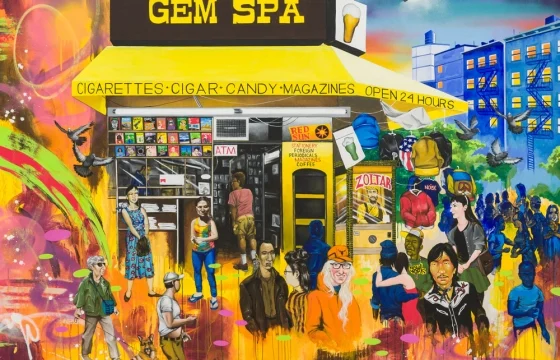
The exhibition is structured to guide the viewer through a narrative of growth and remembrance. In works such as Gem Spa In the 80s (2025), Daze offers a poignant tribute to the iconic St. Mark’s Place newspaper stand and candy store. Once described by poet Allen Ginsberg as a "nerve center" of the city, Gem Spa served as a communal hub for the literary and artistic underground.
Daze’s painting is not merely a landscape; it is a crowded, breathing document of a time and place. Within the composition, sharp-eyed viewers can identify figures of significant cultural importance, including curator Carlo McCormick and artist Martin Wong, mingling in the foreground. It is a masterful use of composition that elevates a local landmark into a historical monument.
Elsewhere, the artist explores the juxtaposition of urban decay and organic beauty. His paintings frequently feature technicolor flowers erupting from piles of concrete rubble. These works—combining tropical flora with local flowers from his current home in upstate New York—serve as a metaphor for the city’s resilience. They represent the optimism that persists amidst inequality and the beauty that continues to emerge from the city’s ever-changing, often destructive, growth.
Immersive Installations: Bringing the Underground Inside
Perhaps the most ambitious aspect of Orchid Rain on the Underground is its rejection of the static gallery experience. The exhibition includes a site-specific mural that physically transports the viewer into the aesthetic of the city streets, eventually leading to a multimedia installation in the final room.
This installation is a time capsule of Daze’s youth. By incorporating authentic subway car seats, a pulsing dance floor, and a curated soundscape of 80s house, disco, and hip-hop, the gallery transforms into an experiential space. This is not just art to be looked at; it is art to be inhabited. It emphasizes the freedom and creative fervor that defined the New York of the 80s, providing a tangible sense of the "vibrant cultural heartbeat" that Daze has spent his life documenting.
Implications for the Contemporary Art World
The significance of Daze’s exhibition extends beyond the walls of PPOW. It speaks to a growing movement within the fine art world to reconcile with the legacies of street art and urban culture. For decades, the high-brow art establishment kept graffiti at arm’s length, viewing it as vandalism rather than a rigorous artistic discipline.
Daze’s body of work challenges this hierarchy. By demonstrating a "thoughtful and meticulous practice" honed over fifty years, he proves that the techniques born from the spray-can are capable of the same nuance and emotional depth as any oil painting.
Furthermore, the exhibition serves as a form of cultural preservation. As New York City continues to undergo rapid gentrification, erasing the landmarks and venues that fostered the creative explosions of the late 20th century, artists like Daze become the primary custodians of memory. By painting Gem Spa, by recreating the club scenes of the Mudd Club, and by memorializing the subway tunnels, Daze is ensuring that the "creative spirit" that persists throughout the city today is not severed from its roots.
Conclusion: An Enduring Legacy
Orchid Rain on the Underground is a rare achievement. It manages to be both a deeply personal autobiography and a broad, sweeping tribute to New York City. It is a celebration of the people—the writers, the poets, the club-goers, and the artists—who transformed the city into a global center for artistic experimentation.
As we look toward 2026 and beyond, Daze’s work serves as a reminder that the "bygone era" of 1970s New York is not truly gone. It is woven into the DNA of the city, surfacing in the colors of a mural, the rhythm of a beat, and the resilience of a flower growing through a crack in the sidewalk. Chris “Daze” Ellis remains the definitive chronicler of this spirit, and his current exhibition at PPOW is an essential encounter for anyone looking to understand the intersection of urban life and the fine art tradition. Through his work, the rain of the underground continues to nourish the creative landscape of the present.