Evan Lee Salim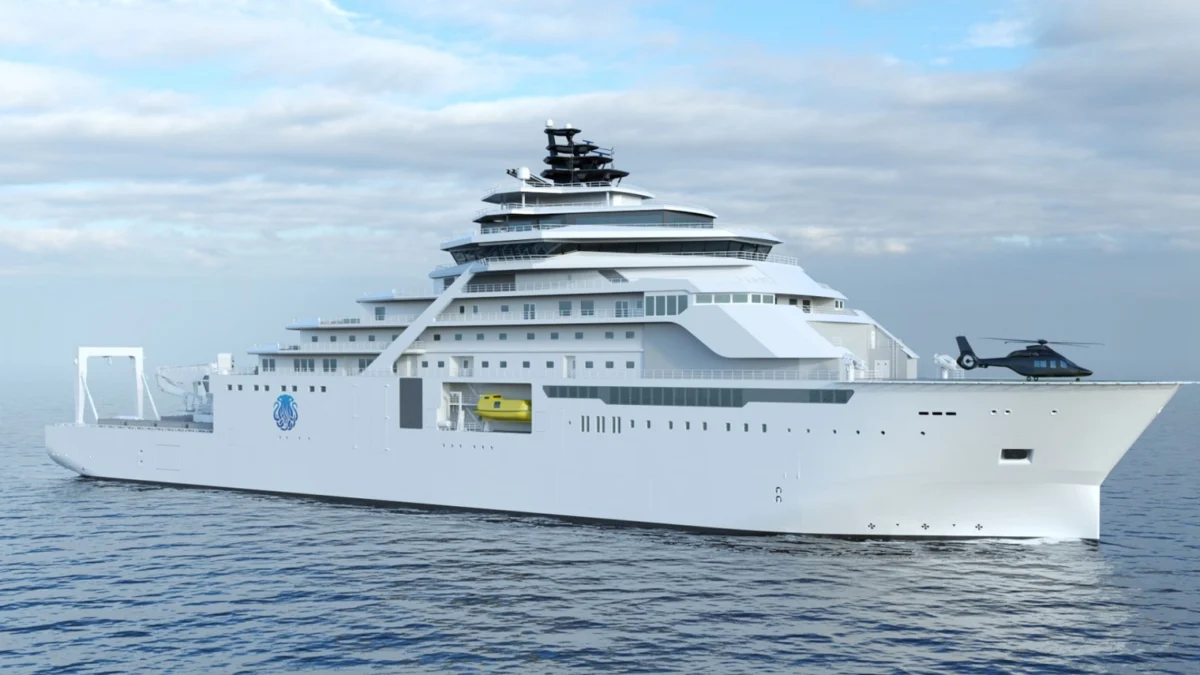
In the world of technology, Gabe Newell is best known for revolutionizing digital distribution and shaping the landscape of modern gaming through Valve Corporation. However, the tech titan has increasingly turned his gaze from the virtual worlds of Half-Life and Steam to the very real, largely uncharted depths of Earth’s oceans. In a move that signals one of the most significant private investments in marine science in history, Newell—through his marine research organization, Inkfish—has commissioned the construction of the RV11000, an $815 million scientific behemoth designed to push the boundaries of deep-sea exploration.
A Massive Undertaking: The Specifications of the RV11000
The contract, finalized in May 2026 with the renowned Norwegian shipbuilder VARD, represents the largest order in the company’s history. The RV11000 is not merely a research ship; it is a mobile, self-sustaining scientific hub designed to operate in the most hostile environments on the planet.
Measuring an imposing 162 meters (531 feet) in length and 28 meters (92 feet) in width, the vessel is a colossal engineering feat. Its primary mission is to facilitate exploration at depths of up to 11,000 meters (36,089 feet), effectively allowing researchers to reach the deepest points of the Mariana Trench and beyond.
The ship’s design reflects a shift toward total autonomy in scientific research. It will feature a dedicated launch system for advanced submarines, integrated hangars for two crewed submersibles, and a specialized 40-meter deployment system for seabed sampling. Furthermore, the vessel is equipped with heavy-duty lifting hardware capable of operating at depths of up to 15,000 meters, far exceeding the depth of the ocean floor, to ensure the recovery of delicate biological and geological specimens.
Chronology: From Digital Dreams to Deep-Sea Discovery
Newell’s transition into marine research has been a deliberate, multi-year progression. While the gaming community often focuses on his role at Valve, the Inkfish initiative has been quietly gathering momentum.
- Early Foundations: Newell’s interest in high-end marine technology began with investments in submersibles and smaller research platforms, signaling an early desire to explore the "blue frontier."
- The RV6000 Milestone: In 2024, news broke that Newell had commissioned the RV6000, a $300 million research vessel. Designed as a proof-of-concept for his long-term vision, the RV6000 is currently slated for a 2028 launch, serving as a precursor to the larger fleet Inkfish aims to operate.
- May 2026 – The VARD Contract: The announcement of the RV11000 contract with VARD marked a significant escalation. It signaled that Newell was no longer merely a participant in marine research but a primary architect of its future infrastructure.
- 2030 – The Horizon: With a delivery date scheduled for the first quarter of 2030, the scientific community is already anticipating the data-gathering potential of the vessel. The gap between now and 2030 is viewed as a period of intensive preparation, with Inkfish refining the software and sensory suites that will power the ship’s discoveries.
The Technological Edge: Innovation Beneath the Surface
What sets the RV11000 apart from government-funded research vessels is its integration of next-generation technology. Central to its design is what VARD has confirmed to be the largest battery installation ever fitted to a ship of its class.
This massive energy storage system serves two critical purposes. First, it allows the RV11000 to operate in "silent mode" for up to 12 hours. In the context of marine biology, noise pollution from traditional diesel engines can disrupt the behavior of deep-sea creatures and interfere with sensitive acoustic sensors. By eliminating engine vibration and noise for extended periods, researchers can observe ecosystems in their natural state.
Second, the ship incorporates four active stabilizers designed to counteract the erratic swells of the open ocean. For a laboratory environment, stability is paramount; the ability to conduct precise chemical analysis or microscopic examination while at sea—without the interference of wave motion—is a capability rarely seen in vessels of this size.
The Human Element: Life Aboard the RV11000
While the ship is a masterpiece of robotics and engineering, it is also a floating home for the minds tasked with unraveling the ocean’s mysteries. The vessel is designed to house 130 scientists and crew members, with a focus on long-duration expeditions.
Recognizing that top-tier researchers require comfort to perform at their peak, Inkfish has mandated that the majority of these personnel be provided with private cabins. The ship also includes dedicated laboratories, high-tech workshops, and office spaces that simulate a university-grade research environment. This approach is designed to attract the world’s leading oceanographers, geologists, and marine biologists to the Inkfish banner, effectively creating a private-sector hub for high-stakes scientific exploration.
Official Responses and Scientific Implications
The sentiment from the Inkfish leadership team reflects a deep commitment to the vessel’s purpose. Stu Buckle, the organization’s lead for new builds and special projects, emphasized that the RV11000 is not merely an upgrade, but a paradigm shift.
"This next-generation vessel builds on earlier designs to deliver significantly greater capability, flexibility, and reach to enable science," Buckle stated following the contract announcement. "RV11000 will be a custom-built platform that pushes the boundaries on what is possible for marine research, strengthening our ability to support scientists and unlock new understanding of the ocean."
From an academic perspective, the implications are profound. With the vast majority of the ocean floor still unmapped and largely unexplored, the RV11000 acts as a force multiplier for global scientific efforts. By providing a platform that can deploy ROVs and human-crewed submersibles in tandem, Newell is essentially donating the "heavy lifting" infrastructure required to tackle questions about climate change, biodiversity, and the geological history of the Earth—questions that were previously hindered by a lack of accessible deep-sea technology.
The "Dave the Diver" Era: A Cultural Shift
The media has frequently drawn parallels between Newell’s oceanic ambitions and the popular indie game Dave the Diver, where players explore, map, and collect samples from the deep. While the term is used in jest, it captures the public’s fascination with Newell’s pivot.
However, Newell’s life remains as enigmatic as his projects. When he isn’t overseeing the construction of world-class research vessels, he has reportedly retreated to a $71 million Florida estate. The property, featuring a private tunnel to the beach, serves as a grounded contrast to the high-seas lifestyle he is currently facilitating for the world’s top oceanographers.
Conclusion: Why the Deep Ocean Matters
As we look toward 2030, the RV11000 stands as a testament to the power of private capital in the service of public knowledge. While space exploration often dominates the headlines, the mysteries of our own planet remain largely sequestered beneath miles of saltwater.
By investing $815 million into the RV11000, Gabe Newell is effectively betting that the next great frontier is not on Mars or the Moon, but in the trenches of the Pacific. If the project succeeds, the data harvested by this vessel could redefine our understanding of marine biology and environmental science, proving that sometimes, the most ambitious discoveries are found by looking down, not up. The era of private, high-capability deep-sea research has arrived, and if the RV11000 is any indication, the future of exploration is just beginning to surface.


 Azzam Bilal Chamdy
 Reynand Wu