In the sprawling, often cacophonous world of contemporary street art, few voices carry the distinctive, haunting resonance of the London-based artist known as Phlegm. His work is a masterclass in visual storytelling, populated by surreal hybrid figures, uncanny machinery, and impossible architectures that seem to pulse with a life of their own. For years, Phlegm’s murals have transformed urban landscapes into portals of mystery, yet the artist himself remains an enigmatic figure, preferring the ambiguity of his work to speak for his intentions.
"I think a lot about the barriers between people understanding each other, and I think I enjoy making artwork that floats in some grey area," Phlegm reflects. This commitment to the "grey area" has defined his career, yet in recent years, his artistic trajectory has undergone a profound shift—a transition from the colossal, public-facing mural to the intimate, meditative world of copper engraving.
The Main Facts: A Shift in Scale and Substance
The most significant development in Phlegm’s recent practice is his deliberate departure from the monumental mural projects that once defined his international reputation. In a move that surprised many of his followers, the artist spent the better part of the last several years stepping back from the scaffolding and the spray can to embrace the exacting discipline of printmaking.

This is not merely a change of medium; it is a fundamental shift in philosophy. While a mural is a public dialogue—an interaction with architecture and the urban crowd—engraving is a solitary, monastic act. It requires a level of focus that is diametrically opposed to the broad, sweeping motions of large-scale painting. Phlegm has traded the open air for the workbench, finding a new, quiet power in the precision of the burin against copper.
Chronology: A Journey from the Concrete to the Copperplate
To understand the current state of Phlegm’s art, one must look at the timeline of his evolution, which began in the world of independent comics and street murals.
The Muralist Years
For over a decade, Phlegm was a titan of the international mural scene. His works, often spanning several stories, were characterized by their monochromatic, high-contrast style. These murals were not merely decorative; they were elaborate, puzzle-like narratives that drew heavily on folklore, prehistory, and the industrial aesthetic of the Victorian era.

The "Little Masters" Influence
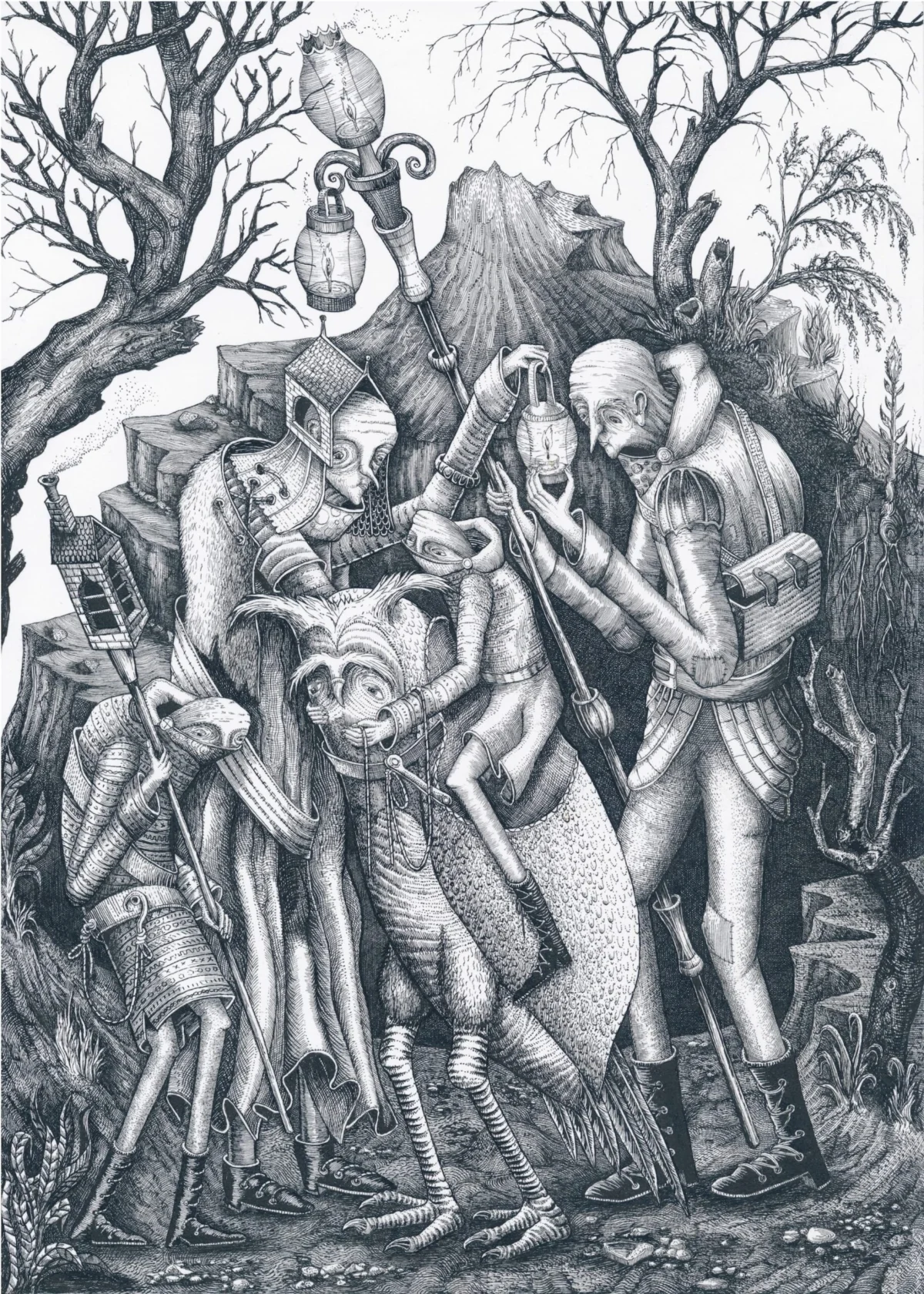
The shift began with a fascination for the Northern Renaissance. Phlegm found himself drawn to the "Little Masters," a group of 16th-century German printmakers known for their breathtakingly intricate works, often crafted on surfaces no larger than a postage stamp. This obsession led to a period of withdrawal. "I pretty much stopped painting murals," he admits, noting that he spent his time in "monastic reverence" to these historical techniques.
The Dürer Project
The culmination of this period was a deep-dive, completist project centered on Albrecht Dürer’s 1513 masterpiece, Knight, Death, and the Devil. Phlegm’s dedication to this project bordered on the obsessive. He collected antique prints, studied the original line work under microscopes, and spent two years meticulously crafting his own version. He did not simply copy the work; he replaced the elements with his own visual vocabulary while maintaining the structural integrity and technical rigor of Dürer’s original composition.
The Return to the Wall
Recently, the artist has begun to re-emerge into the world of mural-making. However, the experience of the last few years has permanently altered his approach. He now views the wall through the lens of the engraver, bringing a new, fluid confidence to his large-scale work that draws upon his deepened understanding of light, shadow, and narrative economy.

Supporting Data: The Anatomy of a Storyteller
What drives this artist to oscillate between such wildly different scales? The answer lies in his approach to narrative. Phlegm describes his work as "broken stories." He compares his creative process to the field of archaeology.
"With archaeology, you can piece together tangible parts of a story and get glimpses of moments from the past, but it’s often broken or without context," he explains. "I’m very drawn to this feeling."
This data-driven, methodical approach to storytelling is evident in his preparation. Before he touches a wall, he often writes out a comprehensive, comic-book-style script, complete with character arcs and detailed histories. Yet, when he finally paints the mural, he intentionally leaves out the vast majority of that narrative. By providing the audience with only a fragment of the tale, he forces the viewer to engage, to speculate, and to fill in the gaps with their own imagination.

Official Perspectives: The Philosophy of Honesty
In an era increasingly dominated by the rapid, often derivative output of generative AI and the constant performative pressure of social media, Phlegm’s emphasis on "honesty" acts as a counter-cultural manifesto.
When he speaks of honesty, he is referring to a specific kind of sincerity—a refusal to pander to the "must-look-good" aesthetic that plagues much of modern street art. "It helps me make something that feels authentic and stops me approaching the space with a mindset tainted by trying to make something look good," he says. "Looking good tends to come secondary to the storytelling."
This philosophy is a critique of the modern art economy, which often prioritizes visual "pop" for the sake of social media engagement. For Phlegm, the authenticity of the process—the hours of engraving, the depth of the research, the deliberate choice to omit context—is far more important than the immediate, surface-level gratification of a high-impact mural.

Implications: The Future of the Mural
What does this synthesis of ancient technique and contemporary street art imply for the future of the genre?
- The Professionalization of Craft: Phlegm’s return to the wall with the mindset of an engraver suggests a shift toward higher technical standards in street art. We are likely to see a decline in "filler" murals and an increase in works that demand a more sophisticated, prolonged engagement from the viewer.
- The Narrative Turn: By utilizing techniques of narrative fragmentation, Phlegm is setting a new precedent for visual storytelling. His work suggests that a mural is not just a picture, but a text to be read, albeit one that is intentionally incomplete.
- The Rejection of Artificiality: In a world where AI can produce a polished image in seconds, Phlegm’s work serves as a reminder of the human cost of art. His "monastic" devotion to his craft is a profound statement against the dehumanization of the creative process.
Conclusion: A Living Mystery
Phlegm remains an artist who occupies the fringes of both the street and the gallery. Whether he is etching a miniature copperplate or covering a six-story building in London with sprawling, dream-like figures, his work remains inherently the same: a challenge to the viewer. He provides the bones of a story and asks us to provide the flesh.
As he continues to balance his mural work with his printmaking, Phlegm’s influence is only growing. He has successfully bridged the gap between the Renaissance masters and the modern urban environment, proving that while techniques may evolve, the human need for mystery, wonder, and the "broken story" remains constant.

For those wishing to follow his journey, Phlegm continues to share his progress and reflections via his Instagram and his insightful Substack, where he chronicles the ongoing, often silent battle between the artist’s intent and the viewer’s perception. In the end, perhaps it is best that we never fully understand the meaning of his work—for as Phlegm suggests, the beauty lies not in the answer, but in the riddle itself.