
 Neng Nana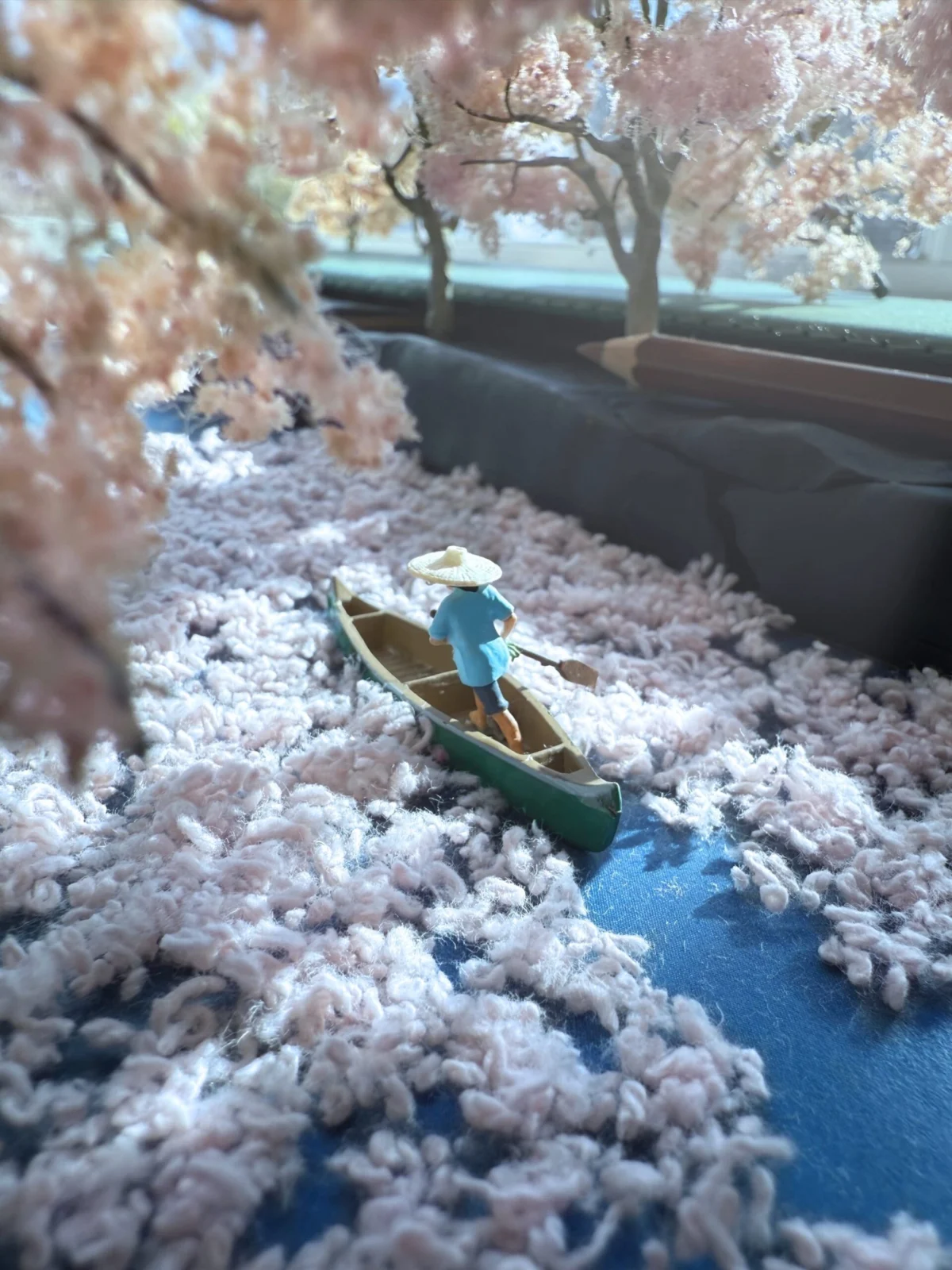
At first glance, the scenes appear to be cinematic stills from a mid-century drama: a traveler clutching a suitcase boards an ocean liner, a woman stands patiently on a city street corner awaiting her tram, and a gentleman in a fedora ascends a grand, historic staircase in an unnamed European metropolis. But upon closer inspection, the facade of reality begins to dissolve. The roofs of the city are revealed to be discarded milk cartons; the tram is framed by the spines of books standing on end; and looming in the misty, distant horizon, a monolithic ceramic coffee mug dwarfs the entire landscape.
This is the whimsical, yet deeply poignant, world of Derrick Lin. Since 2013, the artist has been meticulously crafting miniature dioramas on his desktop, turning the detritus of everyday life—cardboard, stationery, and household objects—into stages for human emotion. Through his lens, the banal is elevated to the sublime, forcing the viewer to confront the scale of their own experiences against the backdrop of an oversized world.

The Genesis of Scale: A Chronology of Discovery
The trajectory of Derrick Lin’s artistic career is a testament to the power of finding meaning in the margins.
2013: The Humble Beginnings
Lin’s foray into the world of miniatures began not as a grand artistic statement, but as an exercise in mindfulness. Working in a fast-paced professional environment, he began using his desk as a canvas. He started by placing hand-painted, minuscule figures into scenarios constructed from common office supplies. The initial goal was simple: to inject a sense of play into the rigidity of his workspace.

2014–2018: Defining the Aesthetic
As Lin’s social media presence grew, so did the complexity of his dioramas. He transitioned from simple desk pranks to narrative-driven scenes that required sophisticated lighting techniques. During this period, he solidified his signature style: the "juxtaposition of the gargantuan." By utilizing giant writing utensils, towering mugs, and massive fruit as structural elements of his cities, he established a visual language that highlighted the contrast between the fleeting nature of the miniature figures and the permanence of the objects we use every day.
2019–Present: Exploring the Human Condition
In recent years, Lin’s work has pivoted toward more introspective themes. No longer content with mere visual puns, his dioramas have become vessels for exploring complex emotional landscapes. The scenes now frequently depict figures in states of contemplation, grief, or anticipation, utilizing shadows and cinematic framing to evoke a sense of profound loneliness and wonder.

The Mechanics of Miniature Storytelling: Supporting Data
What makes Lin’s work resonate with a global audience is not just his technical skill, but his ability to synthesize universal experiences into a single, static image. His process is a masterclass in resourcefulness:
- Material Economy: Lin relies almost exclusively on "found objects." A stack of books becomes a skyscraper; a pencil becomes a structural column; a milk carton becomes a residential block. This reliance on the familiar is intentional, acting as a bridge between the viewer’s real world and the artist’s constructed one.
- The Power of Lighting: Lin treats his tabletop like a film set. By manipulating natural light or using small LED sources, he creates dramatic high-contrast images that mimic the cinematography of classic noir or mid-century cinema.
- The "Turned-Away" Subject: A consistent motif in Lin’s photography is the positioning of his figures. Most characters are captured with their backs turned to the camera, looking into the distance. This deliberate choice invites the viewer to step into the figure’s shoes, fostering a sense of shared empathy rather than objective observation.
The Philosophy of the Small: Official Reflections
In rare interviews, Lin has offered insight into the psychological underpinnings of his work. He views his dioramas as a form of externalized internal monologue.

"I believe the thoughts and feelings we keep to ourselves are what truly shape us," Lin explains. "We often walk through the world feeling small, overwhelmed by the ‘giant’ problems that loom over our daily existence. By using miniature figures as a manifestation of those quiet thoughts and emotions I hesitate to express, I can magnify and spotlight those feelings. When you see a tiny person standing in front of a giant coffee mug, you don’t just see a model; you see a representation of how it feels to be a human being navigating an overwhelming, complex world."
Lin’s work challenges the viewer to reconsider the "scale" of their own problems. By shrinking the world, he actually manages to broaden its emotional scope. His dioramas serve as a mirror, reflecting the quiet, often unacknowledged struggle of the individual living within an environment that is frequently indifferent to them.

Implications for Contemporary Art and Digital Media
The success of Derrick Lin’s project carries several implications for how we consume and appreciate art in the digital age.
The Democratization of Art
Lin’s work serves as a reminder that artistic expression is not reserved for those with access to expensive materials or galleries. By utilizing items found in any home or office, he democratizes the creative process, encouraging others to find beauty in the mundane. His work proves that the most compelling stories are often told through the lens of the objects we use every day.

The Rise of "Slow Content"
In an era of rapid-fire, high-stimulation social media, Lin’s work stands in stark contrast. It requires a slow, deliberate gaze. His followers do not just "scroll past" his images; they pause to examine the construction, to identify the repurposed objects, and to interpret the mood of the scene. This "slow art" movement within digital platforms suggests a growing appetite for substance over speed.
Environmental Consciousness
Though unintentional, there is an inherent environmental message in Lin’s dioramas. By repurposing trash—milk cartons, old boxes, scraps of paper—into elaborate, beautiful cities, he prompts a subconscious re-evaluation of waste. His work subtly asks the viewer: What else could this be? It encourages a mindset of reuse and creative repurposing, even if the primary intent is narrative rather than ecological.

Conclusion: The Quietude of the Miniature
As we look toward the future of visual storytelling, artists like Derrick Lin offer a vital perspective. They remind us that there is profound power in the quiet, the small, and the overlooked.
Whether he is capturing the solitude of a man on an airport bench or the wanderlust of a traveler boarding a ship, Lin’s dioramas serve as a sanctuary for the viewer. They are small worlds, yes, but they contain vast, sprawling human truths. In his ability to turn a pencil into a skyscraper and a coffee mug into a monolith, Lin provides us with a unique vantage point: one where we can look at our own lives from the outside in, and perhaps, find a little more peace in the process.

For those who wish to follow his ongoing journey, Lin continues to document his miniature world on his Instagram account, where each new post serves as another chapter in an ever-expanding, silent, and deeply resonant story of what it means to be human in a world that is always just a little bit too big for us.


 Dwi Wanna
 Lina Irawan




