

Main Facts: A Geopolitical Gaffe
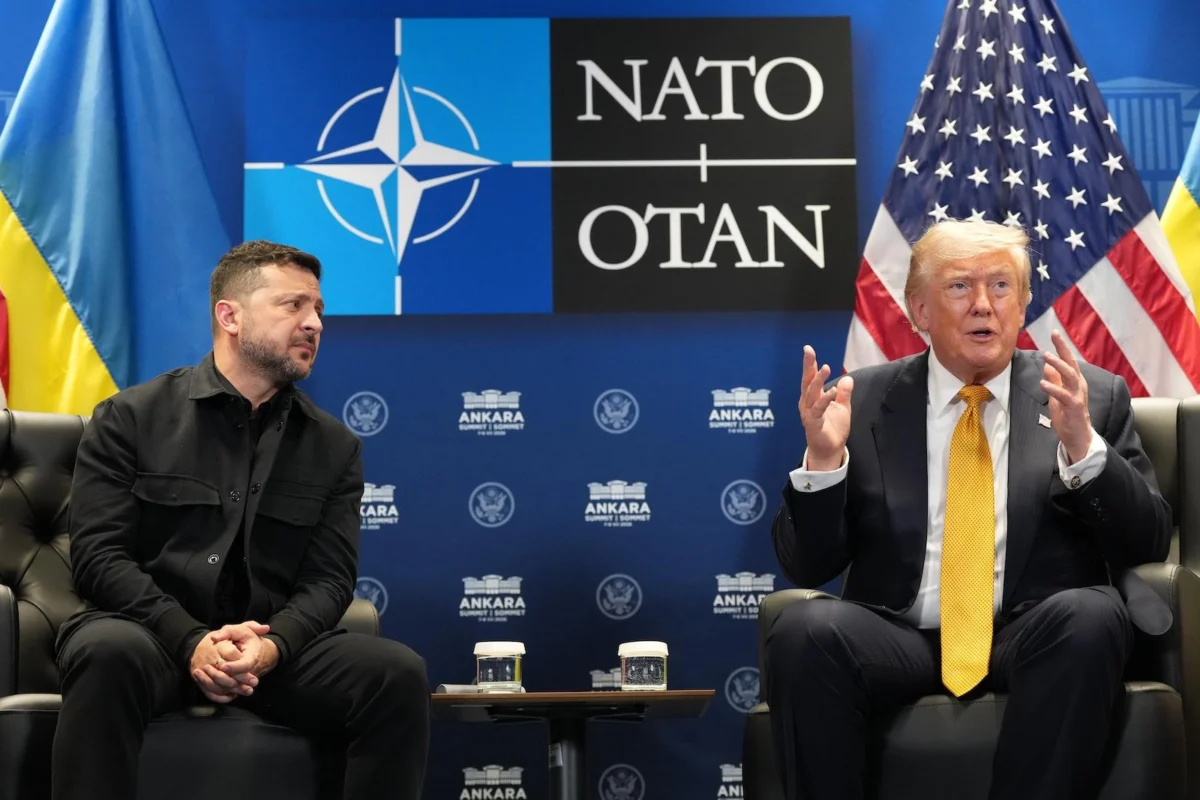
In a moment that has reverberated through international diplomatic circles, U.S. President Donald Trump appeared to conflate two vastly different nations during a high-stakes summit. While meeting with Ukrainian President Volodymyr Zelenskyy in Ankara, Turkey, on the sidelines of a NATO gathering, President Trump made a statement that immediately drew alarm for its factual inaccuracy.
Addressing the media and delegates, the President stated, "We had 111 missiles shot by the Islamic Republic of Japan," claiming these projectiles were targeted at the U.S. aircraft carrier USS Abraham Lincoln over the course of a single hour. He further asserted that all missiles were successfully intercepted. The statement, which conflated the democratic, pacifist nation of Japan with the theocratic Islamic Republic of Iran, represents a significant departure from standard geopolitical nomenclature.
The gravity of the statement lies not merely in the linguistic error, but in the potential misinterpretation of current military tensions. By misidentifying a core Pacific ally as a hostile state in the Middle East, the President created a brief but intense period of confusion among international observers and intelligence analysts.
Chronology of the Incident
The incident unfolded on a Wednesday afternoon during a bilateral meeting between President Trump and President Zelenskyy. The setting was the Turkish capital, Ankara, where leaders had gathered for a NATO summit intended to reinforce collective security commitments.
- 14:00 Local Time: President Trump and President Zelenskyy entered the briefing room to discuss ongoing military cooperation and the regional security architecture of Eastern Europe.
- 14:15 Local Time: During a discussion regarding U.S. naval posture and defense readiness, President Trump pivoted to a narrative regarding recent threats to U.S. naval assets. It was at this juncture that he uttered the phrase "the Islamic Republic of Japan."
- 14:20 Local Time: As the quote was transcribed and distributed by wire services, including Kyodo News, international newsrooms scrambled to verify the claim. It became immediately apparent that no such attack by Japan had occurred, and that the President had mistakenly attributed Iranian military activities to a major U.S. ally.
- 15:00 Local Time: Social media platforms and international news outlets began fact-checking the statement in real-time, highlighting the stark difference between the geopolitical profiles of Japan and Iran.
- 17:00 Local Time: Diplomatic cables from Tokyo to Washington reportedly began to circulate, seeking clarification on whether the statement reflected a shift in U.S. intelligence or was, as widely assumed, a verbal error.
Supporting Data: The Strategic Reality
To understand the magnitude of the confusion, one must examine the vastly different roles Japan and Iran play in the global security environment.
The U.S.-Japan Security Alliance
Japan and the United States share one of the most enduring security partnerships in the world. Under the Treaty of Mutual Cooperation and Security, the two nations have integrated their military logistics, intelligence gathering, and defense technologies. Japan serves as the primary base for U.S. power projection in the Indo-Pacific, hosting thousands of U.S. troops at facilities such as Yokosuka and Kadena.
In recent years, this alliance has deepened to address the rising assertiveness of China and the nuclear ambitions of North Korea. Japanese Self-Defense Forces (JSDF) frequently conduct joint naval exercises with the U.S. Navy, including carrier strike groups like the one led by the USS Abraham Lincoln. The notion of Japan firing missiles at a U.S. carrier is considered a geopolitical impossibility within the current framework of international relations.
The Iran Context
The confusion likely stemmed from ongoing tensions in the Persian Gulf. The USS Abraham Lincoln has, at various points in its deployment history, operated in the Middle East, where it has faced regional threats from Iranian proxy forces and the Iranian military. The mention of "111 missiles" and an "hour-long engagement" bears a striking resemblance to the alarmist rhetoric often utilized when describing the volatility of the Strait of Hormuz. By merging the name of a Pacific ally with the military context of the Middle East, the President inadvertently created a "phantom conflict" that existed only in the spoken record.
Official Responses and Diplomatic Fallout
The immediate aftermath of the statement was characterized by a mixture of diplomatic silence and behind-the-scenes damage control.
The Tokyo Perspective
Officials in Tokyo were reportedly caught off guard. In a carefully worded statement issued by the Japanese Foreign Ministry, spokespersons emphasized the "unwavering strength" of the U.S.-Japan alliance, choosing to interpret the comment as a "misstatement" rather than a policy shift. Behind closed doors, however, Japanese diplomats expressed concern that such rhetoric, even if accidental, undermines the stability of the Indo-Pacific alliance. The Japanese government has worked for decades to maintain amicable ties with all parties, including Iran, and being publicly linked to an act of aggression against the United States was viewed as highly damaging to their international reputation.
The U.S. Administration’s Stance
The White House press office did not immediately issue a formal correction, a common tactic when an administration attempts to minimize the impact of a verbal gaffe. However, anonymous officials speaking on the condition of anonymity suggested that the President had simply conflated briefings regarding Middle Eastern naval defense with his discussions on Pacific security. Critics, however, argue that the error reflects a lack of focus on the nuances of international relations, which could lead to dangerous miscalculations by adversaries who monitor U.S. presidential statements for signs of strategic intent.
Implications for Global Security
The implications of this incident are twofold: the immediate impact on bilateral relations and the long-term questions regarding presidential communication in an era of rapid information dissemination.
Eroding Trust in Diplomatic Accuracy
International relations rely on the predictability of the world’s most powerful actors. When the U.S. President misidentifies a key ally as a hostile state, it introduces a level of uncertainty that foreign governments find difficult to navigate. If an ally like Japan can be mistakenly accused of a naval attack, other nations may begin to wonder if U.S. intelligence briefings or policy decisions are based on similar misidentifications.
The "Normalization" of Misinformation
In the digital age, a statement made by a world leader at a NATO summit is consumed globally in seconds. Even if the statement is factually incorrect, it enters the information ecosystem, where it can be exploited by state-run media outlets in other countries. For instance, adversaries of the U.S. could potentially use this slip-up to suggest that the U.S. does not distinguish between its friends and its enemies, or to cast doubt on the coherence of American foreign policy.
The Need for Rigorous Briefing Protocols
Experts in political communication suggest that such incidents highlight the necessity for more rigorous briefing protocols before press conferences. While high-level summits are notoriously high-pressure environments, the distinction between the "Islamic Republic of Japan"—a phrase that does not exist—and the "Islamic Republic of Iran" is a fundamental geopolitical boundary. The failure to maintain this boundary in public discourse serves as a case study in the risks of extemporaneous speaking in the arena of global diplomacy.
Conclusion
The episode in Ankara serves as a stark reminder of the fragile nature of international diplomacy. While the incident was almost certainly a case of verbal confusion, its impact was magnified by the stature of the speaker and the high-stakes environment of a NATO summit. As the global community continues to grapple with shifting power dynamics, the ability of world leaders to communicate with precision remains a vital component of national security. Whether this gaffe will be remembered as a mere footnote or a symbol of growing diplomatic strain remains to be seen, but it has undoubtedly reinforced the importance of factual accuracy in the halls of power.











