


For the average observer of contemporary Japanese culture, the word "maid" conjures a vivid, neon-soaked mental image: the bustling streets of Akihabara, frilly Victorian-inspired pinafores, heart-shaped omelet garnishes, and the high-pitched, melodic "Welcome home, Master!" that greets visitors at themed cafés.
So, when the Japan Butler Association recently announced the launch of what it bills as the nation’s first systematic "maid school," the internet’s collective imagination immediately pivoted to cosplay, performance art, and otaku culture.
Spoiler alert: it has absolutely nothing to do with any of those things.
The Japan Maid School is a stark, sober endeavor aimed at professionalizing domestic service for the ultra-wealthy. By stripping away the pop-culture veneer that has dominated the term for the last thirty years, the association is attempting to reclaim the historical definition of a "maid"—a skilled, discreet, and highly trained professional essential to the maintenance of an elite private household.
The Architecture of the Program: A Curriculum for the Elite
The Japan Maid School is not a hobbyist workshop; it is an intensive vocational program operated by the Japan Butler Association, an organization already established as the gold standard for training professional butlers for high-net-worth individuals.
The inaugural cohort is scheduled to begin training on July 28, running through September 3. The program is structured as a 12-session online course conducted via Zoom, with classes held every Tuesday and Thursday evening (9:00 to 10:30 pm JST). Given the high-touch, exclusive nature of the training, enrollment is strictly capped at 20 students, admitted on a first-come, first-served basis.
The barrier to entry is both logistical and financial. Tuition for the full course is set at ¥290,000 (approximately USD $1,790 before tax), which breaks down to roughly $150 per session. While the price point reflects the specialized nature of the instruction, the school maintains an egalitarian enrollment policy: any individual aged 20 or older is eligible to apply, regardless of gender or previous professional experience.
Seven Pillars of Domestic Excellence
The curriculum is rigorous, designed to produce "authentic" maids capable of navigating the complex social and physical environments of luxury residences. The training covers seven primary domains:
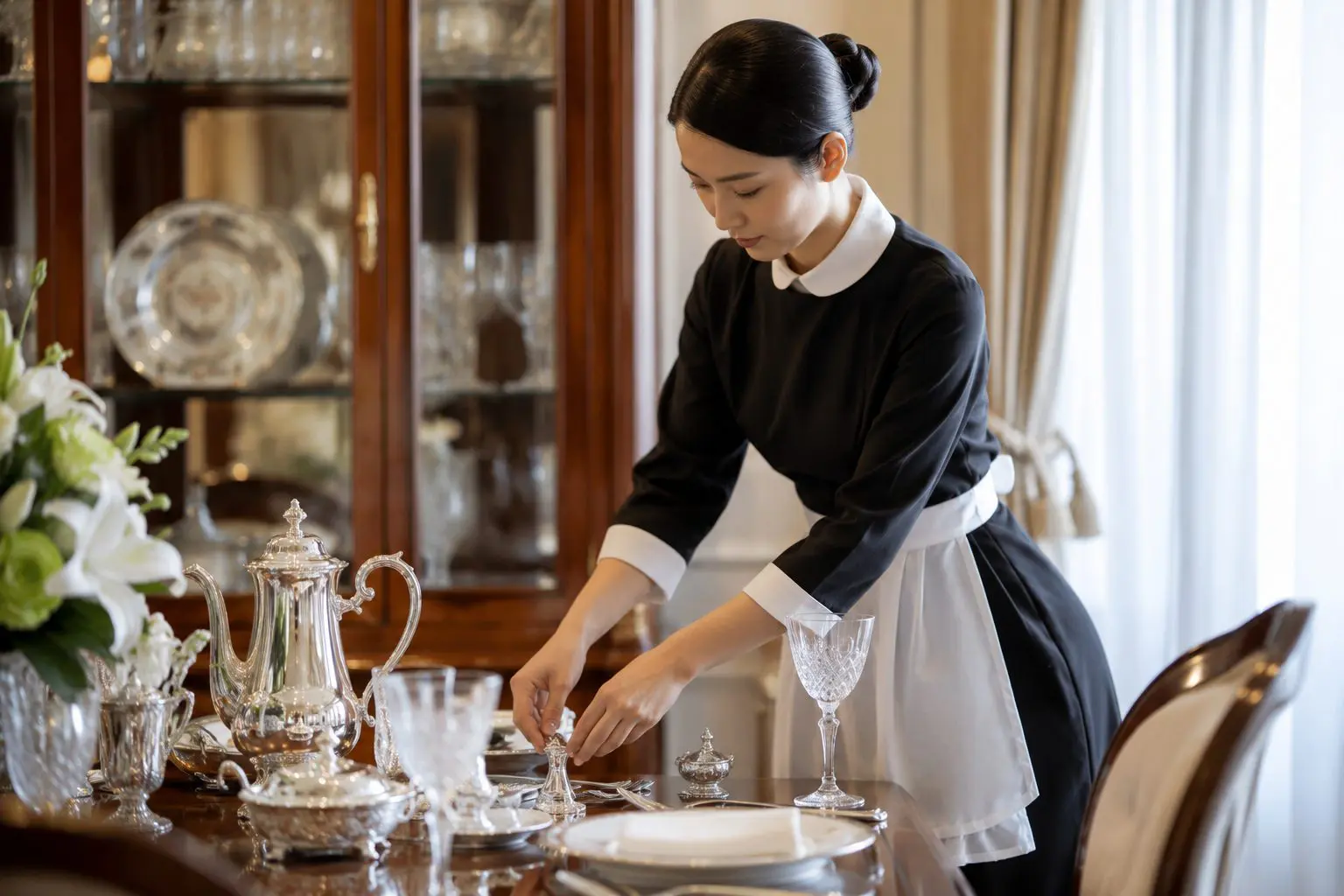
- Advanced Housekeeping: Master-level cleaning and maintenance for luxury assets, including delicate surfaces and fine art.
- Wardrobe and Textile Care: Specialized knowledge in the maintenance of high-end fabrics, luxury garments, and personal attire.
- Table-Service Coordination: Mastery of formal dining protocols and silver service.
- Confidentiality and Professional Ethics: The cornerstone of the profession—understanding the absolute necessity of discretion in a VIP environment.
- VIP Client Management: Navigating the specific social expectations and psychological nuances of serving high-net-worth households.
- Inter-Departmental Coordination: How to work seamlessly alongside butlers, house managers, and concierges.
- Emergency Response: Protocols for handling domestic crises with composure and speed.
Upon completion, students are eligible for one of three professional certification levels: Associate Maid, Certified Maid, or Senior Maid.
A Historical Context: From ‘Jochū’ to Pop Icon
To understand why the Japan Maid School is fighting such a strong cultural tide, one must look at the evolution of domestic labor in Japan.
Prior to World War II, and continuing into the early postwar era, live-in domestic workers were a standard fixture in affluent Japanese homes. These women, then referred to as jochū and later otetsudai-san (literally "the helper"), were the backbone of the household. They managed the complex machinery of family life, from cooking and cleaning to the intricate rituals of Japanese home management.
As Japan’s economy shifted during the late 20th century, the rise of the middle class and the move toward smaller, more compact urban living made full-time, live-in staff a rarity, reserved almost exclusively for the super-wealthy.
As the domestic reality of the "maid" faded from public view, the vacuum was filled by the rise of Akihabara’s "maid café" phenomenon in the late 1990s. This cultural shift transformed the maid into a fantasy figure—a character in a play rather than a professional worker. For younger generations, this performance-based aesthetic became the only definition of the word "maid" they knew.
The Japan Maid School is effectively attempting a linguistic and professional restoration project. By providing formal certification, they are trying to strip the "moe" (cute/endearing) connotation from the title and return it to its origins: the silent, invisible, and highly skilled custodian of a private residence.
The Digital Reaction: Skepticism and Curiosity
When the news hit social media, specifically on platforms like X, the reaction was a mixture of amusement and genuine bewilderment. The most common refrain was one of total surprise: "Wait, it’s not about Akihabara?"
However, beneath the initial humor, there was a wave of critical scrutiny. Many online observers raised pertinent questions about the efficacy of the school’s delivery model.

"Can you really teach high-level domestic service via Zoom?" asked one user, highlighting a central tension in the school’s design. While the Japan Butler Association argues that the program combines digital lectures with role-playing exercises and one-on-one mentorship, skeptics argue that the tactile, physical nature of housekeeping—learning how to polish silver, handle delicate textiles, or manage the flow of a dining room—cannot be mastered through a computer screen.
Furthermore, economic analysts and skeptics have questioned the actual market demand. Japan is already home to a robust sector of housekeeping and domestic-help agencies. Some observers wondered how this new "certified maid" differs from established professional cleaners. The Association’s answer lies in the "luxury" differentiation: they are not aiming to staff standard middle-class homes, but to provide a tier of service that is currently underserved in the Japanese market—the ultra-high-net-worth bracket.
Implications: The Rise of the Luxury Service Economy
The Japan Maid School is not acting in a vacuum. It is a strategic response to the burgeoning luxury-service market in Japan. According to recent market analysis, there is a growing segment of ultra-wealthy individuals in Japan—those with assets exceeding ¥5 billion (approx. USD $31 million) and annual incomes upwards of ¥500 million (USD $3 million)—who require a level of personalized service that standard housekeeping agencies cannot provide.
The Japan Butler Association holds a trump card in this venture: its existing network. The association has spent years cultivating relationships with celebrities and VIPs, both domestic and international. For the students of the Japan Maid School, the value of the tuition is arguably less about the syllabus and more about the pipeline. The school is essentially offering a career placement service into an elite ecosystem that is notoriously difficult to penetrate.
A New Professional Class?
By creating a formal, tiered system of certification, the association is attempting to formalize a career path that has, in Japan, lacked a clear trajectory. If the school succeeds in its mission, it could lead to the establishment of a "prestige" tier of domestic labor in Japan—a role that demands high-level soft skills, an ironclad code of ethics, and the technical prowess of a concierge.
Whether the school can overcome the weight of thirty years of pop-culture association remains to be seen. The term "maid" is deeply encoded with images of frilly aprons and café service. Re-branding it to signify "high-end domestic management" will require more than just a website and a certificate; it will require a sustained shift in how Japanese society views the role of the domestic professional.
For now, the school stands as an intriguing case study in cultural reclamation. It is an attempt to bridge the gap between a fading tradition of domestic care and the modern, high-stakes requirements of the global elite. As the first class of 20 students logs onto Zoom on July 28, they will be the test subjects in a grand experiment to see if a word can be stripped of its modern mask and returned to its original, professional face.
The Japan Maid School may be the first to attempt this in Japan, but they are playing a long game—one where the goal is to be not the most famous, but the most essential. In the world of high-net-worth service, invisibility is the ultimate mark of excellence, and perhaps, that is the most fitting irony for a school that is trying so hard to be noticed.











