Sagoh
Sagoh
By Sam Bradley | July 10, 2026
As the 2026 World Cup approaches its fever-pitch climax, the competition on the pitch is being mirrored by a high-stakes, multi-million-dollar tactical duel in the boardroom. While the quarter-finals promise clashes between titans like France and Morocco, or the individual brilliance of Norway’s Erling Haaland against England’s defensive stalwart Dan Burn, the true "main event" for global marketers is the silent, ongoing war between Nike and Adidas.
It is a rivalry that defines the industry, and this year, the battle lines have been drawn with startling clarity. While Adidas remains an official FIFA partner, Nike is proving that "outsider status"—when paired with aggressive, surgical media spending—can yield a significant return on investment.
The State of Play: Main Facts
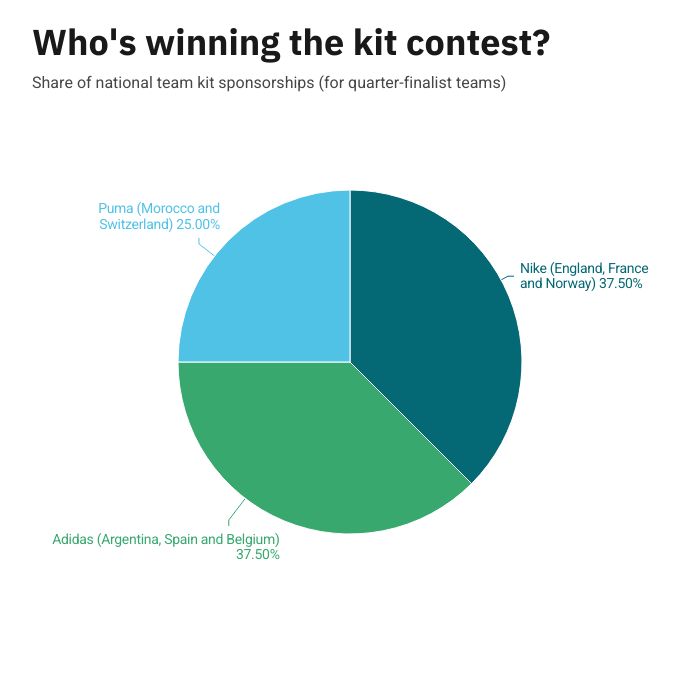
As of the quarter-final stage, the landscape of apparel sponsorship is shifting. Adidas entered the tournament with 14 sponsored kits, while Nike held 12. However, the attrition of the knockout stages has leveled the playing field, with both giants now counting three teams each among the final eight squads. Puma, despite a strong start with 11 teams, remains in the hunt with two: Morocco and Switzerland.
Despite Nike’s lack of official FIFA sponsorship status, the company is reporting a "FIFA dividend." CEO Elliot Hill recently revealed that the brand has moved 2.5 times the volume of kits compared to the 2022 tournament. This surge has provided a much-needed morale boost for shareholders, helping the company navigate a period of flat year-on-year revenue growth and softening direct-to-consumer sales. The market has reacted favorably to this momentum, particularly noting the resilience of Nike’s wholesale revenue channels, which remain the cornerstone of Hill’s turnaround strategy.
A Chronological Breakdown of the "Kit Wars"
The buildup to this year’s tournament saw both brands engaging in a "glitzy" arms race, but their tactical execution diverged sharply as the opening whistle blew in June.
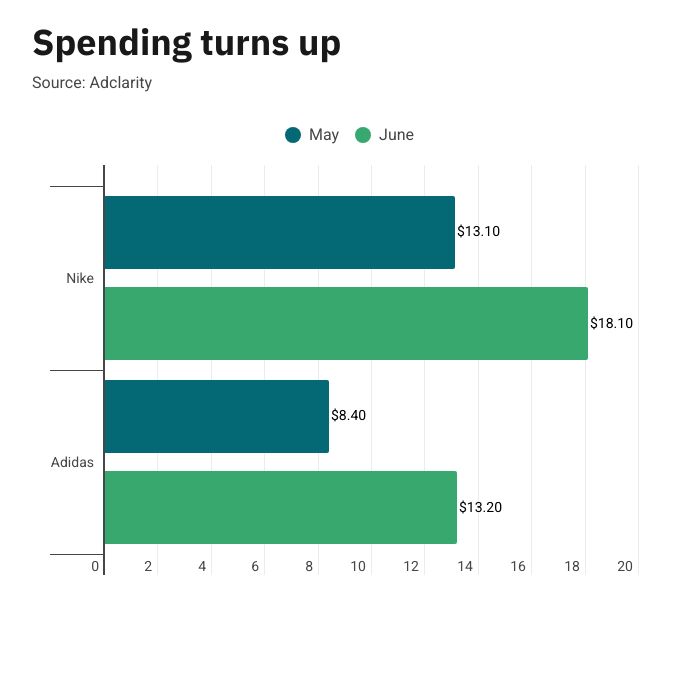
- Pre-Tournament (May 2026): Both brands initiated massive media buy-ins. Data from AdClarity indicates that between May 1 and June 30, the two companies deployed a combined $52.8 million in advertising. Throughout this period, Nike consistently outspent its German rival.
- Early Tournament (June 2026): Adidas dominated the retail floor. Initial market data from M Science suggested the German sportswear maker captured a staggering 58% share of team jersey sales, compared to Nike’s 36%.
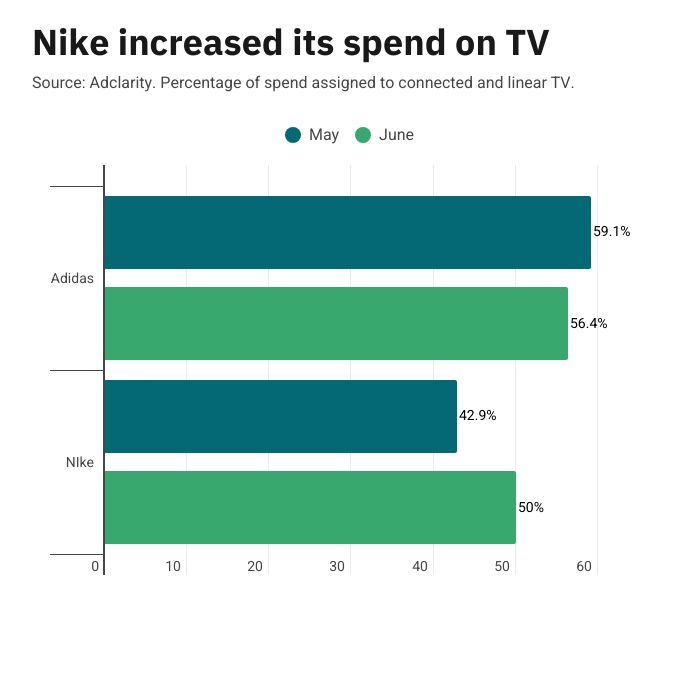
- Mid-Tournament (Late June – Early July 2026): Nike shifted its focus toward broadcast dominance. By increasing its TV ad spend from 42.9% to 50% of its total media budget, Nike effectively saturated the living rooms of casual viewers, aiming to manufacture "cultural moments" despite not being an official partner.
- The Quarter-Finals (Current): The brands have solidified their opposing strategies: Nike is betting on wide-reach, high-frequency television ads, while Adidas is doubling down on social media engagement and soccer-culture authenticity.
Supporting Data: The Anatomy of Ad Spend
The disparity in media strategy is perhaps the most fascinating aspect of this year’s competition. According to iSpot data, Nike has been a relentless presence on linear television. The brand ran its flagship campaign spots 80 times during the tournament’s first half, trailing only Home Depot in terms of visibility. By contrast, Adidas appeared just 32 times, ranking 30th among monitored brands.
However, a lower TV count for Adidas does not equate to a lack of investment; it represents a redirection of funds. Analysis from Mediasense reveals that while Nike pulled back on Meta properties and TikTok, Adidas surged in paid social spending. This allowed Adidas to insert itself directly into the ongoing digital discourse of soccer fanatics, effectively "owning" the social conversation around the tournament.
The effectiveness of these campaigns has been measured by Mediasense’s "extendability" metrics. Adidas’s "Backyard Legends" campaign has been lauded for its relevance to core soccer culture and its ability to foster genuine fan participation. Meanwhile, Nike’s "Rip the Script" campaign—a "quasi-anarchic" effort—has prioritized modularity, allowing the brand to chop its creative into bite-sized, shareable clips for social media, maximizing the impact of its star-studded roster.
Official Responses and Strategic Pivot
Nike CEO Elliot Hill has remained bullish on the company’s performance, framing the World Cup as a critical stress test for the brand’s new strategy. "The World Cup is always a moment to prove ourselves," Hill stated during this week’s earnings call. "It’s one of the toughest battlegrounds in sport, and we’re coming with our best."
The strategy appears to be rooted in "scaling culture." By focusing on marquee names like Erling Haaland—whose performance against Brazil has turned him into the tournament’s defining "villain"—Nike has managed to create a narrative that transcends the tournament’s official marketing.
Conversely, Adidas’s reliance on the "traditional big creative idea" has secured them a more stable foothold among the die-hard soccer base. While Nike plays the role of the disruptor, Adidas maintains the authority of the incumbent. This is perhaps best exemplified by the reception of its kits. Regardless of sales figures, industry analysts and fans alike have widely crowned the Adidas Magritte-inspired away shirt for Belgium as the most aesthetically significant kit of the tournament.
Implications for Future Sports Marketing
The 2026 World Cup has provided a masterclass in how to compete for market share without the exorbitant price tag of an official FIFA sponsorship.
1. The Death of the "Official" Monopoly
Nike’s ability to siphon interest away from official partners proves that brand awareness is no longer solely dictated by official logos. Through sheer force of media spend and the tactical use of high-profile athletes, a non-partner can effectively "hijack" the conversation.
2. The Rise of Modular Content
The success of Nike’s "Rip the Script" campaign underscores a shift in how creative must be delivered. Brands are no longer looking for one singular, monolithic commercial; they are looking for "franchises" that can be broken into dozens of individual, viral moments. Scaling culture, as Mediasense’s Ishan Chatterjee noted, is the new benchmark for success.
3. TV vs. Social: A Bifurcated Audience
The tournament has highlighted a growing divide in consumption habits. The "casual" viewer remains tethered to the linear TV experience, where Nike has established total dominance. The "fanatic" lives on social media, where Adidas has invested heavily to foster a sense of community and participation.
4. The Wholesale Recovery
For Nike, the World Cup is not just about brand equity; it is a tactical tool to support its wholesale partners. By driving demand through mass-market advertising, Nike is pushing consumers toward retail partners, providing a much-needed boost to the wholesale segment that Hill has identified as vital for long-term health.
Conclusion: The Final Whistle
As the tournament enters its final stages, the contest between Nike and Adidas serves as a microcosm of modern marketing. Adidas holds the high ground of heritage and community-driven social engagement, while Nike acts as the aggressive, high-spending challenger, utilizing television and star power to rewrite the rules of engagement.
While the teams on the pitch will decide who hoards the FIFA trophy, the battle for the consumer’s wallet is far from over. With three teams remaining for each brand, the final outcome will likely be decided by who can better capitalize on the heightened emotions of the semi-finals and the grand final. Whether it is through an iconic jersey design or a viral social media moment, one thing is certain: the winner of the 2026 World Cup will be determined as much by the marketing teams in Beaverton and Herzogenaurach as it is by the players on the field.

 Nila Kartika Wati
 Reynand Wu