Introduction: A Shift in Creative Trajectory
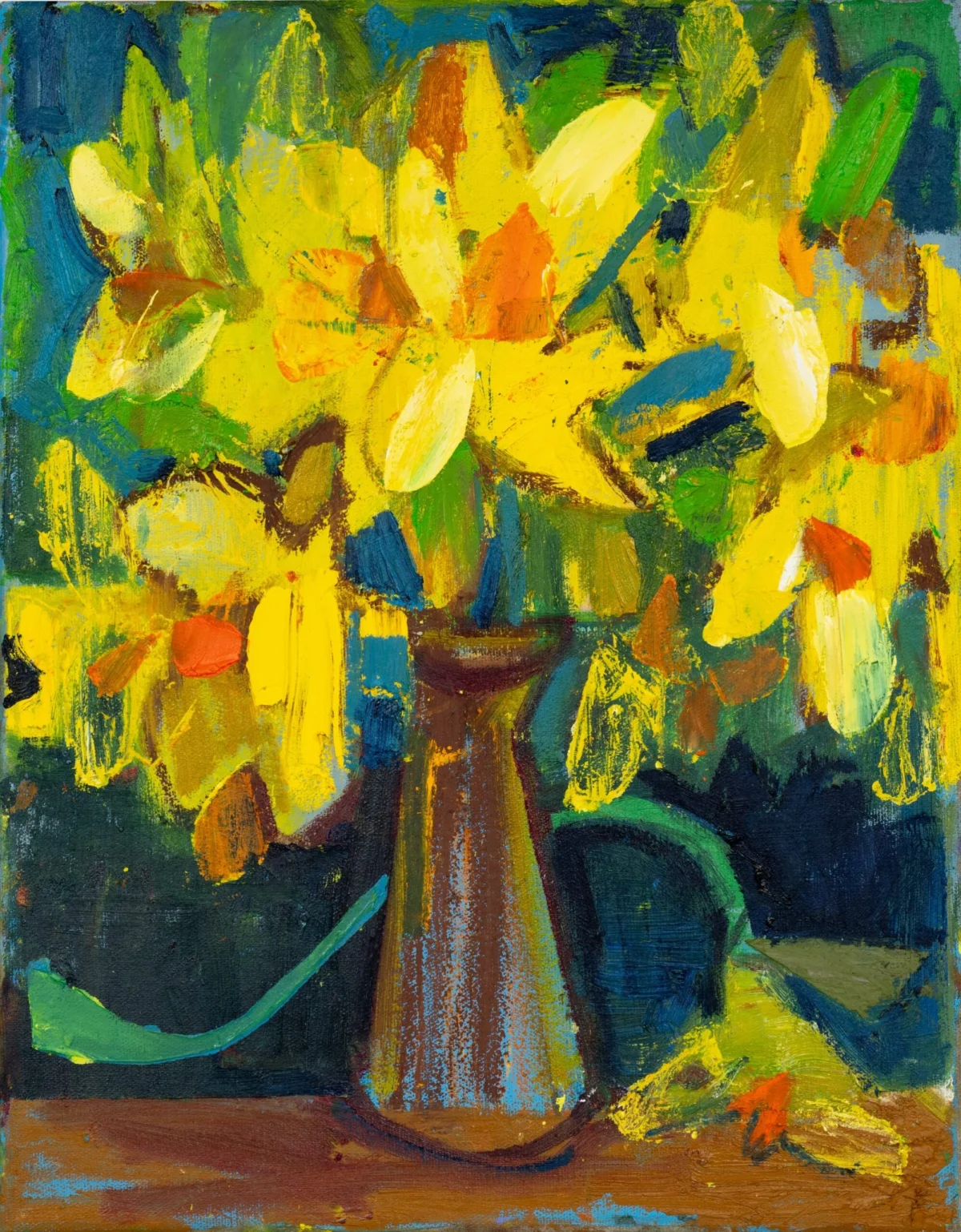
For over a decade, Andrew Salgado has cemented his reputation as a formidable force in contemporary figurative painting. Known for his emotionally charged, often psychologically dense portraiture, Salgado has frequently leaned into narrative-driven processes that weave complex literary and historical threads into the fabric of the human face. However, his latest body of work represents a radical departure. In a series of vibrant, gestural still lifes, Salgado has traded the constraints of human representation for the intuitive, unbridled spontaneity of the floral arrangement.
The exhibition, titled Glory!, serves as a testament to an artist in transition—one who is moving away from the calculated, reference-heavy compositions of his past toward a practice defined by immediate sensation, color theory, and the rhythmic application of paint.
The Genesis of Glory!: From Figures to Flora
The transition to still life was not a rejection of his roots, but rather an evolution of his philosophy. Salgado has long been an artist who views the canvas as a site of interrogation, but by stripping away the figurative element, he has created a space where the paint itself—the brushstroke, the drip, the smear—becomes the primary actor.

The Role of Spontaneity
In his previous series, Salgado often began with a firm, predetermined narrative anchor. In Glory!, the artist has embraced a more fluid methodology. He speaks of "latching onto a thought or association" and allowing the material to lead. This shift has allowed for a greater degree of improvisation. The bouquets, rendered in varying states of bloom and decay, are not merely depictions of flowers; they are visual representations of the artist’s own internal energy. The resulting canvases feel alive, oscillating between controlled structure and a chaotic, vibrant dissolution.
Chronology of a Creative Pivot
The development of this new body of work can be traced through the artist’s recent studio practice, which has increasingly prioritized the physical act of painting over the cerebral demands of narrative construction.
- Early 2025: Salgado begins experimenting with non-figurative subject matter, seeking a "cleansing" of his visual language.
- Late 2025: The artist formalizes his focus on the still life, drawing inspiration from classical art history while filtering these subjects through a contemporary, expressionistic lens.
- Spring 2026: Finalization of the Glory! series, featuring works such as The Prince, Dear Theo, and Narcissus Wept.
- July 16, 2026: Official opening of Glory! at BEERS London, marking the public debut of this experimental transition.
Supporting Data: Literary and Historical Intersections
Despite his stated move toward a more intuitive process, Salgado remains an inveterate bibliophile. His work continues to function as a bridge between visual art and literature, with each piece serving as a subtle dialogue with a specific text or historical figure.

"The Prince" and the Architecture of Paranoia
One of the most striking pieces in the collection is The Prince, a painting defined by its monochromatic saturation in various shades of blue. The title is a direct reference to a novel by Austrian author Thomas Bernhard, a writer notorious for his exploration of aristocratic decay, obsession, and the spiraling nature of the human psyche. In Salgado’s interpretation, the flowers are splayed in a frenetic, almost defensive posture. The singular color palette creates an environment of claustrophobic intensity, mirroring the mental landscape of a protagonist descending into paranoia.
"Dear Theo": A Homage to Van Gogh
Perhaps the most poignant entry in the series is Dear Theo. The work centers on a cluster of sunflowers—a subject inextricably linked to the legacy of Vincent van Gogh. Salgado goes beyond mere visual allusion; he includes a handwritten note at the bottom right of the canvas addressed to Theo, the artist’s brother and steadfast support system.
The inclusion of this note invites a broader reflection on the nature of the artistic process. Salgado quotes Vincent’s own words: "To be sufficiently heated up to melt those golds and those flower tones, not just anybody can do that. It takes an individual’s whole and entire energy and attention." By invoking this quote, Salgado is essentially providing a manifesto for his current practice. He is documenting the immense physical and emotional expenditure required to translate "heat" into pigment.

Official Perspectives: The Artist’s Stance
In recent interviews, Salgado has characterized this shift as a necessary liberation. "I wanted to stop explaining and start feeling," he noted when discussing the move toward the gestural. By removing the narrative burden of the human figure, he has allowed the viewer to interact with the paintings on a more visceral level.
The gallery, BEERS London, has championed this development, noting that the work retains the "Salgado signature"—the bold mark-making and the confident handling of paint—while expanding the boundaries of his artistic lexicon. For the gallery, Glory! is not just a change in subject matter, but a demonstration of an artist’s willingness to risk his established brand to maintain creative authenticity.
Implications for Contemporary Painting
The success of Glory! poses significant questions for the broader discourse on contemporary painting. In an era where "narrative painting" has seen a massive resurgence, Salgado’s pivot suggests that there is a growing desire for abstraction and process-based work even among artists known for their figurative prowess.

The Return to the "Still Life"
The still life has historically been treated as a training ground or a minor genre. However, by imbuing these arrangements with literary weight and psychological tension, Salgado is re-centering the genre. He treats the flower not as a static object, but as a dynamic vessel for human emotion. The transition from "blossom to decay" in his work acts as a metaphor for the temporal nature of human existence, proving that the still life remains a fertile ground for profound existential exploration.
The Synthesis of Intellect and Intuition
The most significant implication of this body of work is the synthesis of the intellectual and the physical. By blending the "reference-rich" compositions of his past with the "intuitive" energy of his current process, Salgado is mapping a middle ground. He is proving that an artist does not need to choose between being a student of history and a creature of raw, unmediated expression.
Conclusion: A Future in Bloom
Glory! serves as more than just an exhibition; it is a vital checkpoint in the career of Andrew Salgado. As he moves forward, the lessons learned from this series—the freedom to abandon the expected, the courage to follow the brush, and the ability to find profound meaning in the humble bouquet—will undoubtedly inform his future practice.

For those familiar with his previous work, the shift might initially feel jarring. Yet, upon closer inspection, the DNA of his earlier figurative work is present in every stroke of The Prince and every petal of Dear Theo. He has not abandoned his identity; he has merely expanded it to include the infinite, wild possibilities of the natural world.
Glory! remains on view at BEERS London through August 15, 2026. As the art world continues to dissect the significance of this pivot, one thing remains clear: Andrew Salgado is an artist who refuses to stagnate, choosing instead to "heat up" his practice and melt the boundaries of his own creative limitations. Whether through the gaze of a portrait subject or the wilted petal of a sunflower, Salgado’s commitment to the intensity of human experience remains the pulse of his work.