Ammar Sabilarrohman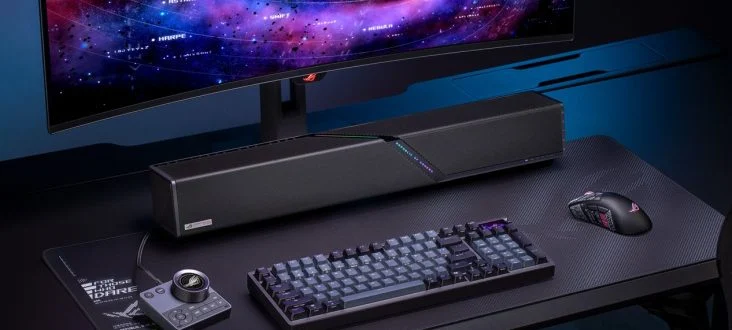
In the hyper-competitive world of PC and console gaming, audio has long been the unsung hero of immersion. While visual fidelity often steals the spotlight with high-refresh-rate monitors and 4K resolution, the ability to discern the subtle crunch of a footstep behind a wall or the direction of an incoming projectile is a tactical necessity. Asus, through its Republic of Gamers (ROG) division, has officially signaled its intent to redefine the desktop audio experience with the launch of the ROG Gjallar, a premium 2.1.2-channel soundbar system that promises to bring cinema-grade Dolby Atmos immersion to the gaming desk.
Main Facts: Engineering the Soundstage
The ROG Gjallar is not merely a speaker; it is an integrated audio ecosystem designed to solve the common pitfalls of PC audio—namely, the clutter of traditional 5.1 surround sound systems and the lack of depth in standard stereo setups.
The soundbar utilizes a sophisticated driver array consisting of dedicated left and right full-range speakers paired with high-frequency tweeters. To achieve true verticality in its soundstage, the unit incorporates upward-firing channels designed to bounce sound off the ceiling, creating the "overhead" sensation central to Dolby Atmos.
Complementing the soundbar is a 6.5-inch, 65W wireless subwoofer. By utilizing a dedicated 5GHz wireless connection, Asus claims to have effectively eliminated the latency issues that often plague consumer-grade wireless audio peripherals, ensuring that low-end "thump" arrives in perfect sync with the on-screen action.
Chronology: The Evolution of ROG Audio
Asus ROG has been steadily encroaching on the audiophile market for years. The timeline of this progression is telling:
- 2018–2020: Asus focused primarily on high-end gaming headsets (the Delta and Strix lines), establishing their software prowess with the Armoury Crate ecosystem.
- 2021–2023: The company experimented with specialized DACs and sound cards, moving beyond the headset to address the needs of power users with high-impedance headphones.
- 2024: Asus introduced the concept of the "smart desk," integrating peripheral control hubs into monitors and keyboards.
- 2025–Present: The announcement of the ROG Gjallar marks the culmination of this journey. By moving from personal audio (headsets) to environmental audio (soundbars), Asus is attempting to capture the growing demographic of gamers who want high-fidelity sound without the fatigue of wearing a headset for hours on end.
Technical Specifications and Connectivity
The ROG Gjallar distinguishes itself through its robust input/output architecture, specifically targeting the needs of modern multi-platform gamers.
HDMI 2.1 and Visual Pass-through
The inclusion of HDMI 2.1 is arguably the most significant feature for console and high-end PC gamers. Supporting 4K resolution at 120Hz pass-through, the soundbar ensures that users do not have to sacrifice graphical integrity to achieve high-quality audio. By acting as a passthrough device between the console (or PC) and the monitor, the Gjallar avoids the signal degradation often associated with legacy optical or USB-based audio solutions.
The Control Hub Interface
One of the most innovative aspects of the Gjallar is the external multi-function control hub. Rather than forcing users to reach for buttons on the back of the soundbar, the hub provides:
- LCD Interface: Real-time visual feedback for volume levels, EQ presets, and active inputs.
- Integrated Microphones: A sophisticated array featuring AI beamforming and Acoustic Echo Cancellation (AEC). This allows the soundbar to function as a communication device, filtering out ambient mechanical keyboard noise while isolating the user’s voice.
- Peripheral Integration: Two USB Type-A ports built into the side of the unit provide a convenient dock for wireless dongles, reducing the need for lengthy cables stretching to the PC tower.
Connectivity Suite
Beyond HDMI 2.1 with eARC, the Gjallar supports:
- Bluetooth 5.3: For seamless connection to mobile devices or tablets.
- USB-C: For direct high-fidelity digital audio input from PCs.
- Optical and AUX: Retaining support for legacy audio hardware.
Official Responses and Design Philosophy
In internal statements regarding the design of the Gjallar, Asus engineers emphasized that the "Gjallar" name—derived from the legendary horn of the Norse god Heimdall—was chosen to symbolize its role as a "guardian of the soundscape."
"We wanted to build a bridge between the clinical precision required for competitive gaming and the cinematic richness demanded by AAA narrative experiences," an Asus representative noted. "The challenge was the wireless subwoofer. By using the 5GHz spectrum, we are providing a ‘wired’ experience without the physical constraints, allowing the user to place the bass unit anywhere in the room without worrying about cable management or input lag."
Furthermore, the integration of the Gear Link tool and mobile application represents Asus’s commitment to software-defined hardware. Users can tweak the Aura RGB lighting—which can sync with other ROG peripherals—and save specific microphone profiles for streaming, gaming, or general media consumption.
Implications for the Peripheral Market
The release of the ROG Gjallar signals a shift in the gaming peripheral industry.
The Decline of the "Desktop Mess"
For years, the "clean setup" aesthetic has dominated social media platforms like Reddit’s r/battlestations. Bulky 5.1 systems with wires snaking across the floor have fallen out of favor. The Gjallar addresses this by consolidating the control hub, the peripheral dock, and the audio processing into a streamlined, low-profile footprint.
Competition and Market Dynamics
Asus is entering a space traditionally occupied by high-end audio manufacturers like Creative (who recently announced their own XF1 Hi-Res speakers) and specialized soundbar makers like Razer. However, by including HDMI 2.1 and a dedicated AI-beamforming mic array, Asus is aiming for the "prosumer" segment—users who demand a single, high-performance solution that handles audio, lighting, and peripheral connectivity simultaneously.
The Future of "Spatial Awareness"
The reliance on Dolby Atmos is a calculated move. As more game developers utilize spatial audio data (such as the HRTF implementations in Valorant, Call of Duty, or Cyberpunk 2077), hardware that can interpret these channels accurately becomes a competitive advantage. The Gjallar’s upward-firing speakers provide a vertical dimension that standard 2.0 speakers cannot replicate, potentially giving players a clearer sense of enemies moving on floors above or below them.
Conclusion: Is the Soundbar the New Standard?
The Asus ROG Gjallar is a statement piece. It is clearly priced and designed for the enthusiast who refuses to compromise on aesthetics or performance. While traditionalists may still argue that dedicated open-back headphones provide the ultimate soundstage, the convenience and immersive power of a 2.1.2 soundbar with HDMI 2.1 connectivity offer a compelling alternative.
As the industry moves toward higher resolutions and more complex audio environments, the Gjallar appears well-positioned to become the centerpiece of the modern gaming station. Whether it will succeed in displacing the high-end gaming headset remains to be seen, but with its combination of AI-driven microphone technology, 4K@120Hz support, and minimalist design, Asus has certainly raised the bar for what a gaming speaker system should be.
For those interested in the latest audio trends, keep an eye on how these high-end soundbars integrate with the emerging standards of Bluetooth 6.0 and beyond, as manufacturers continue to push the boundaries of what is possible in the desktop audio space.

 Iffa Jayyana
 Jia Lissa