Dwi Wanna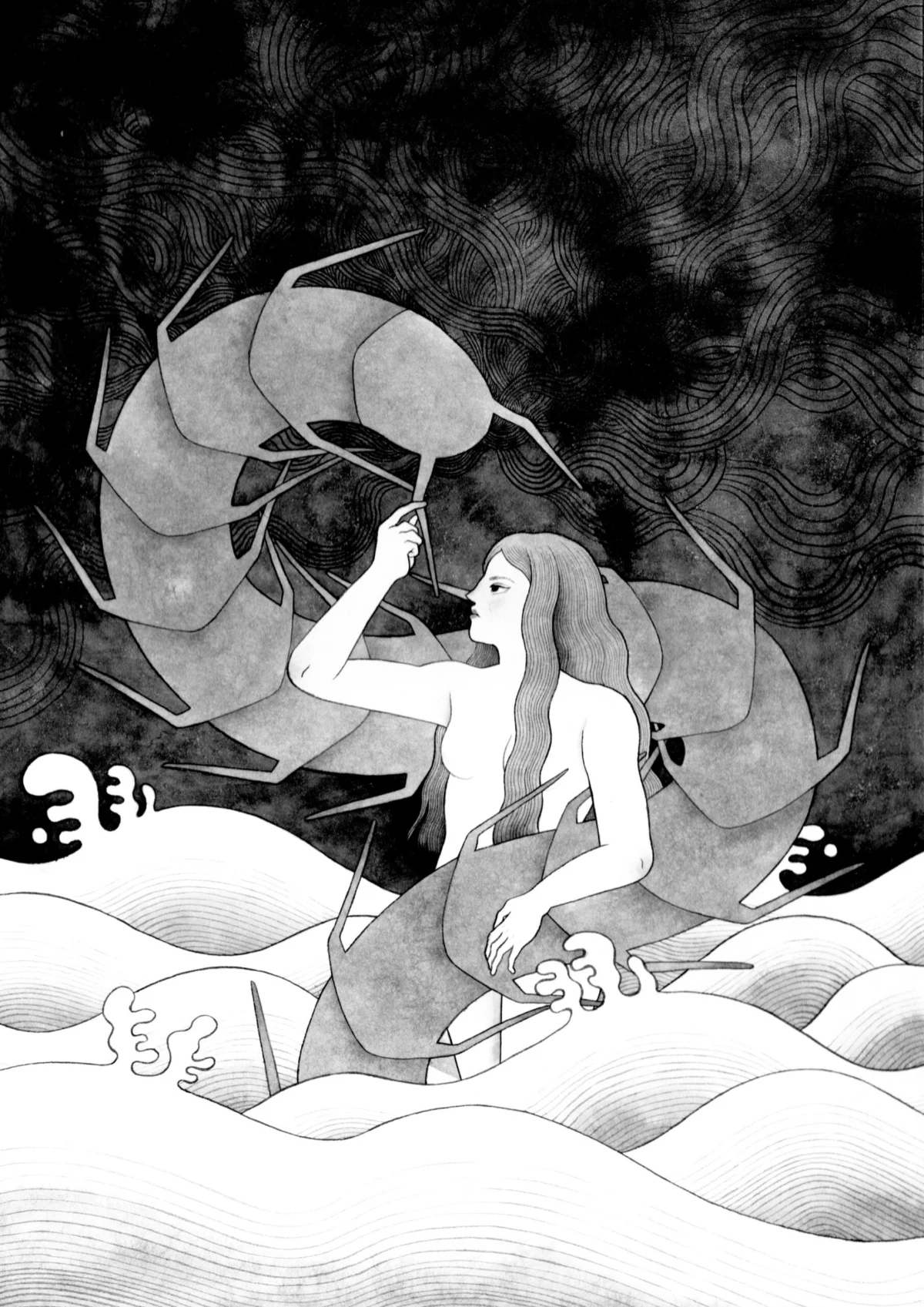
In the quiet, rhythmic movements of an artist’s brush, history often finds its most vivid expression. For Busan-based artist Jeongmin Lee, the act of painting is not merely an aesthetic pursuit but an archaeological one. By bridging the gap between ancient Korean oral traditions and contemporary surrealist illustration, Lee has carved out a unique space in the art world, exploring what she describes as the ways "memory is carried through craft and repetition."
Her work, primarily rendered on hanji (traditional Korean mulberry paper) using bunchae (mineral pigments and ink), serves as a visual bridge between the folklore of the past and the fluid, often turbulent, realities of the present. As her latest series, Daughters of the Sea, gains international attention, Lee’s practice offers a profound meditation on how we preserve, reinterpret, and inhabit our cultural heritage.

Main Facts: The Intersection of Craft and Folklore
At the heart of Lee’s artistic identity is a dedication to slow, deliberate creation. Her compositions are characterized by delicate, intricate lines that capture the undulating textures of the ocean and the ephemeral nature of myth. She draws deeply from the cultural tapestry of Busan—a city inextricably linked to the sea—to create surreal scenes that feel both dreamlike and rooted in visceral human experience.
Technical Mastery and Materiality
Lee’s commitment to hanji is a deliberate choice. Unlike mass-produced paper, hanji possesses a fibrous, absorbent quality that interacts with bunchae pigments in a way that creates depth and texture impossible to replicate with digital or synthetic mediums. This labor-intensive process requires a meditative, layered approach. Each layer of color is applied with precision, allowing the pigment to settle into the fibers of the paper, mirroring the way stories settle into the collective memory of a community.

Thematic Focus: The Resilience of Women
While her work spans a wide range of mythical motifs, a significant portion of her portfolio centers on the themes of women’s knowledge, labor, and resilience. Drawing inspiration from the haenyeo—the legendary female divers of Korea’s coast—and various regional sea deities, Lee recontextualizes historical symbols. Her illustrations do not merely retell old stories; they serve as a conduit for the emotions, unspoken questions, and symbols embedded within these narratives, giving a modern voice to historical female figures.
Chronology: The Evolution of a Narrative Artist
Lee’s artistic trajectory has been one of gradual immersion into the regional histories that define her environment. Her evolution reflects a shift from purely illustrative storytelling to a more investigative and participatory form of art.

- Early Explorations: Lee’s initial focus centered on traditional ink techniques, where she mastered the foundational skills of bunchae. During this period, she began experimenting with how to translate oral traditions into visual narratives.
- The Turn to Folklore: Recognizing that the stories of her hometown of Busan were fading, Lee shifted her focus toward field research. She began visiting coastal villages, documenting oral histories, and engaging with the elderly populations who still hold the memories of local legends.
- The Development of Daughters of the Sea: This series marked a turning point in her career, synthesizing years of research into a cohesive narrative. The series, which has since been exhibited globally, including at the SÄBRS Festival in Riga, serves as an exploration of the feminine archetypes of the sea.
- The Present and Future: Currently, Lee is pivoting toward the medium of the graphic novel. This project, slated for completion next year, aims to consolidate her research into a singular, sprawling narrative centered on the mythology of Busan, moving beyond the single-frame illustration into long-form storytelling.
Supporting Data: The Cultural Context of Hanji and Haenyeo
To understand the weight of Lee’s work, one must understand the cultural pillars upon which it rests.
The Significance of Hanji
Hanji is more than just paper; it is a symbol of Korean endurance. Made from the inner bark of the mulberry tree, it is known for its incredible durability, with some documents surviving for over a thousand years. By choosing this medium, Lee aligns her work with a long lineage of Korean artistry that prizes longevity and organic harmony with nature.

The Legacy of Haenyeo
The haenyeo, or "sea women," are an iconic group of female free-divers who have historically sustained coastal communities through their labor. Their ability to harvest seafood without modern equipment has made them a symbol of extreme resilience and independence. Lee’s work often depicts these women not just as laborers, but as mythic figures who command the sea. By weaving their legacy into her surrealist illustrations, she elevates their historical contributions to the level of folklore.
Official Responses: Critics and the Artistic Community
The reception of Lee’s work has been marked by praise for its ability to balance traditional technique with modern sensibilities. Art critics have noted that her work avoids the pitfalls of "folkloric kitsch" by focusing on the emotional residue of the stories rather than the literal events.

At the SÄBRS Festival, curators highlighted Lee’s contribution as "a vital exercise in cultural memory." By moving away from the didactic retelling of folktales and toward an interpretive, symbolic approach, she invites the audience to participate in the act of storytelling. As one critic noted, "Lee doesn’t just show us a myth; she shows us how the myth feels to the person living in its shadow."
Implications: The Future of Folklore and Collective Memory
Jeongmin Lee’s work raises critical questions about the role of the artist in an era of globalization. As local traditions face the threat of erasure in the face of rapid urbanization, artists like Lee serve as essential keepers of cultural identity.

Folklore as a Participatory Experience
Lee’s desire to expand her work into a participatory format suggests a shift in how we might view art in the 21st century. She argues that folklore should not be a static relic trapped behind the glass of a gallery, but a living, breathing discourse. "I’m exploring ways that folklore can become something people experience and talk about together," Lee notes. This implies a future where her installations might evolve into workshops, public performances, or community-based storytelling events.
The Graphic Novel as a Vehicle for Tradition
By transitioning to a graphic novel format, Lee is essentially attempting to make mythology accessible to a new generation. The graphic novel, with its sequential nature, allows for the pacing and depth that a single illustration cannot capture. This shift has major implications for the preservation of Busan’s history, as it provides a structured, long-form narrative that can be easily shared, reprinted, and studied by audiences who might otherwise be disconnected from these regional myths.

A Global Connection
Perhaps the most significant implication of her work is its universality. While the symbols—the sea gods, the diving traditions, the specific flora of Busan—are deeply rooted in Korean soil, the emotions they convey—loss, resilience, longing, and mystery—are universal. Her work serves as a bridge, suggesting that local folklore, when treated with sufficient care and artistic rigor, can function as a global language.
Conclusion
Jeongmin Lee’s practice is a testament to the idea that the past is never truly behind us. Through the patient application of ink onto paper, she creates a space where history is allowed to breathe. Her work reminds us that memory is not a stagnant archive, but a fluid, living thing that must be constantly reshaped and retold.

As she moves toward her upcoming graphic novel and continues to experiment with ways to bring folklore into the public square, Lee stands as a pivotal figure in contemporary Korean art. By honoring the labor of the haenyeo and the delicate, enduring nature of hanji, she ensures that the stories of the sea will continue to ripple outward, touching new audiences and keeping the spirit of her heritage alive in the modern world. For those looking to follow her progress, her ongoing contributions can be viewed via her Instagram page, where she continues to document the intersection of craft, memory, and myth.


 Nila Kartika Wati
 Ali Ikhwan