
 Nila Kartika Wati
In a bold move that signals a tectonic shift in the artificial intelligence landscape, OpenAI has officially unveiled performance data for "Jalapeño," its first custom-built inference ASIC (Application-Specific Integrated Circuit). Presented at the prestigious Hot Chips conference, the disclosure arrives just days after the company secured a staggering $105 billion in financing—backed in part by its primary hardware supplier, Nvidia—to fuel its massive data center expansion.
By shifting from a pure software powerhouse to a hardware-conscious entity, OpenAI is aiming to reclaim control over its operational efficiency. The Jalapeño chip, developed in a lightning-fast nine-month partnership with Broadcom, is being positioned as a direct competitor to Nvidia’s flagship GB200 and GB300 systems. With initial benchmarks suggesting significant leads in power efficiency and latency, the industry is now forced to reconcile with a new, formidable entrant in the semiconductor space.
The Benchmark Breakdown: Performance vs. The Giant
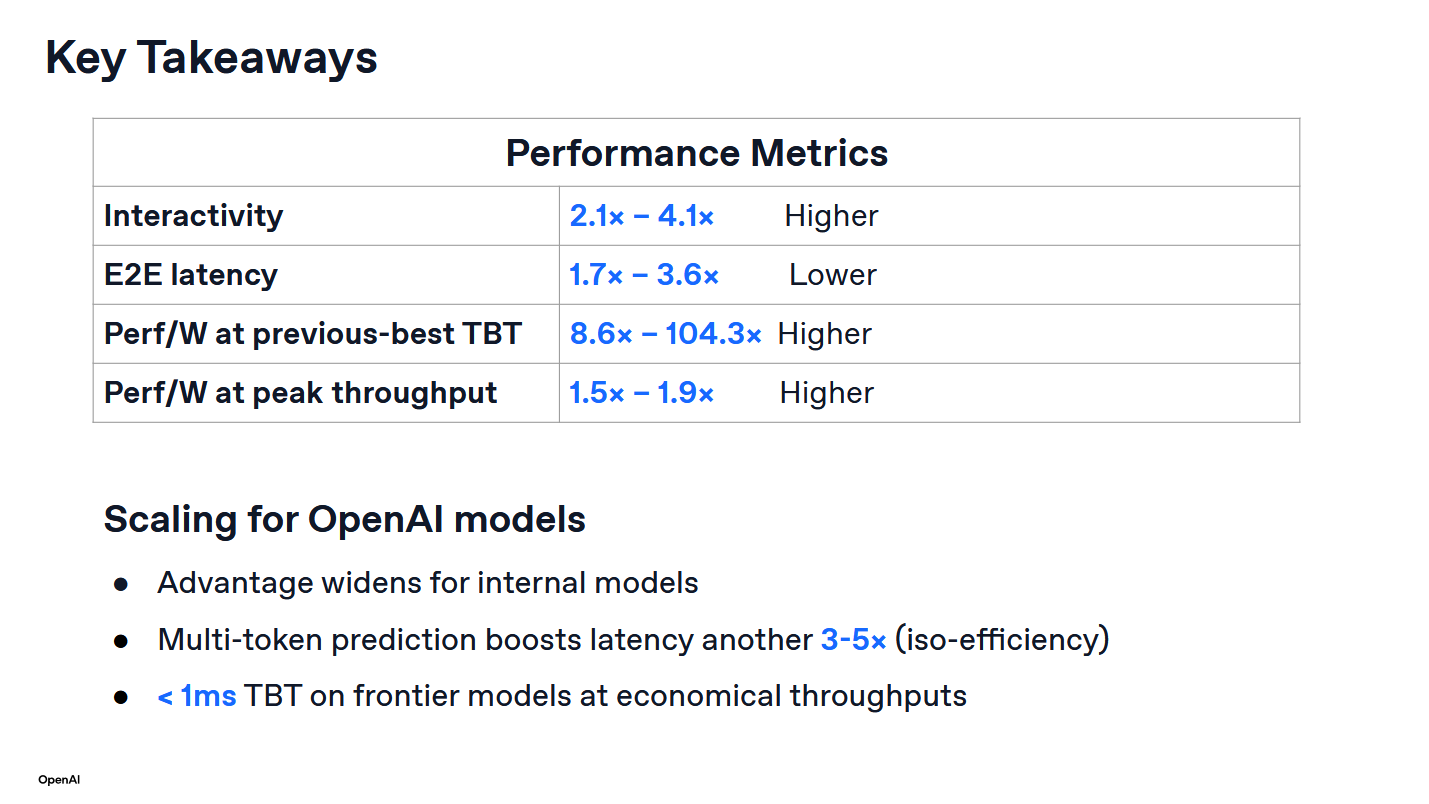
At the heart of the debate are the performance metrics shared by OpenAI. According to data validated through SemiAnalysis’s InferenceX suite, Jalapeño is demonstrating remarkable throughput advantages. In head-to-head comparisons against Nvidia’s GB200 and GB300 rack systems, OpenAI’s chip reported between 1.5x and 1.9x greater throughput per kilowatt. Furthermore, it achieved end-to-end latency reductions of 1.7x to 3.6x.
Perhaps most striking is the power profile. Jalapeño is rated at 700W, significantly lower than the 1,200W and 1,400W ratings of the Nvidia accelerators it faced. When tested across diverse open-source models—including the 120B parameter GPT-OSS, the 670B DeepSeek R1, and the massive 1-trillion-parameter Kimi K2.5—OpenAI’s architecture showcased its prowess at low-latency operating points. At these thresholds, OpenAI claims its chip delivers up to 104.3 times more throughput per kilowatt than the GB300.

However, the industry is cautious. Analysts point out that these figures were normalized to published Thermal Design Power (TDP). In practical, real-world utility testing—measuring all-in power consumption—the gap between Jalapeño (1.18kW) and the GB300 (2.55kW) narrows. Moreover, the testing methodology focused on single-token prediction, whereas production environments for Nvidia hardware often leverage multi-token prediction to optimize speed, a factor that could mitigate some of the performance disparities reported by OpenAI.
Chronology of a Silicon Pivot
The journey to Jalapeño was not an overnight endeavor, but rather the result of a deliberate, high-stakes strategic pivot.
- October 2023: OpenAI signed a landmark 10GW deployment agreement with Broadcom, signaling the start of a deep-dive into custom silicon.
- June 2024: Following an aggressive nine-month development cycle—a feat rarely seen in the chip industry—the Jalapeño chip was officially unveiled, showcasing a massive, reticle-sized ASIC design.
- August 17, 2026: Nvidia reaffirmed its critical role in the ecosystem by agreeing to provide $105 billion in financing for an OpenAI-led data center campus in Ohio.
- August 25, 2026: OpenAI takes the stage at Hot Chips, providing the first public, technical look at how its custom silicon stacks up against the industry standard.
This rapid development cycle has set a new benchmark for silicon design, forcing incumbent players to evaluate the speed at which the market is evolving.
Supporting Data: Memory and Efficiency
The Jalapeño architecture is built around a compute-die-heavy design paired with six HBM4 stacks, providing a massive 216 GiB of memory at 15.4 TB/s. While the GB300 boasts a higher total capacity (288GB), OpenAI’s focus is on "exposing" aggregate bandwidth rather than merely stacking memory density.

This design philosophy addresses a critical bottleneck in modern AI: the memory wall. As models grow larger, the ability to move data to the processor becomes the primary limiting factor for inference speed. However, this strategy places OpenAI in direct competition for the most scarce resource in the tech world: High Bandwidth Memory (HBM). With Samsung, SK hynix, and Micron sold out through 2027, the battle for wafer allocation is becoming increasingly cutthroat. Micron recently noted that HBM consumes three times the wafer area of standard DDR5, creating an "area tax" that makes every gigabyte of HBM precious.
Official Perspectives and Industry Reactions
Richard Ho, OpenAI’s Vice President of Hardware, has been careful to frame the development as a partnership rather than a divorce from Nvidia. In a post-announcement interview with Bloomberg, Ho noted, "Nvidia is a really good partner, and we continue to need a lot of Nvidia." This underscores the reality that Jalapeño is currently designed strictly for inference—the process of running models—and not for the training of new, foundation-level models, where Nvidia’s software ecosystem remains untouchable.
Independent industry observers, such as the team at SemiAnalysis, have expressed surprise at the maturity of the silicon. Having tested the chip in a controlled lab environment with OpenAI engineers, they characterized the part as "beating every Nvidia, AMD, and Google chip we have been able to test" in specific inference workloads. Yet, the consensus remains that until the chip is deployed at scale in a live production environment, these figures are "best-case" scenarios.
Implications: A New Era for Data Centers
The rise of Jalapeño signals three major shifts for the semiconductor and AI industries:
- Vertical Integration as an Economic Necessity: OpenAI’s move suggests that for the largest AI labs, relying solely on merchant silicon is no longer sufficient. To maintain margins and performance, they must own the hardware stack.
- The Supply Chain Squeeze: By moving toward a 10GW deployment, OpenAI is becoming a major rival to Nvidia for access to TSMC’s 3nm capacity and advanced packaging lines. This creates a complex dynamic where the two companies are simultaneously partners and fierce competitors for manufacturing priority.
- The Rise of Inference-Specific Silicon: The industry has long focused on "training" power. With Jalapeño, the focus shifts to "inference efficiency." As models are deployed to billions of users, the cost per token becomes the defining metric for business viability. If OpenAI can prove that Jalapeño lowers this cost by 50% or more, it will trigger a massive industry-wide migration toward application-specific hardware.
Looking ahead, the roadmap is already clear. OpenAI is reportedly within months of tapeout for its second-generation chip, with conceptual designs for a third generation already in progress. While Nvidia remains the king of the AI hill, the appearance of Jalapeño proves that the "moat" around the GPU market is not as wide as it once was.
For the average tech consumer, this competition is a net positive. Increased efficiency in inference leads to faster, cheaper, and more capable AI applications. However, for the giants of the semiconductor world, the arrival of Jalapeño is a clear warning: the future of AI will be built on chips as much as it is on code, and the hardware landscape is about to get much more crowded.


 Pevita Pearce
 Reynand Wu




