In the landscape of modern media, there is a specific, potent form of creative genius found in the artist who is willing to follow an absurd premise to its absolute, logical, and often terrifying conclusion. Whether it is Andy Warhol’s serial repetition of Brillo boxes to critique the intersection of commerce and high art, or a narrative that demands the reader navigate "ancillary" texts to find the true story, there is a unique satisfaction in watching an auteur "commit to the bit."
Casper Kelly, the visionary behind the 2014 viral sensation Too Many Cooks, has returned to this territory with his latest feature, Buddy. While Too Many Cooks served as a surreal autopsy of the 1990s television sitcom, Buddy turns its surgical lens toward an even more unsettling genre: the over-lit, hyper-wholesome world of children’s edutainment.
The Evolution of the Nightmare: From Too Many Cooks to Buddy
To understand the cultural gravity of Buddy, one must first revisit the impact of Too Many Cooks. When it aired as a late-night Adult Swim sketch, it became a cultural touchstone overnight. It began as a saccharine, earworm-heavy parody of TGIF-style sitcoms, complete with an improbable cast of characters—cartoonist dads, impossibly hot older sisters, and a puppet cat named "Smarf."
However, over the course of its 11-minute runtime, the sketch underwent a structural collapse. The "opening credits" grew longer and more claustrophobic, eventually introducing a machete-wielding murderer who systematically hunted the cast through a dizzying array of TV genres, from medical dramas to sci-fi dystopias. It was a masterclass in tonal shifting, drilling into the "dark heart of television" and returning with a nightmare that felt deeply familiar to anyone raised in front of a flickering cathode-ray tube.
Buddy acts as a spiritual successor to this chaos. Co-written by Kelly and Jamie King, the film pivots from the sitcom parody to the specific, sickly aesthetic of early-childhood programming. Drawing DNA from icons like Dora the Explorer, Thomas the Tank Engine, and the omnipresent, terrifyingly cheerful Barney & Friends, the film constructs a world that is as bright as it is hollow.
A Chronology of Dread: Entering the World of Buddy
The film’s narrative structure is as deliberate as its visual style. Buddy introduces us to an ensemble of upbeat, archetypal children living in a fenced-in, idyllic cul-de-sac. The set includes all the hallmarks of a low-budget children’s show: a talking mailbox, a treehouse, and a wishing well.

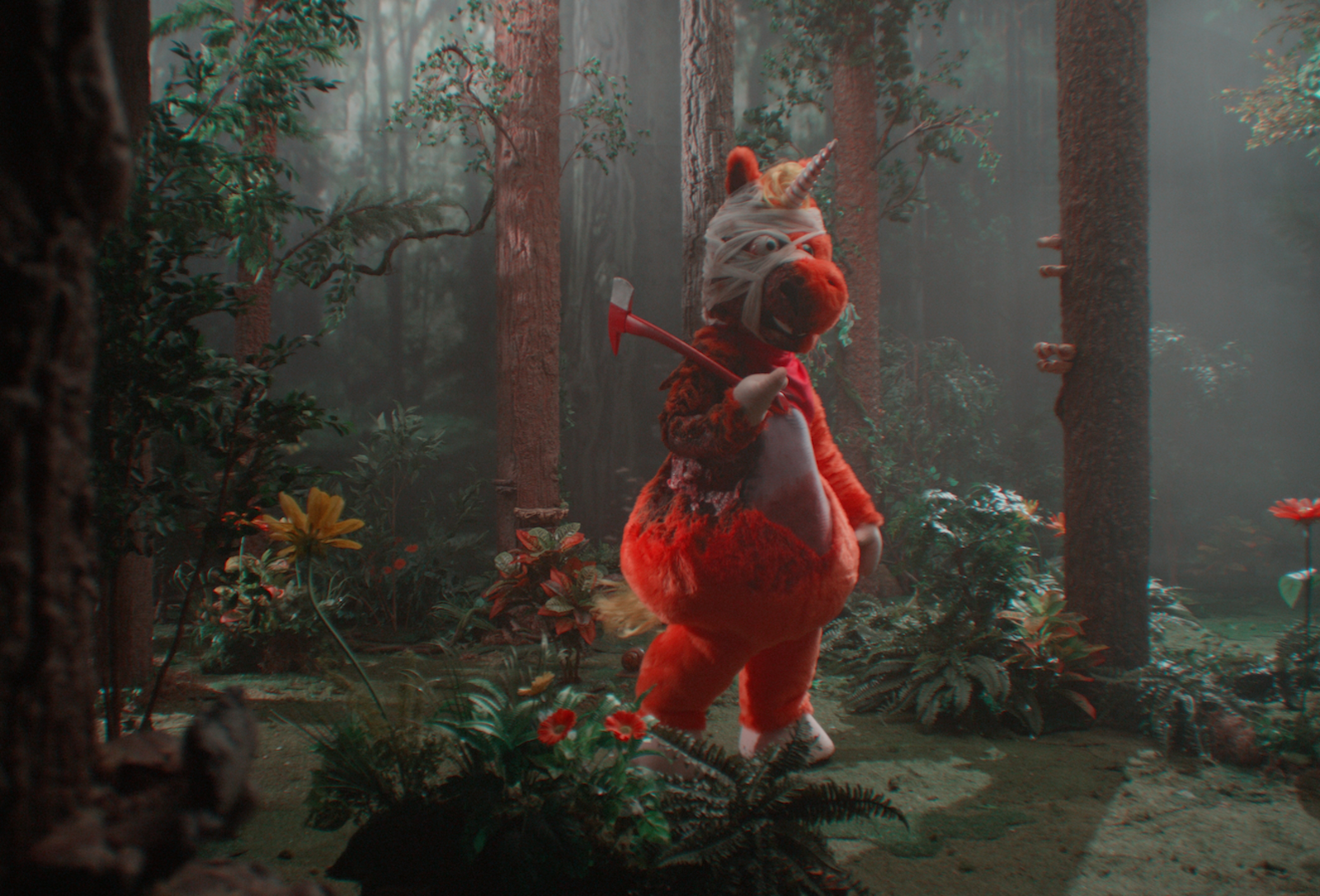
The central figure is Buddy, a plush, sentient unicorn who appears whenever the children sing the summoning refrain, "Oh, Buddyyyy!" Buddy arrives to teach the children lessons on processing fear or overcoming social anxiety. However, the veneer of morality begins to crack when one child—Josh, the intellectual outcast—refuses to participate in the scripted play, preferring the relative reality of his book.
- The Inciting Incident: The introduction of the "wholesome" world, characterized by oversaturated lighting and the rigid, performative joy of the child actors.
- The Turning Point: The refusal of the protagonist to conform, which triggers an ominous shift in Buddy’s demeanor and the environment itself.
- The Genre Shift: The film breaks away from the claustrophobic confines of the "edutainment" set, morphing into a picaresque adventure-horror that explores the consequences of the characters’ forced isolation.
- The Deconstruction: The final act, where the artifice of the show is stripped away, revealing the underlying trauma and existential dread of the performers trapped within the medium.
Supporting Data: Performance as a Prison
The success of Buddy rests heavily on a cast that manages a precarious balancing act: playing both "cloying child-TV actors" and "people trapped in a hell dimension."
Cristin Milioti serves as a focal point for the film’s emotional weight, delivering a performance that confirms her status as one of the most versatile actors working today. However, it is Keegan-Michael Key, the voice and "soul" of Buddy, who steals the film. Key’s performance is a virtuosic display of vocal manipulation; he shifts with terrifying fluidity between the nasal, chirruping warmth required by the character and the jagged, homicidal rage of a being whose reality is disintegrating.
The child actors—Delaney Quinn, Caleb Williams, Tristan Broders, Madison Skyy Polan, and Luke Speakman—deserve equal praise. Their transition from the performative, whiny cadence of 90s television tropes to the raw, nuanced vulnerability of children in genuine peril provides the film with its emotional anchor. When the horror begins, the artifice drops, leaving behind the chilling image of children who are not acting, but reacting to an encroaching, inescapable darkness.
Official Responses and Cultural Context
While Buddy is a work of fiction, it exists within a larger, burgeoning cultural movement—a collective reckoning with the "wholesome" media of the late 20th century. Recent years have seen an explosion of content that recontextualizes childhood icons as sources of trauma.
Projects like The Bone Temple (which explored the unsettling reality of Teletubbies and the Jimmy Savile era), the Backrooms series, and the pervasive "goth/witch" aesthetics found in films like Camp suggest that audiences are hungry for this kind of deconstruction. We are looking at our childhoods through the lens of adulthood, realizing that the "goodness" marketed to us was often a distraction from a much colder, more commercial reality.

In terms of production, the creative team behind Buddy has leaned into the "uncanny valley" of cheap set design. By using lighting that is intentionally migraine-inducing and sets that look as if they might topple over with a single push, they have replicated the exact sensory experience of watching low-budget educational television as a child.
Implications: The Horror of the "Bit"
The primary implication of Buddy is its commentary on media, loneliness, and the psychological effects of gaslighting. The film asks a fundamental question: When we create stories to comfort ourselves, at what point do those stories become cages?
The shift in the film’s second act—from a confined, repetitive loop to a more conventional, albeit horrific, adventure—has sparked debate among critics. Some argue that the shift undermines the claustrophobic purity of the initial concept. Others, including the creative team, argue that it was a necessary evolution to keep the audience from suffering from total sensory overload. As noted, if the film had remained solely in its initial, maddening tone, it might have been unwatchable. The shift provides a "sustainable" narrative path for what would otherwise be an unbearable experience.
Ultimately, Buddy is a testament to the power of commitment. It is a film that refuses to blink. It takes the "blood-soaked Barney episode" premise and elevates it to a meditation on the human condition. It reminds us that behind every bright, smiling mask in the world of television, there is a performer, a person, and a story waiting to be told—or in this case, waiting to be violently unmade.
For those who find joy in the dark, the absurd, and the expertly executed, Buddy is not just a film; it is a vital entry in the modern horror canon. It understands that we use stories to find strength, even when those stories are trying to eat us alive. Whether the film loves us back is a question left for the viewer, but one thing is certain: it is a work that is, completely and unapologetically, itself.