Capcom’s Onimusha: Way of the Sword has arrived as the final major release in a landmark year for the publisher. Following the technical successes of Resident Evil Requiem and Pragmata, this latest title serves as a testament to the continued evolution of Capcom’s proprietary RE Engine. Known for its remarkable scalability and efficiency, the RE Engine has once again proven its ability to bridge the gap between bleeding-edge hardware and aging legacy systems.
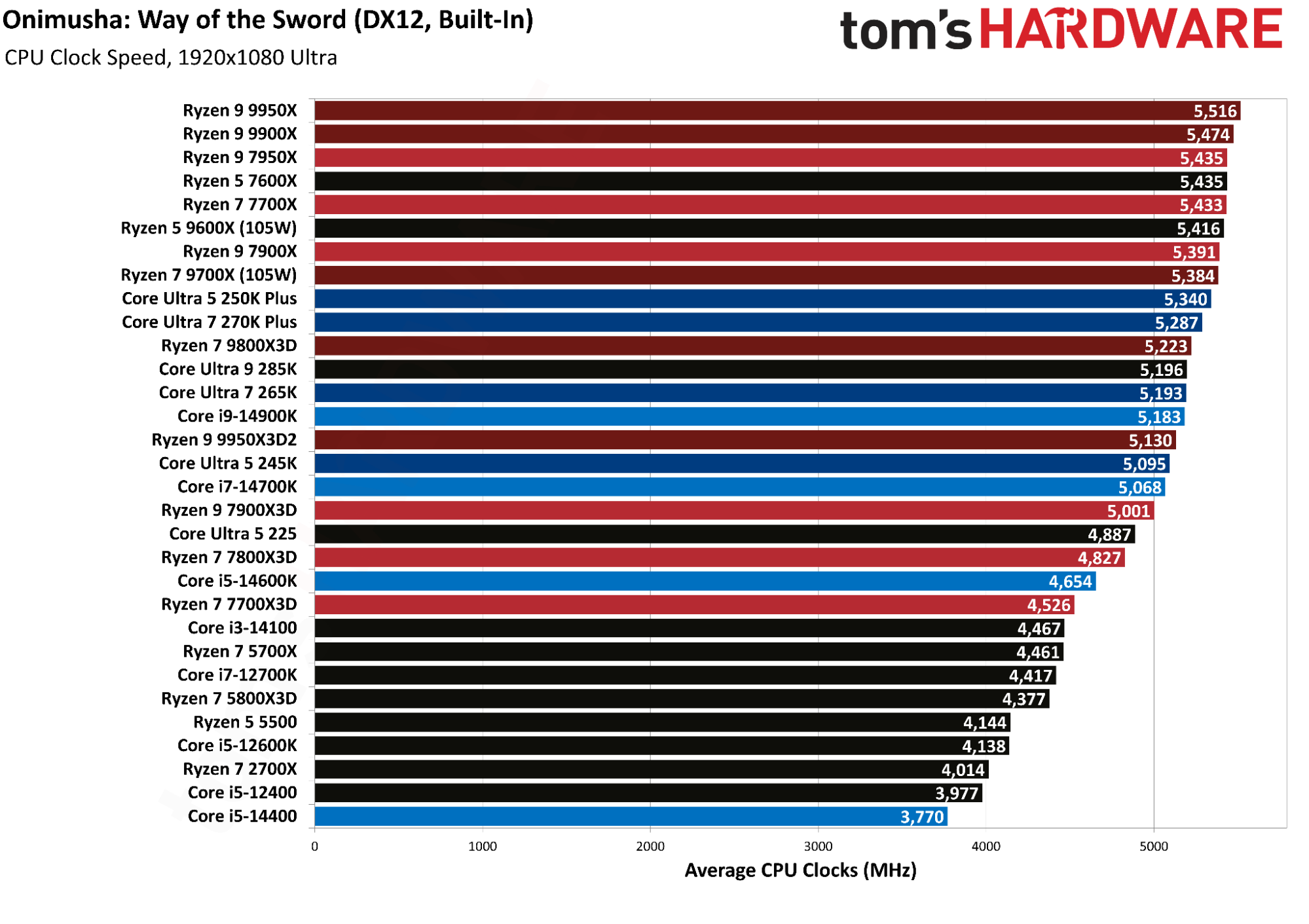
However, as with any high-profile PC launch, the community is eager to understand how the game interacts with modern processing architectures. To shed light on this, we conducted an exhaustive benchmark analysis using 31 different CPUs, ranging from the latest flagship processors like the Core Ultra 7 270K Plus to battle-hardened relics of the past decade, such as the AMD Ryzen 7 2700X.
The Technical Landscape: A Deep Dive into Scaling
The RE Engine has historically been more GPU-bound than CPU-bound, but Onimusha: Way of the Sword presents unique demands on the processor. Our testing confirms that while the engine is well-optimized, there are distinct nuances in how it leverages CPU resources.
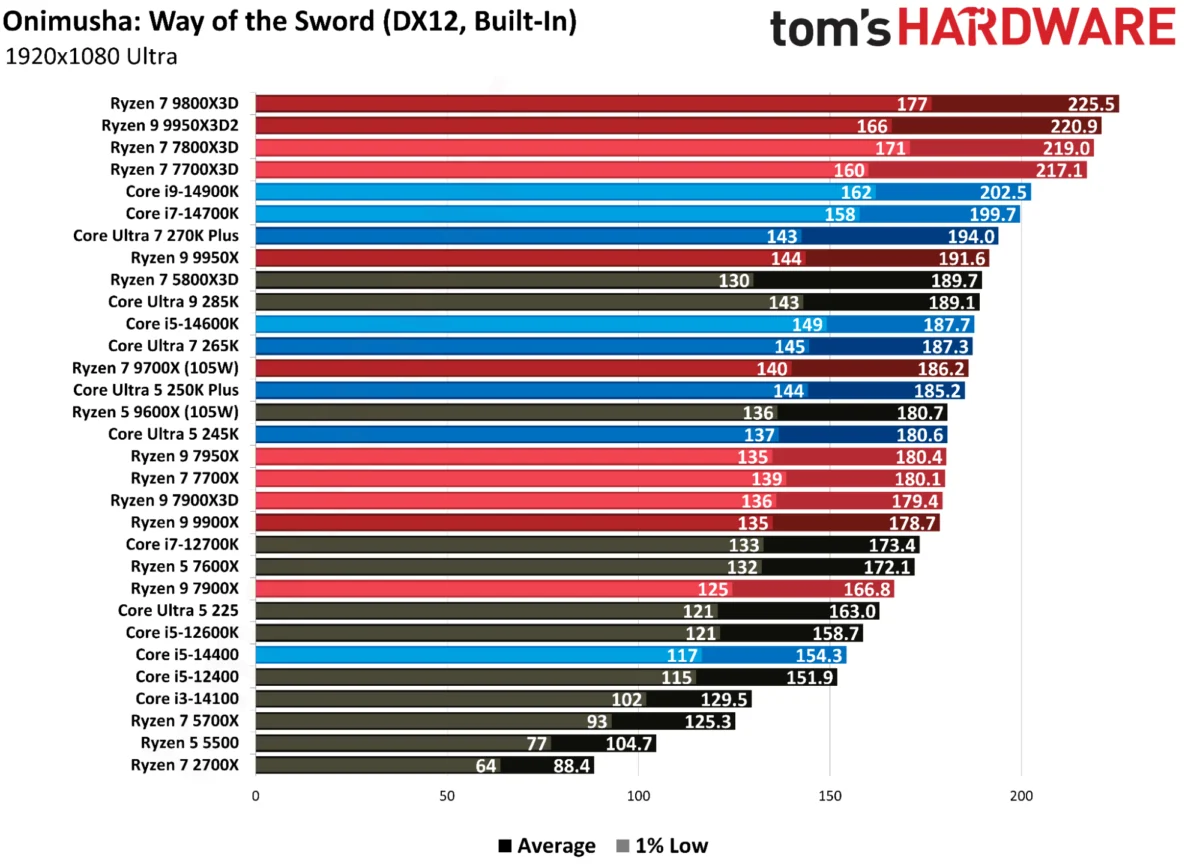
In our controlled testing environment—using an NVIDIA RTX 5090 Founders Edition to minimize graphics bottlenecks—we observed consistent performance scaling across the board. Even when pairing the latest GPUs with older CPUs, the game maintained a respectable baseline. For instance, the Ryzen 7 2700X, despite its age, managed to hover near 90 FPS at 1080p with Ultra settings and ray tracing disabled. This confirms that the engine remains highly accessible for players who have not yet upgraded to the latest silicon.
However, the data also revealed unexpected anomalies. Specifically, AMD’s 12-core Ryzen 9 models exhibited performance characteristics that deviated from the expected trend, often trailing behind their 6-core counterparts.
Chronology of Our Testing Methodology
To ensure the integrity of our results, our testing process followed a rigid protocol. The Onimusha: Way of the Sword in-game benchmark spans approximately five minutes, divided into two distinct phases: real-time in-engine cutscenes and a gameplay sequence.
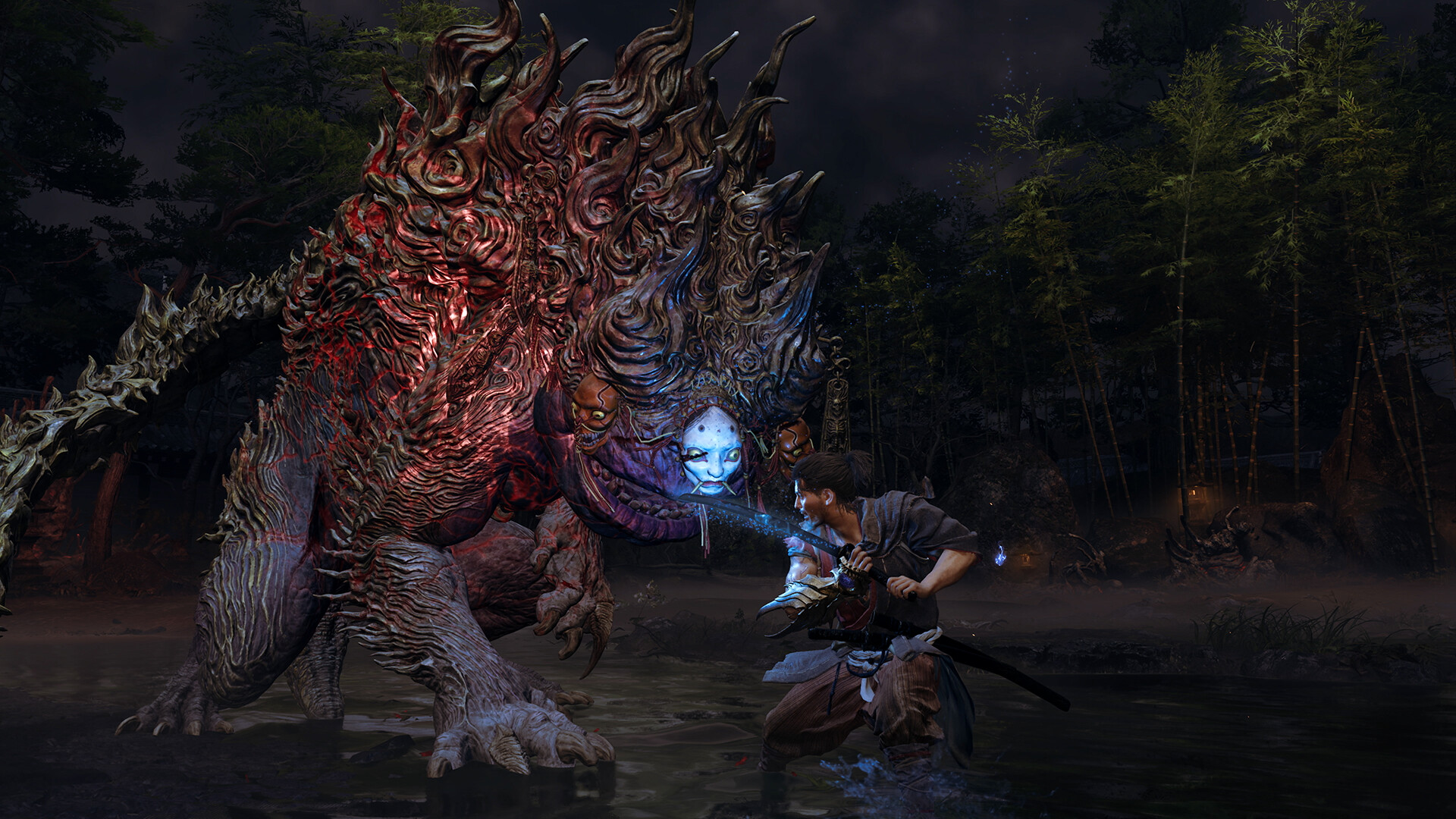
While the cutscenes are visually impressive, they are less demanding on the CPU than the active gameplay portion. Consequently, we focused our data collection specifically on the gameplay section, as it represents the "worst-case scenario" for frame times and processing load.
- Preparation: We utilized a frozen OS image to ensure all drivers, dependencies, and background services remained identical across every test pass.
- Configuration: All tests were conducted at 1080p using the Ultra preset with no ray tracing. To isolate CPU performance, we purposefully avoided AI-driven upscaling solutions like DLSS or FSR.
- Validation: Each CPU underwent three full benchmark runs. We discarded outliers and calculated the median result to ensure the data accurately reflected the chip’s sustained performance capability.
- BIOS Standardization: We adhered to stock settings, enabling only manufacturer-supported "warrantied" performance features. This included enabling Intel’s Core Ultra 200S Boost where applicable and utilizing the 105W TDP mode for the Ryzen 5 9600X and Ryzen 7 9700X.
Supporting Data: The 12-Core Paradox
The most striking finding from our testing involves AMD’s 12-core processors. In most modern titles, a higher core count generally correlates with better performance or, at the very least, parity with lower-tier chips. In Onimusha: Way of the Sword, this logic fails.
The Ryzen 9 7900X, for example, recorded results roughly 3% slower than the Ryzen 5 7600X. Similarly, the Ryzen 9 9900X trailed the Ryzen 5 9600X by 1%. This "12-core penalty" is specific to these models, as the single-CCD Ryzen 5/7 chips and the 16-core dual-CCD models did not suffer from this regression.
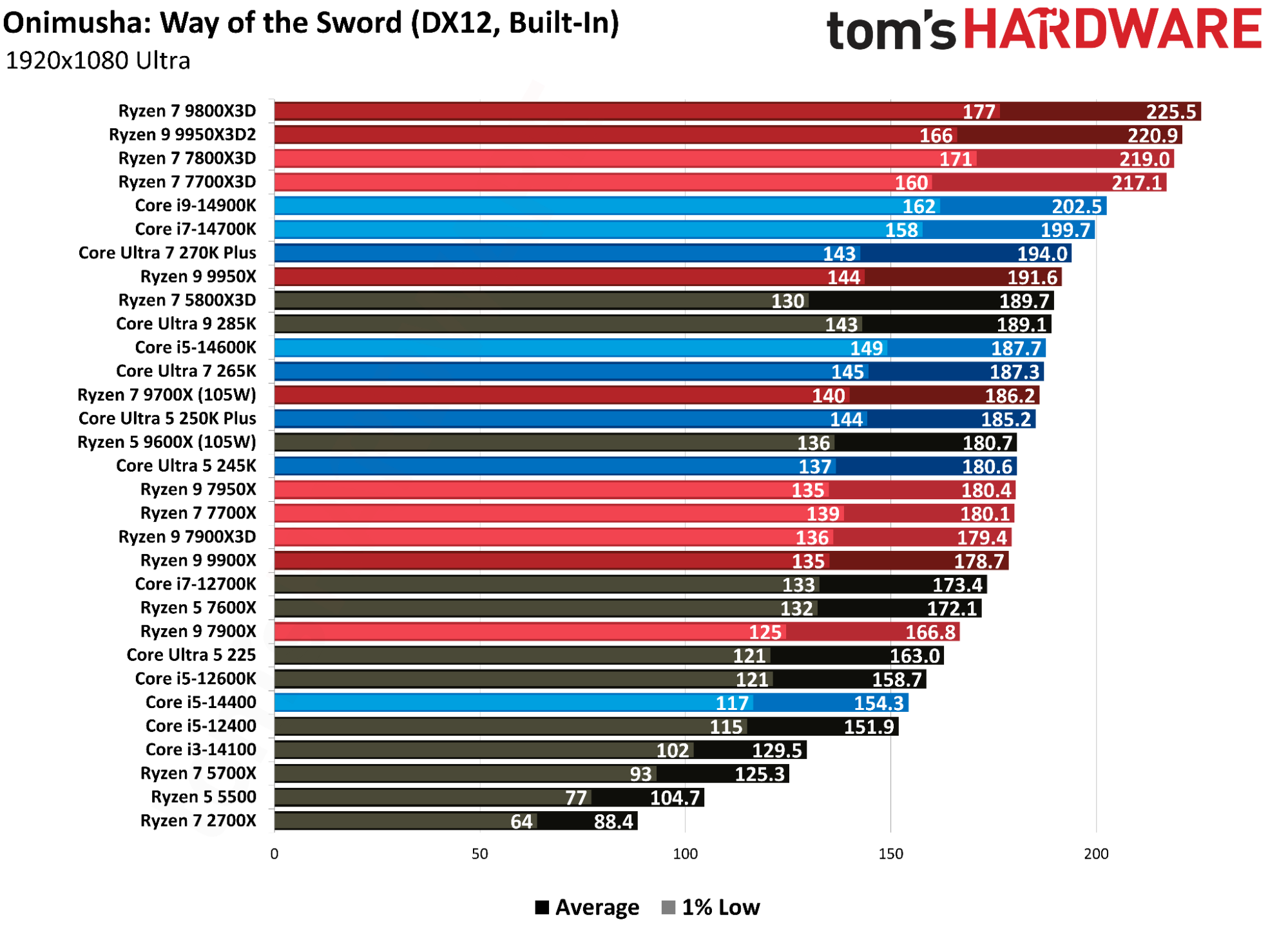
We even tested the Ryzen 9 7900X3D to determine if the additional L3 cache could mitigate the issue, but the chip remained in lockstep with the Ryzen 7 7700X. This suggests an architectural or scheduling conflict within the RE Engine’s current build that specifically affects the 12-core configuration.
The X3D Advantage and Intel’s Position
As expected, AMD’s X3D processors dominated the top of our performance charts. The Ryzen 7 9800X3D leads the pack, offering an 11.3% performance advantage over Intel’s current strongest contender, the Core i9-14900K.
Intel’s performance remains robust, though it lacks the explosive lead found in some other titles. Interestingly, the Core i7-14700K outperformed the newer Core Ultra 7 270K Plus in our tests by approximately 2.9%. This suggests that the current optimization for Intel’s Arrow Lake architecture is still maturing. Because Onimusha lacks support for Intel’s Binary Optimization Tool (iBOT), it is likely that the performance we are seeing is currently capped, potentially waiting for future patches or architectural refinements in the upcoming Nova Lake series.
Efficiency and Power Consumption
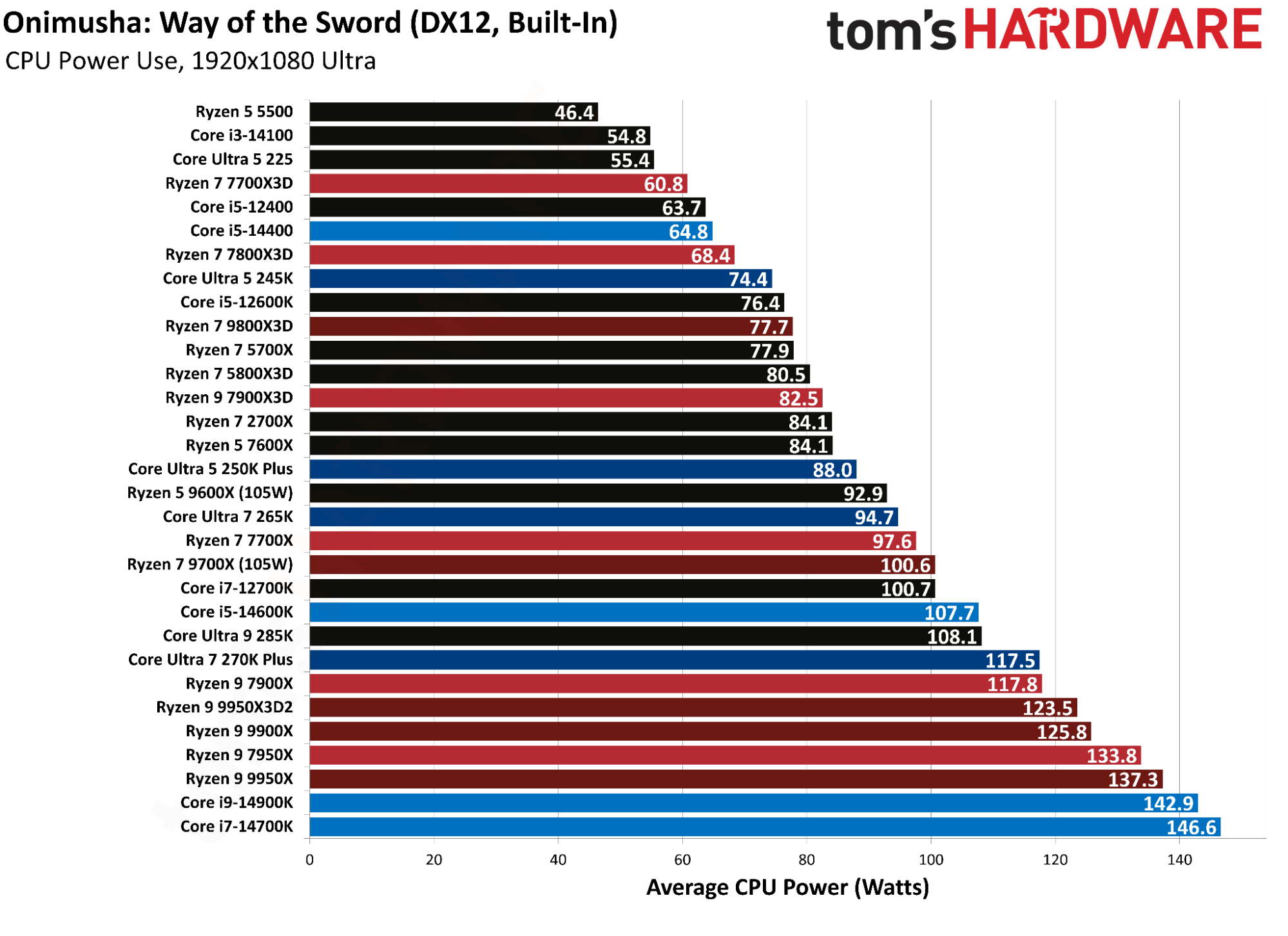
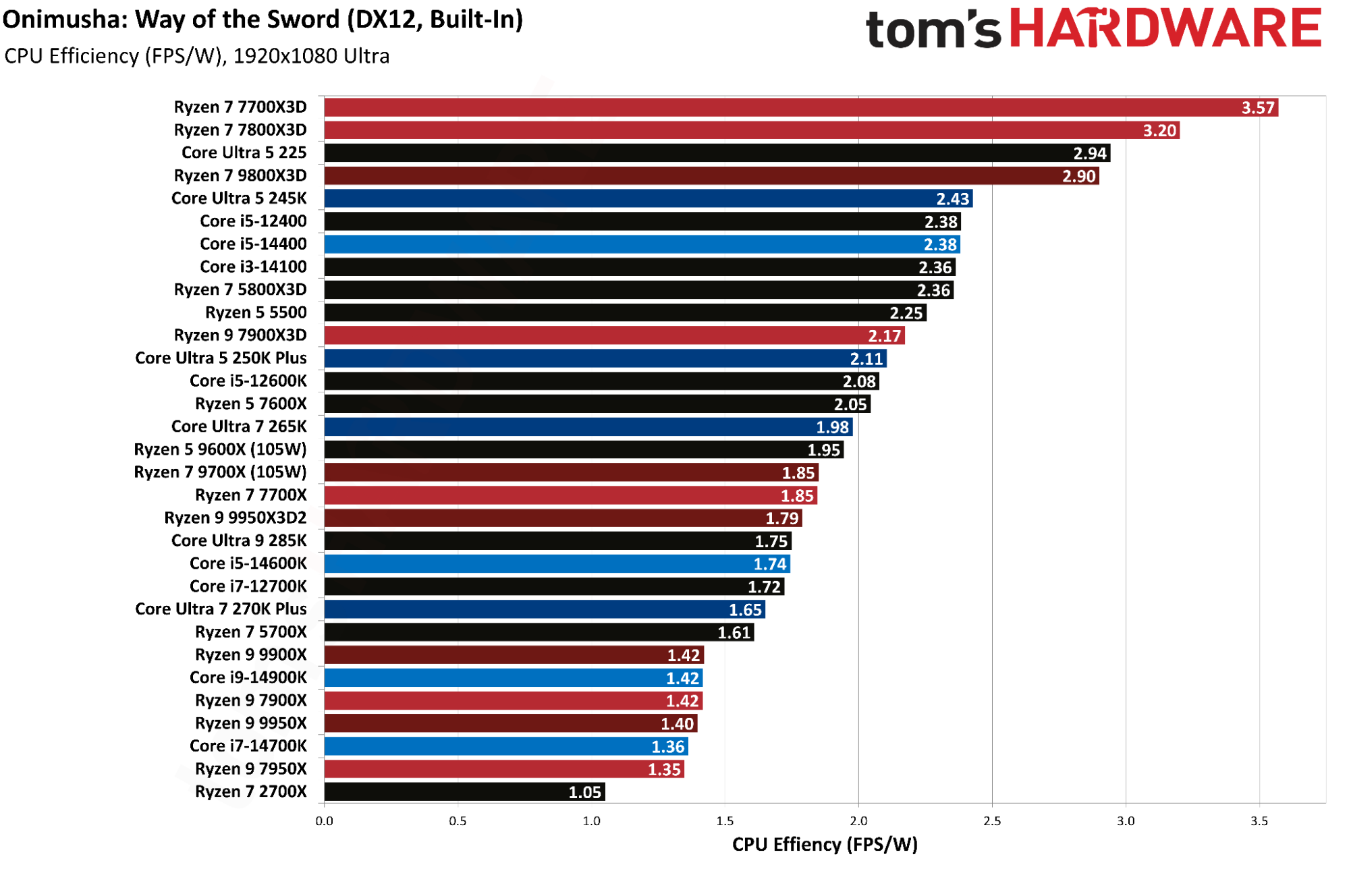
Beyond raw frame rates, efficiency is a critical metric for the modern enthusiast. The Ryzen 7 7700X3D emerged as the clear winner in our efficiency tests, providing over 3.5 frames per watt.
By contrast, the Raptor Lake Refresh chips—specifically the Core i7-14700K and i9-14900K—demanded significantly higher power draws to reach their performance tiers. While we do not want to conflate performance data with power telemetry, it is evident that the power-per-frame ratio on Intel’s current platform is substantially higher than that of AMD’s X3D lineup in this specific engine.
Implications for the Future
The performance discrepancies observed, particularly with the 12-core AMD Ryzen 9 series, represent a critical area for potential improvement. It is entirely possible that this is a "launch-day" quirk that Capcom will address through a future game update. Alternatively, it may require a firmware or microcode update from AMD to better handle the way the RE Engine threads its tasks across the CCDs.
For the average gamer, the takeaway is clear: Onimusha: Way of the Sword is exceptionally well-scaled for a wide array of hardware. Whether you are running a four-year-old Ryzen 5000-series chip or a brand-new flagship, the game delivers a playable, consistent experience.
Final Thoughts on Engine Optimization
The move toward more multi-threaded engines in the industry is clear, and Onimusha confirms that while single-core speed remains the king of gaming performance, the game clearly benefits from a jump in capability beyond the four-core baseline.
As we continue to monitor the game’s performance post-launch, we expect that minor patches will likely smooth out the anomalies we encountered with the 12-core Ryzen parts. Until then, players should take comfort in the fact that Capcom has once again delivered a title that respects the user’s hardware, regardless of where that hardware sits on the performance spectrum. The RE Engine continues to be the gold standard for PC accessibility, and despite some minor "growing pains" for specific CPU architectures, it remains a robust platform for high-fidelity gaming.
Jake Roach is the Senior CPU Analyst at Tom’s Hardware. With a background in systems engineering and performance benchmarking, he focuses on providing data-driven insights into the latest consumer and workstation processors.