After months of intense industry scrutiny, heated debate, and a flurry of unauthorized community modifications, Nvidia’s DLSS 5 has officially made its public debut. The debut title for this controversial iteration of the company’s signature upscaling and frame generation technology is NBA 2K27, a choice that has surprised many in the hardware community given the game’s focus on sports simulation rather than the high-fidelity fantasy environments typically associated with major graphical leaps.
While DLSS 5 promises to revolutionize real-time rendering through neural-guided lighting and material reconstruction, its launch serves as a stark reminder of the growing tension between raw graphical innovation, hardware accessibility, and the ongoing discourse regarding the reliance on AI-generated "slop" in modern gaming.
The Core Technology: How DLSS 5 Functions
At its heart, DLSS 5 is not merely an upscaler—it is a sophisticated, AI-driven neural rendering framework. In NBA 2K27, Nvidia has collaborated closely with developers at Visual Concepts to integrate the technology directly into the game’s rendering pipeline.
Unlike previous versions of DLSS, which focused primarily on reconstructing lower-resolution inputs into higher-resolution frames, DLSS 5 acts as a collaborative partner to the base engine. The game still utilizes high-fidelity scanned 3D models of athletes to establish base geometry. Once this base is set, DLSS 5 consumes a combination of pre-trained neural datasets and real-time engine telemetry to "hallucinate" or infer complex lighting, shadows, and material properties.
This implementation is significant because it moves away from a "global filter" approach. By operating at the engine level, developers retain creative control, allowing them to fine-tune the output to ensure that the neural rendering aligns with the intended artistic aesthetic of the game.
A Chronology of Controversy: From Leaks to Launch
The journey to the official release of DLSS 5 has been anything but conventional. The timeline reveals a high-stakes cat-and-mouse game between Nvidia’s marketing machine, internal development, and the tech enthusiast community.
- Initial Announcement (Early 2026): Nvidia unveiled the concept of DLSS 5, promising a paradigm shift in visual fidelity. However, the announcement was met with immediate skepticism regarding the compute costs and the potential for "hallucinated" graphical artifacts.
- The Modder’s Breakthrough: As rumors swirled that the technology would be locked exclusively to the high-end RTX 50-series "Blackwell" architecture, modders managed to extract and port early versions of the DLSS 5 DLL files. Testing in titles like Control revealed that the technology could, in theory, run on previous-generation hardware, though at a significant performance penalty.
- The "Leaked" Performance Drop: Benchmarks from early community tests showed that running DLSS 5 on older RTX 40-series cards was possible but inefficient, with frame rates plummeting as the hardware struggled to keep up with the intense neural processing requirements.
- Official Launch (September 2026): NBA 2K27 launched with native DLSS 5 support, confirming the steep hardware requirements and the reliance on massive frame interpolation to achieve marketing-friendly frame rates.
Decoding the Performance Metrics: The "Fake Frame" Reality
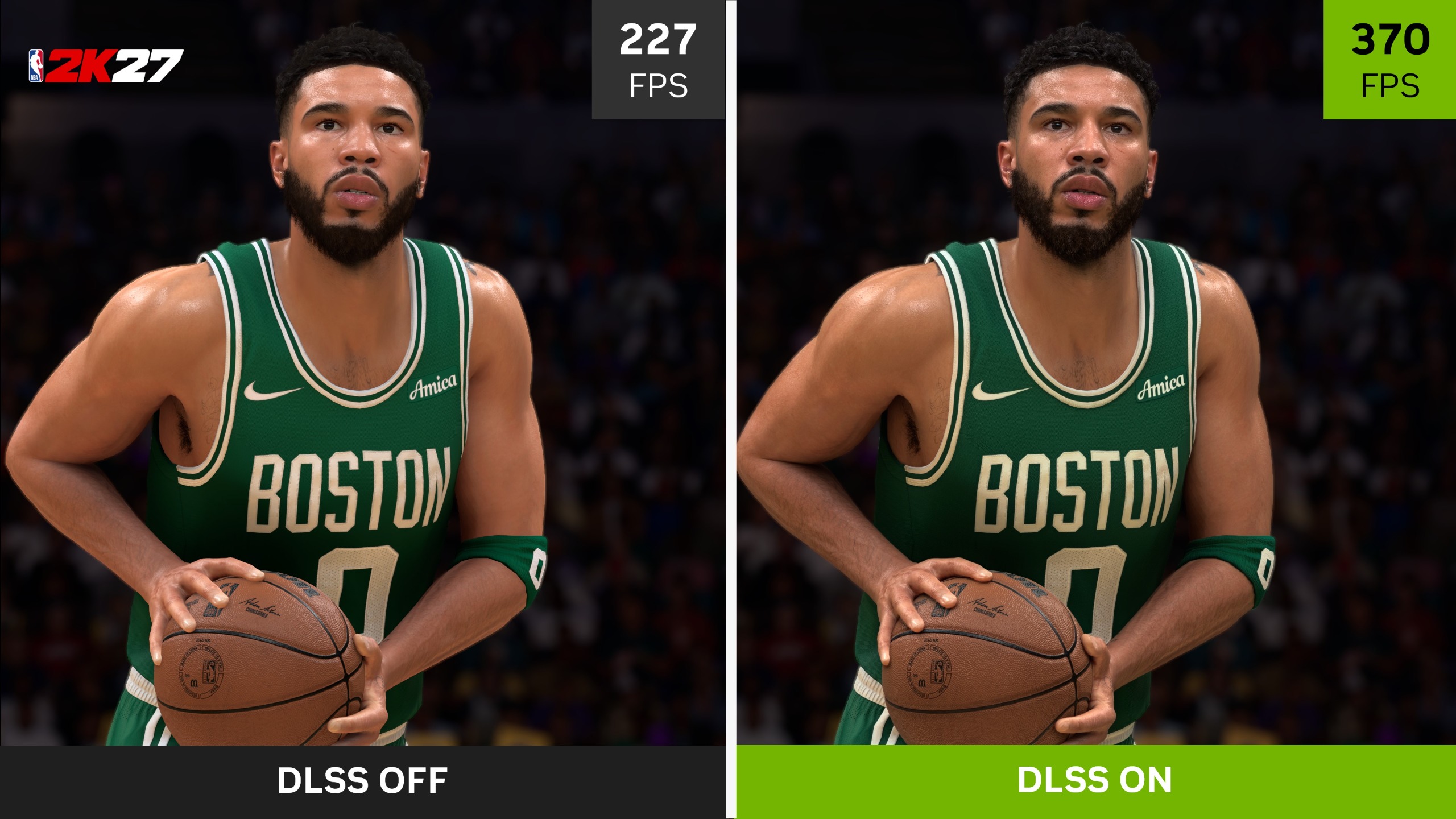
Nvidia’s marketing for NBA 2K27 has been aggressive, touting figures like 370 FPS at 4K resolution when paired with the flagship RTX 5090 GPU. However, a deeper dive into these numbers reveals a complex reality regarding how those frames are generated.

The 370 FPS figure is largely predicated on "6x Multi-Frame Generation" (MFG). In this mode, the system is synthesizing five "fake" AI-interpolated frames for every single rendered frame produced by the GPU. When stripped of these interpolated frames, the base performance is closer to 61 FPS.
While 61 FPS is certainly playable, the massive discrepancy between the raw performance and the AI-inflated frame rate has led to criticism from purists who argue that high-latency, interpolated frames do not offer the same experience as native rendering. Furthermore, because the game is being upscaled from a 1080p base to 4K, the reliance on DLSS 5 is absolute; turning the feature off results in a performance tank that renders the game significantly less smooth on current hardware.
Official Responses and the Hardware Roadmap
The initial decision to restrict DLSS 5 to the RTX 50-series caused significant backlash, particularly among RTX 40-series owners who felt their relatively recent hardware was being artificially sidelined. Following the community’s success in porting the technology, Nvidia has softened its stance.
Ben Berraondo, Head of PR at Nvidia, recently clarified the company’s roadmap: "Our current focus is on optimizing performance for the GeForce RTX 50 Series with model updates expected later this fall. Once RTX 50 Series performance is more fully tuned, we plan to work on expanding official support to the GeForce RTX 40 Series."
This admission suggests that while the hardware is theoretically capable of running the technology, the optimization overhead for the Blackwell architecture is currently so high that supporting older chips would likely result in a poor user experience. By focusing on the 50-series first, Nvidia hopes to refine the models so that when they do arrive on the 40-series—which will likely be capped at 2x MFG due to hardware limitations—the performance will be acceptable.
Implications: The Future of Neural Rendering
The launch of DLSS 5 in NBA 2K27 signals a pivot point in the gaming industry. As the line between "rendered" and "AI-inferred" blurs, several key implications emerge:
1. The Death of Optimization?
Critics, including developers behind projects like the RPCS3 emulator, have slammed DLSS 5 as "AI slop." The argument is that developers and hardware manufacturers are using AI upscaling and frame generation as a crutch to mask poor game optimization. If a game can be made to look "photorealistic" through neural inference, there is less incentive to invest in the time-consuming process of manual geometry and lighting optimization.
2. The Rise of the "Subscriber" Experience
With the technology currently best experienced on the RTX 50-series or through the "Ultimate" tier of the GeForce Now cloud gaming service, DLSS 5 is becoming a walled garden. Users who want the "next-gen" look are increasingly incentivized to either upgrade their hardware every cycle or pay for premium streaming services, further segmenting the PC gaming market.
3. The Modding Community as a Watchdog
The fact that modders were able to port DLSS 5 to older Ampere and even Turing-based cards serves as a vital check on corporate narratives. It forces companies like Nvidia to be more transparent about the capabilities—and the shortcomings—of their hardware. It also proves that "software locking" is a major part of the strategy behind modern graphical innovation.
Conclusion
DLSS 5 is undeniably a technical marvel. The ability to perform real-time, 3D-guided neural rendering in a game as complex as NBA 2K27 is a feat of engineering that would have been unimaginable just a few years ago. However, its current implementation highlights a trend toward performance-per-watt optimization that favors AI over traditional rasterization.
As we move forward, the success of DLSS 5 will not be measured by its peak frame rates in marketing materials, but by its ability to offer a tangible, high-quality improvement in visual fidelity without the "hallucinations" or input latency that currently plague the early stages of this technology. For now, the hardware community will be watching closely as Nvidia attempts to bridge the gap between its latest, most powerful silicon and the millions of users currently running last-gen hardware.
The promise of DLSS 5 is a world where games look more realistic than ever; the challenge is ensuring that the "realism" isn’t just a clever trick of the light, generated by an algorithm at the expense of genuine graphical integrity.