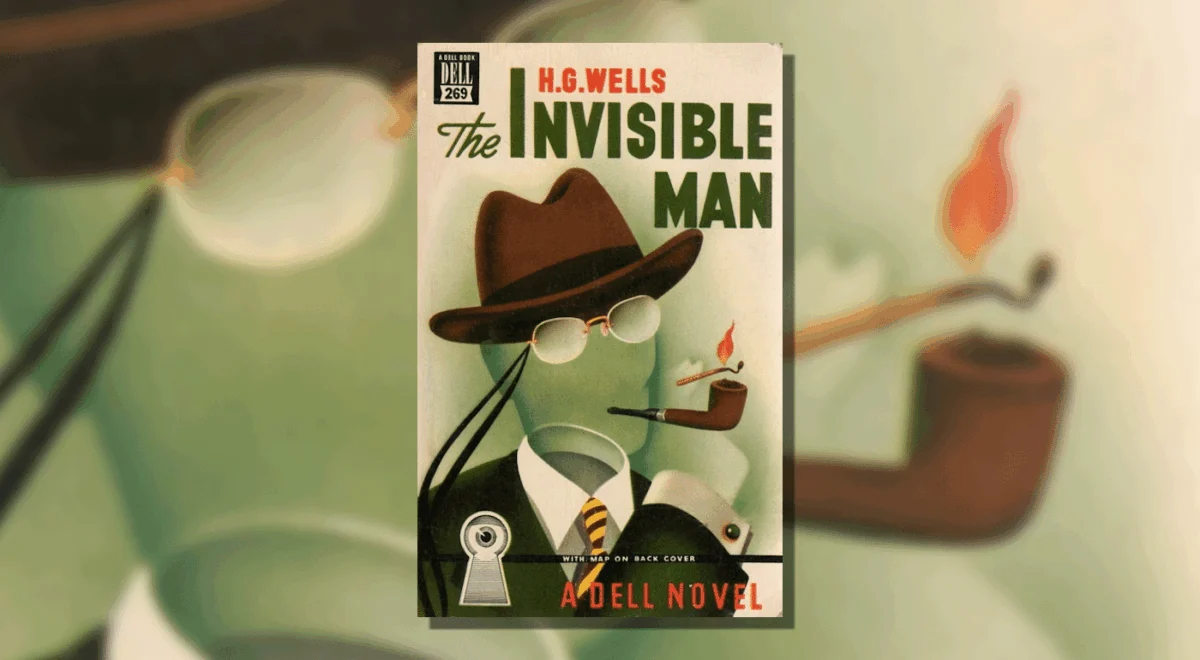
In his ongoing bi-weekly series, Front Lines and Frontiers, critic Alan Brown examines the seminal works that defined the trajectory of speculative fiction. This week, the lens turns to a pillar of the genre: H.G. Wells’ The Invisible Man. A masterclass in suspense, scientific hubris, and social isolation, this novella remains as potent today as it was upon its 1897 publication. By comparing the literary original with the landmark 1933 Universal Studios film adaptation, we gain a deeper understanding of how the concept of "invisibility" evolved from a scientific curiosity into a profound metaphor for the human condition.
The Genesis of an Icon: Main Facts and Historical Context
H.G. Wells (1866–1946) stands as a titan of literature, often cited as the "Father of Science Fiction." His early bibliography—including The Time Machine (1895), The Island of Doctor Moreau (1896), and The War of the Worlds (1898)—effectively laid the bedrock for modern genre fiction. Yet, Wells famously chafed at these labels, viewing his work not merely as escapist entertainment but as a vehicle for political discourse and social critique.
The Invisible Man was first serialized in Pearson’s Weekly before appearing in book form in 1897. The narrative follows the tragic descent of Jack Griffin, a brilliant but arrogant scientist who discovers a formula for invisibility, only to find that the price of his discovery is his sanity and his humanity. The novella’s enduring relevance lies in its grounded approach; unlike modern, high-tech iterations of the trope, Wells’ invisibility is a scientific process—a calculated, albeit obsessive, endeavor that leaves the protagonist physically vulnerable and socially discarded.
A Chronology of the Invisible Man
The journey of The Invisible Man from page to screen is a fascinating study in creative adaptation.
- 1897: The novel is published, introducing the world to Griffin, a man whose ambition leads to the destruction of his social and moral fabric.
- 1933: Universal Studios releases the film adaptation, directed by James Whale. Coming off the massive success of Frankenstein, Whale pushed the technological limits of the era, crafting a visual language for invisibility that would influence filmmakers for decades.
- 1940–1951: A wave of sequels, including The Invisible Man Returns and the comedic Abbott and Costello Meet the Invisible Man, cements the character as a cornerstone of the "Universal Monsters" brand.
- Late 20th Century to Present: The trope evolves through various lenses, from John Carpenter’s Memoirs of an Invisible Man (1992) to Paul Verhoeven’s Hollow Man (2000) and Leigh Whannell’s critically acclaimed The Invisible Man (2020), which shifts the narrative to address domestic abuse and gaslighting.
Supporting Data: Behind the Lens and the Page
The 1933 film adaptation remains a benchmark for practical effects. The production utilized black velvet, meticulous lighting, and double-exposure photography to achieve the illusion of invisibility. It was a laborious, frame-by-frame process that required immense patience.
Claude Rains, who portrayed Griffin, was a revelation. Interestingly, Rains was not the first choice for the role; however, his background—born into poverty with a thick Cockney accent—served him well. He underwent rigorous voice training to develop the smooth, cultured tone that became his signature. This vocal dexterity allowed him to command the screen through tone and inflection, even when he was obscured by bandages or entirely absent from the frame.
In contrast to the film, the original novella provides a starker, more realistic experience. In the book, there is no "chemically induced madness" or romantic subplots involving a fiancé. Instead, Wells presents a man whose descent is driven entirely by his own hubris and the psychological toll of being removed from the sight of his peers. The novella treats the village of Iping as a mundane, tangible setting, which makes the intrusion of the supernatural—the invisible man—all the more jarring and effective.
Official Responses and Creative Departures
When adapting the novel, Universal Studios faced the challenge of translating Wells’ internal, intellectual terror into a visual spectacle. Wells, who was notoriously protective of his work and wary of previous poor adaptations, demanded—and received—script approval. This ensured that while the film introduced elements of melodrama and comic relief (such as the character of the innkeeper’s wife, played by Una O’Connor), the core essence of the tragedy remained intact.

James Whale’s decision to move away from the direct sequel structure of his Frankenstein series and instead explore a new scientific disaster highlights the creative autonomy of the era’s directors. The studio’s commitment to "The Invisible Man" as a recurring brand allowed the concept to survive multiple iterations, eventually becoming a staple of pop culture, appearing everywhere from Star Trek’s Klingon cloaking devices to the Fantastic Four’s Invisible Woman.
Implications: The Psychological Weight of Invisibility
The cultural fascination with invisibility is not merely about the power of disappearing; it is about the implications of the "unseen." Throughout the history of the character, the narrative has shifted to reflect the anxieties of the time. In Wells’ original, the anxiety was rooted in the danger of unchecked scientific ambition and the isolation of the intellectual class. In the 1933 film, it became a monster movie—a cautionary tale of a man who loses his place in society and turns to malice to reclaim it.
Modern adaptations have pushed the metaphor further. The 2020 iteration by Leigh Whannell, for instance, uses the concept of the invisible to explore the terrifying reality of being trapped by an unseen abuser. This proves that the core of Wells’ original idea—that to be invisible is to be detached from the social contract—is a universal concept.
Furthermore, Wells’ influence extends into unexpected territories. As an early pioneer of war gaming, he understood the value of tactical simulation. In many ways, his literary work functioned as a simulation of social collapse. He forced his readers to ask: If we could disappear, would we use that freedom for the betterment of society, or would we, like Griffin, succumb to the urge to dominate?
Final Thoughts: A Legacy of Reflection
The Invisible Man serves as a bridge between Victorian science fiction and the modern psychological thriller. Whether one prefers the nuanced, grounded prose of Wells’ novella or the high-stakes, visual drama of the 1933 film, the story remains a quintessential exploration of the human shadow.
Claude Rains’ performance continues to resonate, reminding us that an actor’s power lies not just in their visibility, but in their presence. Wells’ writing remains a gem of the genre, proving that the most terrifying monsters are not those with claws and fangs, but those who are indistinguishable from us, save for their loss of empathy.
As we look toward the future of the genre, the legacy of The Invisible Man reminds us that speculative fiction is at its best when it holds a mirror to our own nature. Invisibility is not just a scientific formula; it is the ultimate test of the soul. When no one is watching, who are we? That is the question H.G. Wells posed over a century ago, and it is a question we are still answering today.
What are your thoughts on the legacy of the Invisible Man? Do you find the original novella’s grounded realism more effective, or does the cinematic spectacle of the Universal monster era define the character for you? Join the conversation and share your favorite examples of the "unseen" in science fiction.