
 Ali Ikhwan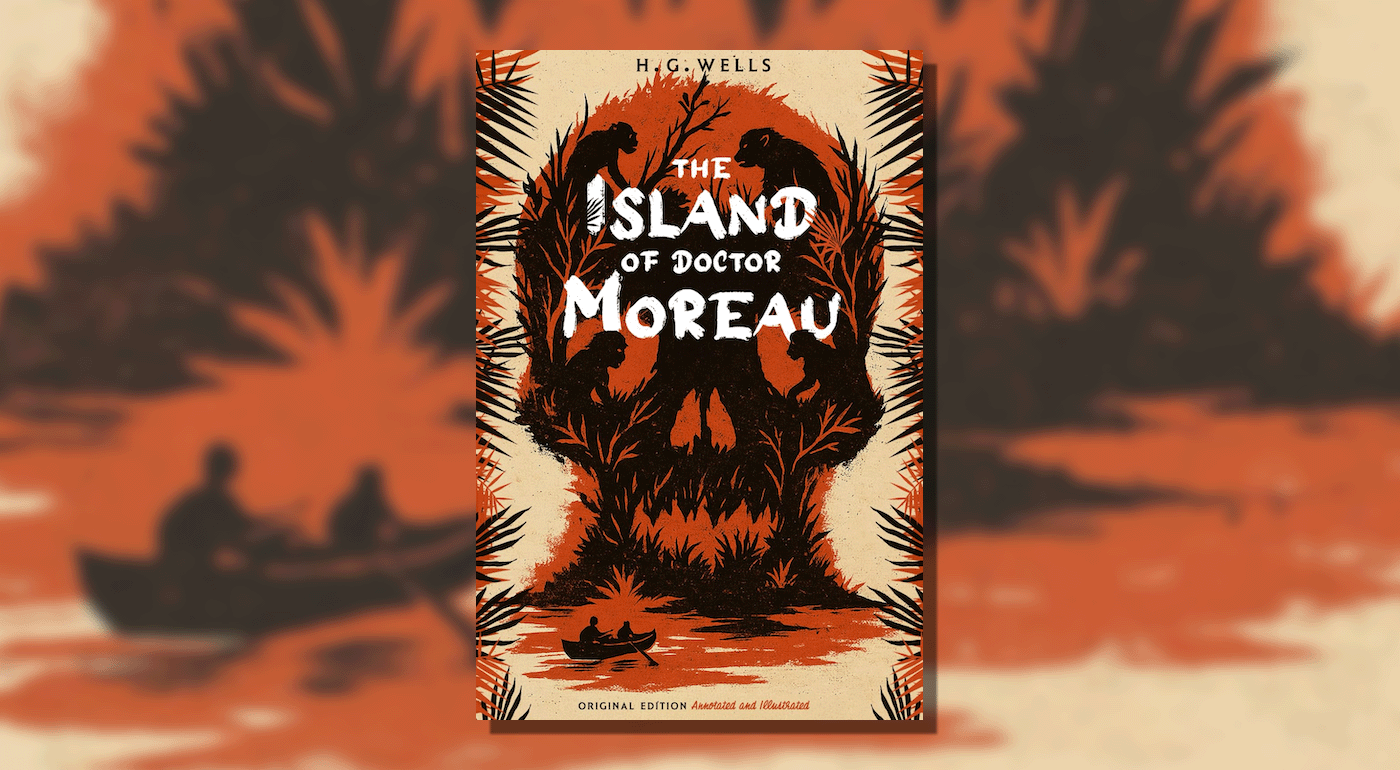
In the annals of speculative fiction, few texts have maintained their power to unsettle, provoke, and horrify as effectively as H.G. Wells’ 1896 masterwork, The Island of Doctor Moreau. As part of the ongoing Reading the Weird series, we turn our critical lens to Chapters 13–15, a pivotal sequence where the narrative shifts from a survivalist struggle into a profound, chilling philosophical discourse on the nature of suffering, the limits of scientific ambition, and the definition of humanity itself.
Main Facts: The Intersection of Man and Beast
The narrative arc of these chapters follows Edward Prendick, a shipwrecked survivor who finds himself trapped on an isolated Pacific island under the stewardship of the disgraced surgeon Doctor Moreau and his assistant, Montgomery.
Having escaped the immediate threat of being vivisected into an animal-hybrid himself, Prendick is forced into a harrowing "parley." Through a combination of threats and uneasy truces, Moreau deigns to explain his life’s work. The "Beast Folk"—the tragic, malformed denizens of the island—are not merely monsters; they are the result of a radical, systematic, and agonizing process of surgical and psychological "humanization." Moreau’s work encompasses everything from skin grafting and limb rearticulation to the suppression of base instincts through rigorous, if cruel, conditioning.
This is not a tale of accidental discovery; it is a clinical, detached mission to explore the "plasticity of living flesh." The primary conflict is no longer physical survival, but a confrontation between the traditional, empathetic human morality represented by Prendick and the cold, ruthless "scientific" rationalism championed by Moreau.
Chronology of Events: From Parley to Understanding
The progression of these three chapters serves to systematically strip away Prendick’s comfort.
- Chapter XIII (A Parley): Prendick, attempting to flee, finds his path blocked by Moreau, Montgomery, and their creations. Faced with the choice of suicide or submission, Prendick enters into a dialogue with the doctor. He accuses Moreau of infecting the creatures with a "bestial taint," only for Moreau to retort with cold logic: he is not a creator of monsters, but a scientist pushing the boundaries of physiological potential.
- Chapter XIV (Doctor Moreau Explains): This chapter functions as the intellectual heart of the sequence. Seated in a "guest room" and armed with revolvers—which Moreau coolly allows him to keep—Prendick listens as the doctor outlines his philosophy. Moreau characterizes pain as a primitive, animalistic warning system that a higher intelligence should seek to transcend. His work is described as a "strange, colorless delight," an intellectual pursuit that renders empathy irrelevant.
- Chapter XV (Concerning the Beast Folk): The focus shifts to the practical management of the island’s sixty-plus inhabitants. Montgomery provides insight into the "Law"—a set of religious-like prohibitions enforced by the threat of the "House of Pain." The chapter catalogs the various hybrids, from the Leopard-Man to the Sayer of the Law, painting a picture of a failed, unstable society held together by fear and surgical indoctrination.
Supporting Data: The Anatomy of a Mad Science
To understand the gravity of Wells’ vision, one must look at the specific mechanisms Moreau employs. The text details a comprehensive, if nightmarish, methodology:
- Surgical Intervention: The use of vivisection to alter vocal apparatuses, bone structure, and physical appearance.
- Psychological Conditioning: The implementation of the "Law" to suppress animalistic urges.
- Biological Manipulation: The use of blood transfusions and hormonal regulation to maintain these unstable, synthetic forms.
The statistics of the island are equally stark. Moreau claims to have created approximately 120 creatures over his tenure, with roughly 60 currently surviving. The high mortality rate, the presence of "smaller monstrosities," and the inability of the creations to breed true suggest a perpetual, desperate cycle of creation and failure. These numbers, however, represent more than just biological data; they represent a body count of failed, sentient experiments existing in a state of perpetual, manufactured suffering.
Official Responses and Philosophical Implications
The literary and philosophical response to The Island of Doctor Moreau has been as contentious as the doctor’s own experiments.
The Question of Hubris
A common critique labels Moreau as a "mad scientist" driven by the sin of hubris—the desire to play God. However, closer analysis suggests his flaw is not arrogance, but a total, chilling lack of moral grounding. Unlike Victor Frankenstein, who abandons his creation out of horror at his own act, Moreau views his creations with the detached interest of a sculptor. He is not "playing God" in the sense of desiring power; he is seeking the "bright, clear line" of scientific discovery, regardless of the carnage left in his wake.
The Vivisection Controversy
When Wells wrote this, the debate over vivisection was at a fever pitch in British society. Critics like P. Chalmers Mitchell attacked the book for its "bloodiness," yet Wells himself later defended the necessity of regulated, scientific research. The text acts as a mirror for the reader’s own discomfort: at what point does the pursuit of knowledge become an affront to the dignity of living things? Prendick himself admits he might support such work if it had "application," highlighting the hypocrisy inherent in societal views on animal experimentation.
The Theological Underpinnings
Moreau’s assertion that he is religious "as every sane man must be" is perhaps the most disturbing element of his character. By framing pain as the "mark of the beast" and ethics as a "provincial" concern of the lower soul, he justifies his atrocities as a form of divine, or at least natural, order. The "House of Pain" is essentially a secular, surgical hell designed to enforce obedience—a direct parallel to the punitive aspects of organized religion.
The Humanization of the Reader
Ultimately, the power of these chapters lies in how they force the reader to confront their own definitions of humanity. As Prendick spends more time with the Beast Folk, his horror begins to morph into a cynical resignation. He starts to see the Bull-Man as a laborer and the Fox-Bear as a shifty acquaintance.
The implication is devastating: humanity may not be a divine gift or a biological constant, but a thin, fragile veneer that can be stripped away, manufactured, or conditioned. When we witness the creatures’ struggle to maintain their "humanity" in the face of their animal instincts, we are forced to ask if our own "humanity" is anything more than a similarly fragile construct maintained by our own, less visible "Laws."
In the final analysis, Moreau is not a man who has lost his mind; he is a man who has lost his capacity for empathy—a state that may be the most "inhuman" condition of all. As he continues his work, obsessed with the "plasticity of living flesh," he remains a warning against a future where scientific capability outpaces moral evolution. Through Wells’ haunting prose, we are reminded that the line between the man and the beast is often drawn not in the laboratory, but in the heart of the one holding the scalpel.

 Nana Wu
 Layla Zulfa





