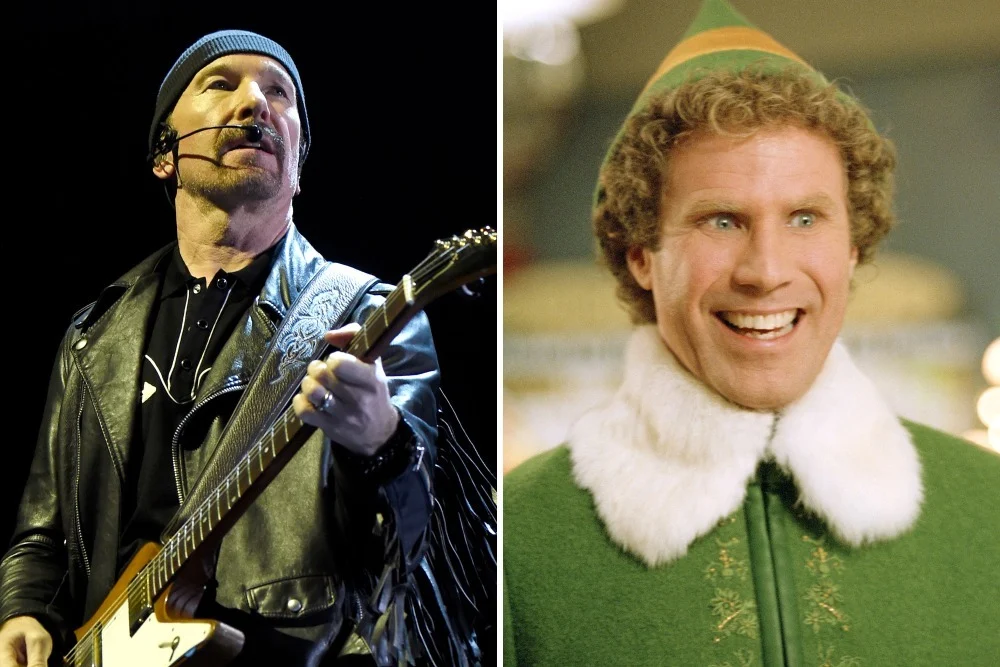
For over two decades, the 2003 film Elf has stood as a monolithic achievement in the holiday cinematic canon. Directed by Jon Favreau and anchored by Will Ferrell’s transcendent performance as Buddy, the fish-out-of-water story of a human raised by North Pole elves has become a cultural touchstone. Yet, beneath the tinsel and the maple syrup-covered spaghetti lies a secret history of Hollywood "what-ifs."
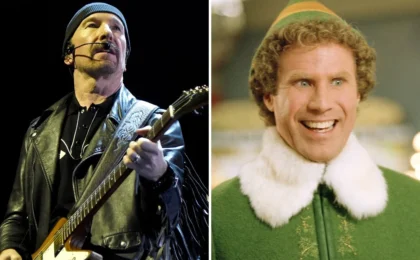
Recent revelations from actor and comedian Andy Richter—who appeared in the film as a colleague of James Caan’s Walter Hobbs—have peeled back the curtain on the bizarre, unproduced attempts to turn the standalone classic into a franchise. Most notably, these efforts included a mysterious, abandoned script penned by none other than David Howell Evans, better known as The Edge of the rock band U2.
The Genesis of an Unlikely Sequel: The Edge’s Secret Manuscript
On a recent episode of Obsessed: The Podcast, Richter provided an account that sounds more like a Hollywood urban legend than a piece of industry history. According to Richter, Shauna Robertson, the esteemed producer behind the original Elf, was once approached with a proposition that seemed to defy logic: a full-length screenplay for an Elf sequel written by the lead guitarist of one of the world’s most iconic rock bands.
"Somebody reached out to her and said, ‘The Edge from U2 has written a sequel to Elf, and he wants to talk to you about it,’" Richter recounted.
The proposal was not merely a pitch or a rough outline; according to the information relayed to Robertson, the script was "fully written." For fans of both cinema and rock history, this raises an array of questions: Did The Edge envision a musical component? Was it a dark, atmospheric reimagining, or a whimsical continuation of Buddy’s journey?
Richter admits that the story is "the weirdest thing," noting that while a meeting was briefly considered, the project ultimately vanished into the ether. "Somewhere in the world, there is an Edge-penned Elf 2 out there," Richter mused. "I would love for that to make the light of day. It never happened. It’s one of those things where [Robertson] was like, ‘All right, sure, I’ll meet him,’ and then it just petered out and never happened."
A Pantheon of Failed Follow-Ups
The Edge was not the only creative voice to attempt to unlock the potential of a sequel. Richter disclosed that the studio had been approached by other writers, most notably Scot Armstrong, the scribe behind Old School and The Hangover Part II.
Armstrong, who had actually contributed to the original Elf script—though he remained uncredited due to Writers Guild of America (WGA) regulations—had a distinct vision for where the franchise could go. His pitch involved a narrative shift toward the "evil South Pole elves" who would kidnap Santa Claus.
This revelation highlights a frantic period of "sequelitis" that often grips studios following the runaway success of a sleeper hit. Elf grossed over $220 million worldwide against a modest budget, making it an obvious candidate for a franchise in the eyes of executives. However, the disconnect between these pitches and the source material’s grounded, emotional heart suggests that the industry struggled to grasp why the film worked so well in the first place.
The Anatomy of a Classic: Why Elf Defied the Odds
To understand why a sequel never manifested, one must look at the specific alchemy of the 2003 film. Directed by Jon Favreau, Elf served as a bridge between the cynical, high-concept comedies of the 90s and the heartfelt, character-driven narratives of the 2000s.
Will Ferrell’s performance as Buddy was not just comedic; it was a masterclass in sincerity. By playing a grown man who believes he is an elf with absolute, unblinking conviction, Ferrell bypassed the "wink-and-a-nod" irony that was prevalent in film at the time. When paired with the late James Caan’s grounded, often prickly performance as the "naughty-list" father, Walter Hobbs, the film achieved a poignant emotional resonance that is difficult to replicate.
The supporting cast, including Zooey Deschanel, Mary Steenburgen, and Bob Newhart, added layers of world-building that felt complete. When the credits rolled, the narrative arc—Buddy finding his family, winning over his father, and saving Christmas—felt finished. There was no "cliffhanger" to resolve, and the character development reached a natural conclusion.
The Case for Preservation: Richter’s Stance on Legacy
Despite his own involvement in the production and his current role as an authority on the film’s history—having recently co-authored the book Elf Unwrapped: Behind the Scenes of a Modern Christmas Classic—Andy Richter is a staunch opponent of a sequel.
His reasoning is both philosophical and pragmatic. "I’m on the side of ‘Let it stand,’" Richter stated. "Just let Elf be Elf. You don’t have to use every part of the animal."
Richter’s argument touches on a growing sentiment among cinephiles regarding the "tarnishing" of beloved classics. In an era where intellectual property is often mined until it loses its luster, Richter believes that the passage of time has only served to elevate Elf.
"Now that time has passed, the movie has become so special that I think that people, rightfully so, are loath to mess with it," he explained. "We all can think of movies that have been tarnished by their sequels. And this is so special and so perfect and so beloved… Why risk it?"
The Implications of the "Lost" Scripts
The existence of these scripts serves as a fascinating case study in the difference between studio desire and creative integrity. For years, rumors have circulated about Will Ferrell’s own reluctance to return to the role, with reports suggesting he turned down an astronomical sum—reportedly $29 million—to reprise his role for a second film. Ferrell has previously noted that the prospect of doing a mediocre sequel felt like an insult to the original, echoing the sentiment that some stories are best left as singular artifacts.
The Edge’s script, in particular, represents the intersection of pop culture worlds. That a legendary musician would take the time to write a screenplay for a Christmas comedy suggests that the impact of Elf reached far beyond the confines of the film industry. It became a cultural touchstone that inspired artists to want to "play" in that sandbox.
However, the fact that these scripts never reached production is a testament to the discipline of those involved. It suggests a rare moment of restraint in an industry often defined by its inability to stop while ahead.
A Legacy of Integrity
As the 23rd anniversary of the film’s release approaches, the lore surrounding Elf continues to grow. From the behind-the-scenes tensions on set to the "what-if" scenarios involving legendary rock stars, the film remains a subject of intense public fascination.
Yet, perhaps the most important part of the Elf story is what did not happen. By resisting the urge to expand, dilute, or "franchise" the story of Buddy the Elf, the creators ensured that the film remains a pristine time capsule of a specific moment in comedy.
In his new book, Elf Unwrapped, Richter provides an exhaustive look at how the magic was made, offering fans a deeper appreciation for the work without compromising the film’s integrity. For the audience, the lesson remains clear: true classics don’t need sequels. They simply need to be remembered, rewatched, and kept, like the best of Christmas traditions, exactly as they are.
Somewhere in a desk drawer in Hollywood, or perhaps in a private archive in Dublin, lies the "Edge-penned Elf 2." And for now, it is likely best that it stays there—a mysterious, footnote-sized reminder that not every idea needs to be a blockbuster, and not every story needs a second act.