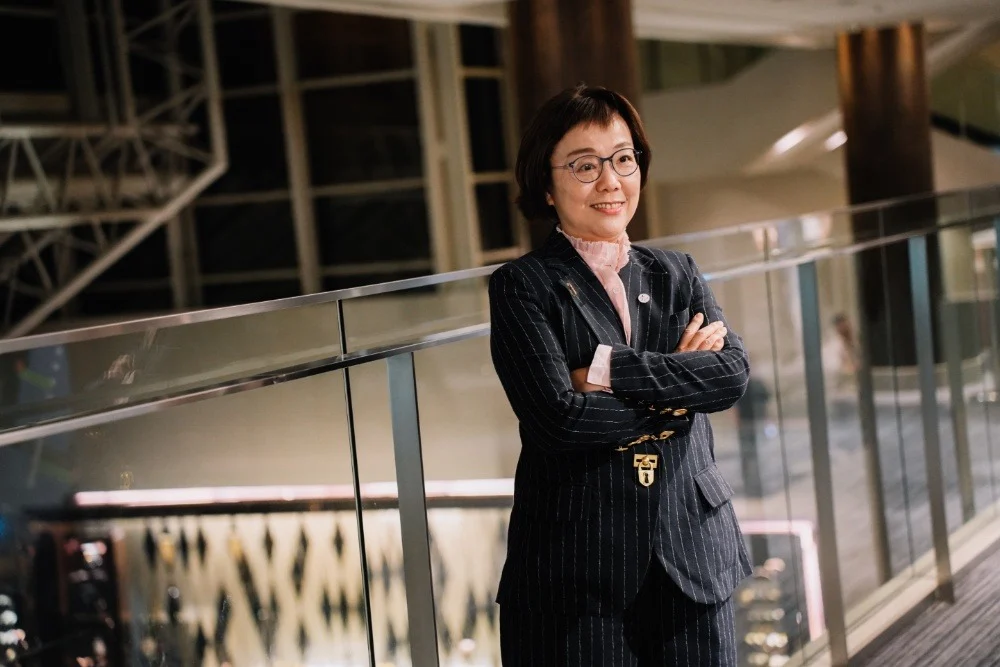
As the 2026 Taiwan Creative Content Fest (TCCF) opens its doors in Taipei from November 6–9, the island’s cultural landscape stands at a critical juncture. For years, Taiwan has been lauded for its vibrant artistic output, yet the transition from "vibrant scene" to "global powerhouse" remains the primary challenge for industry leaders. At the center of this transformation is Sue Wang, chair of the Taiwan Creative Content Agency (TAICCA), who is spearheading a fundamental shift in strategy: moving away from a reliance on sporadic subsidies toward a rigorous, business-first model focused on Intellectual Property (IP) commercialization.
The Paradigm Shift: Prioritizing Scalable Business Models
For Wang, the central challenge facing Taiwanese creators is no longer a lack of talent or artistic vision, but a deficiency in the mechanics of scalability. "The challenge is not simply whether we can create good content," Wang stated as the TCCF festivities commenced. "It is whether companies have the capabilities and business models to turn creative ideas into sustainable revenue, build scalable businesses, and reach audiences across different markets."
Wang’s philosophy is clear: capital injection is not a panacea. "Without a viable business model that has been tested in the market, simply introducing more funding or investment programs will not necessarily create a sustainable growth cycle," she warned.
TAICCA’s current strategy is built on a "capabilities-first" approach. Before the agency pushes for international distribution or large-scale growth capital, it is working to help domestic production houses strengthen their foundational business pillars—pricing strategies, licensing frameworks, branding, and audience development. The logic is sound: by building IP with demonstrated market potential, producers reduce the inherent risks of the entertainment business, making their projects more attractive to global investors and distributors.
Chronology and Evolution of TCCF
The TCCF has evolved rapidly since its inception, becoming the primary nexus for Taiwan’s engagement with the global entertainment industry. This year’s edition, themed "Reshape," reflects an industry in the midst of tectonic shifts.
- Pre-Event Momentum (October 2026): By October 30, TAICCA had successfully funneled NT$560 million ($17.1 million) into 24 international co-financing and co-production projects. These partnerships span 15 countries and cover diverse formats, including feature films, series, and animation.
- November 6–9 (TCCF Event Days): The TCCF Market is hosting 107 exhibitors from seven countries, marking a significant 13% increase in participation from the publishing, comics, and character-IP sectors compared to last year.
- Spotlight Screenings: On November 7, the festival presented April, followed by the Taiwan-Singapore series See You at 11pm on November 8. These sessions are strategically designed to bolster the international profile of Taiwanese talent, providing a direct pipeline between international buyers and the creative teams behind the projects.
Supporting Data: Investment, Co-Production, and Growth
The data underscores TAICCA’s ambition to move beyond local borders. The agency’s co-production efforts are already yielding tangible results on the global festival circuit. A prime example is the Taiwan-Japan collaboration Arrested Memory, which secured a prestigious selection for the Venice Open (Out of Competition) at the 83rd Venice Film Festival, as well as a slot in the Midnight Madness section of the 51st Toronto Film Festival.
Beyond public funding, TAICCA is successfully leveraging private capital. Through the Taiwan-Korea Entertainment and Cultural Content Fund and the Far EasTone Creative Entertainment Fund’s Enjoy Entertainment Limited Partnership, approximately NT$600 million ($18.3 million) in private capital has been mobilized. This capital has backed 12 major projects, including:
- Music Festivals: The Kaohsiung Park Music Festival (a collaboration with CJ ENM’s Seoul Park Music Festival) and the 2026 ID. Music Festival (partnered with Spotify).
- Concert IP: Her Voice: The Fearless Female Voice.
- Film: The road movie Lonely Together and the latest entry in the successful horror franchise The Rope Curse 4: Kuntilanak.
Strategic International Alliances
TAICCA’s roadmap for growth is heavily reliant on deepening bilateral ties. With France, the agency is focusing on "Cultural Tech," a sector where Taiwan and France have shared interests for over a decade. The upcoming 30th anniversary of the Taiwan-France Cultural Award in 2027 serves as a milestone for this enduring partnership.
Similarly, in South Korea—a market that has mastered the art of IP commercialization—TAICCA is looking to diversify. Moving beyond screen content, the agency is targeting collaborations in independent music, live venue management, and the performing arts, aiming to mirror the successful "360-degree" IP ecosystem that has propelled the Korean Wave globally.
The AI Dilemma: A Cautious Approach
In an era where Artificial Intelligence is dominating headlines, Wang remains pragmatic. TAICCA views AI primarily as a technical utility—a tool for post-production, visual effects, and animation optimization. However, the agency remains deeply skeptical of generative AI’s role in "core creative work," such as scriptwriting or musical composition.
Wang cites two major concerns: the uncertainty of public acceptance and the hidden labor costs. "Generative AI often requires a massive amount of human correction," she noted. "We don’t want to see a situation where people end up working as assistants to AI." This cautionary stance highlights TAICCA’s focus on preserving the human-centric, culturally specific essence of Taiwanese content, which it believes is the key to long-term audience loyalty.
Implications: The Three-Year Horizon
The implications of TAICCA’s current trajectory are significant. By focusing on "Reshaping" the industry, Wang hopes to achieve three clear objectives within the next three years:
- Industrial Consolidation: The emergence of several medium-to-large-scale production houses capable of producing over 10 titles annually. This would provide the necessary volume to compete with larger international studios.
- Institutionalized Co-Production: Transitioning international co-production from an occasional experiment to a standard, daily operational practice.
- Investment Diversification: Encouraging a steady influx of capital from the technology and private sectors, ensuring that the industry is not solely dependent on state support.
"There is no established playbook or ready-made solution for navigating the changes currently taking place in the industry," Wang concluded. Yet, by prioritizing the rigor of business development alongside creative flair, TAICCA is drafting its own playbook.
As the TCCF concludes, the message to the international market is clear: Taiwan is no longer just looking to showcase its stories; it is building the infrastructure to ensure those stories are sold, scaled, and sustained on the global stage. For investors and partners, the message is equally precise—Taiwan’s creative industry is open for business, provided that business is built on a foundation of professional, scalable, and market-ready IP.