

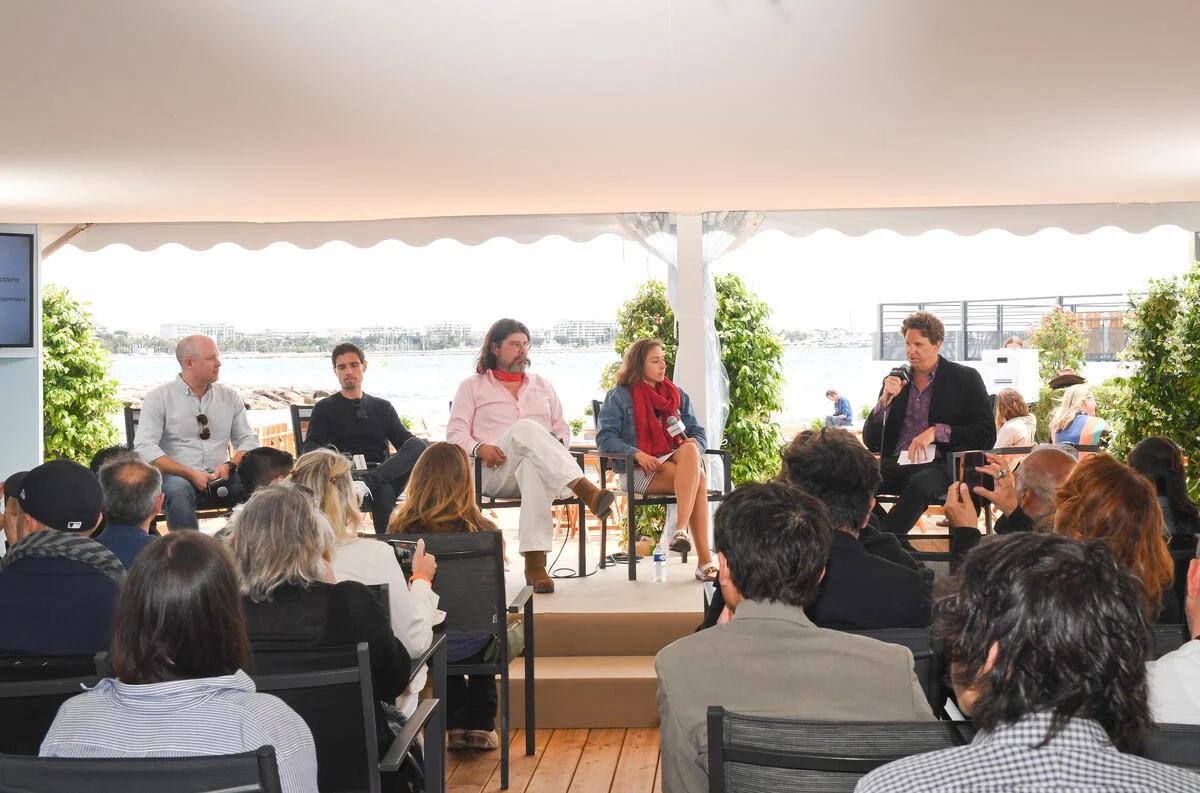
The global independent film industry stands at a precarious crossroads. As production costs soar and traditional distribution models fracture under the weight of streaming dominance and changing audience habits, the “labor of love” that defines indie cinema is facing an existential fiscal challenge. At the 2026 Cannes Film Festival, held within the hallowed grounds of The American Pavilion, industry leaders gathered to address this instability. The resulting panel, The New Playbook for Independent Film: From Financing to Distribution in the Age of AI, moderated by Clever Caboose Founder and CEO Andrei Bulawka, served as a rallying cry for innovation without the erosion of artistry.
The discussion, featuring a diverse cross-section of industry expertise, moved beyond the speculative fear-mongering often associated with artificial intelligence. Instead, it offered a pragmatic look at how emerging technologies might actually secure the future of the independent sector.
The Financial Landscape: Why the Old Rules No Longer Apply
For decades, the independent film financing model relied on a predictable, if narrow, path: pre-sales, tax incentives, and the potential for a splashy festival acquisition. Today, those pillars are buckling. Rising labor costs, the impact of post-pandemic inflation on physical production, and the sheer volume of content flooding the market have made it harder than ever for mid-budget projects to secure the necessary capital to reach the screen.
During the panel, the participants acknowledged that the "tougher" economics mentioned by filmmakers are not merely a temporary dip but a fundamental shift in the industry’s architecture. As production costs rise and return on investment (ROI) trajectories flatten, producers are forced to confront a brutal reality: they must either scale back their creative ambitions or find radical efficiencies in their logistical pipelines.
A Chronology of Disruption: From Traditional Models to AI Integration
The discourse at The American Pavilion underscored a timeline of evolution in how independent films are realized.
- The Pre-Digital Era: Historically, the bottleneck for indie films was physical infrastructure—the cost of film stock, the difficulty of distribution, and the reliance on traditional studio gatekeepers.
- The Digital Democratization: The early 2000s saw a rise in independent output thanks to digital cameras and non-linear editing. This lowered the barrier to entry but simultaneously created a saturated marketplace.
- The Current Crisis (2024–2026): We are now in a phase where technology has become too accessible, leading to an over-saturation that devalues the individual product. At the same time, the cost of top-tier talent and high-quality production value has skyrocketed, leaving the "indie middle class" struggling to compete.
- The AI Pivot: As of 2026, the focus has shifted toward "intelligent production." The conversation is no longer about whether to use AI, but how to use it as a surgical tool to reduce overhead without compromising the final image.
Industry Perspectives: The Panelists Speak
The panel brought together four distinct voices—Viviana Zarragoitia (TPC), Torsten Ruether (Hello Moment Productions), Josh Spector (Grindstone Entertainment), and Ryan Black (Luma AI)—to delineate where these efficiencies lie.

Viviana Zarragoitia on Capital Efficiency
Viviana Zarragoitia, Executive Vice President at TPC, emphasized that the integration of AI is not a creative replacement but a fiscal lifeline. "I think AI is becoming a tool, especially for independent film," she stated. "You can have some cost savings as part of your budget. A lot of independent producers are finding it worthwhile that there is this tool that keeps their costs low and minimal." For Zarragoitia, the focus is on the bottom line: if AI can handle the "grunt work" of production—be it in logistics or administrative overhead—the capital saved can be redirected toward the onscreen talent or the director’s vision.
Ryan Black on Pre-Production and Greenlighting
Ryan Black, Entertainment Account Executive at Luma AI, addressed the granular reality of getting a film greenlit. He noted that the primary hurdle for most projects is the initial budget. "Most of the films that are trying to get greenlit are having similar issues," Black explained. "They need to figure out a way to either shave a day off the schedule or a hundred thousand dollars off the budget." By using AI-driven pre-visualization and efficiency-focused production tools, creators can present a more attractive financial package to investors, effectively lowering the barrier to entry for risky, innovative narratives.
Torsten Ruether on Preserving the ‘Soul’
Perhaps the most poignant contribution came from writer/director/producer Torsten Ruether. While acknowledging the utility of modern tools, he provided a necessary moral check. "We have to consider all the tools, and we do," Ruether said. "There’s a lot of fantastic tools, no doubt about it. But what I also think… we have to protect the soul of it. Not lose the soul, protect the soul, and consider all those tools with a lot of sensibility." This sentiment resonated throughout the room, serving as a reminder that a film’s value is derived from its human perspective—a factor that no algorithm can replicate.
Supporting Data: The Cost of Production and the AI Advantage
While the panel provided qualitative insights, the underlying data supports their assertions. Industry reports from 2026 show that independent films utilizing AI for post-production tasks—such as rotoscoping, color grading automation, and background enhancement—have seen a reduction in post-production costs by approximately 15% to 20%.
Furthermore, AI-driven scheduling software has allowed producers to optimize shooting days, reducing the "dead time" that often plagues independent sets. By trimming even two days off a twenty-day shoot, producers can save tens of thousands of dollars in equipment rental, catering, and crew labor, directly impacting the film’s break-even point.
The Implications for Independent Cinema
The implications of this "new playbook" are profound. If the independent film industry successfully adopts AI as a tool for efficiency, we may witness a renaissance of mid-budget, high-concept storytelling.

1. Democratizing High-Concept Visuals
Historically, genres like science fiction or historical drama were off-limits to independent filmmakers due to the high cost of visual effects. With the rapid evolution of generative AI, the ability to create high-quality environments and set extensions is becoming affordable. This will likely lead to an influx of imaginative, genre-defying indie cinema that was previously locked behind studio-level budgets.
2. The Shift in Labor Dynamics
While the panelists were optimistic, there remains a legitimate concern regarding the labor market. If AI replaces certain post-production roles, the industry must prepare for a transition. However, the panel suggested that the focus should remain on "human-in-the-loop" workflows. Instead of replacing editors, the industry should look to empower them with tools that allow them to accomplish more in less time, perhaps allowing for more ambitious creative choices within the same timeframe.
3. Distribution in a Crowded Market
Distribution remains the final frontier. With the rise of AI-driven analytics, producers can now better understand their target demographics before a single frame is shot. By aligning the production process with data-backed insights, independent filmmakers can craft marketing strategies that cut through the noise of the streaming era, ensuring their films find their specific, dedicated audiences.
Conclusion: The Path Forward
The consensus from the Cannes panel was clear: the independent film industry is at a point of no return, but that does not mean it is at an end. By embracing the technological advancements of the age—not as a substitute for creativity, but as a scaffold for it—filmmakers can continue to tell the stories that define our culture.
As Andrei Bulawka noted, the goal is to find a balance. The "New Playbook" is not a set of instructions for building a soulless, automated product, but rather a strategy for protecting the human element of filmmaking by removing the financial barriers that currently threaten to stifle it. If the insights shared at The American Pavilion are any indication, the future of independent cinema will be defined by those who are brave enough to experiment with the new, while remaining fiercely protective of the old.
For the independent filmmaker, the message is simple: use the tools to lower the stakes of production, so you can raise the stakes of your storytelling. The "soul" of cinema, it seems, is not in the process, but in the vision—and as long as that vision remains human, the art form will endure.











No comments yet. Be the first to join the conversation!