In the world of PC building, the pursuit of lower temperatures is often an obsession. Enthusiasts spend thousands on liquid cooling loops, high-static-pressure fans, and thermally efficient cases, all in the name of shaving a few degrees off their CPU and GPU temperatures. However, for Reddit user u/Motor_Attention1865, the objective wasn’t just about protecting silicon—it was about reclaiming the comfort of his living space.
Tired of his high-performance rig turning his home office into an inadvertent sauna, this intrepid modder engineered a custom, exterior-vented cooling loop that effectively turns his PC into a mini-split air conditioning unit. By physically routing his thermal load outside, he has not only achieved sub-ambient cooling performance but also solved a domestic climate control issue that plagues many power users.
Main Facts: The Architecture of the Loop
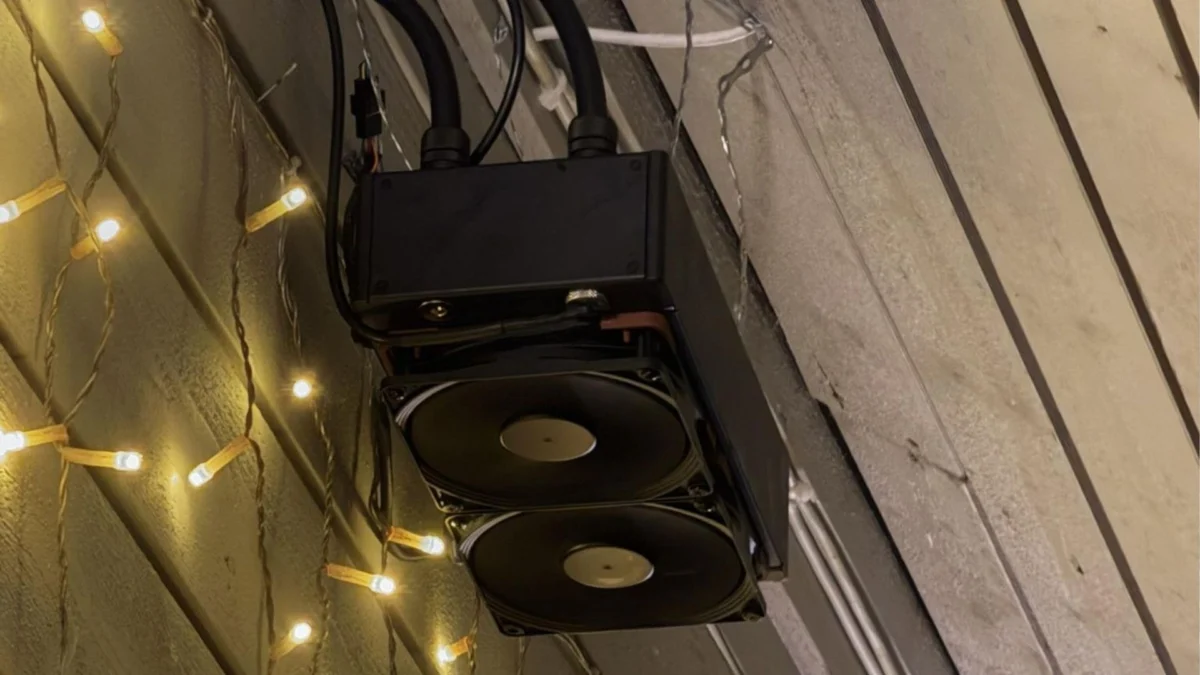
At the heart of this project is a sophisticated integration of custom liquid cooling and automation. Rather than relying on traditional indoor radiator dissipation, the user constructed a secondary loop that exits the building envelope.
The system utilizes an Arduino Mega as the central "brain." This microcontroller monitors the thermal output of the PC and manages the flow of coolant based on real-time data. The core of the mechanical assembly is a three-way valve system that dictates whether the coolant circulates through the standard internal loop or is diverted to the external radiator setup.
Perhaps the most impressive technical feat is the inclusion of an anti-condensation protocol. When dealing with sub-zero external temperatures, the risk of the coolant dropping below the dew point—which could cause moisture to condense on internal PC components and lead to catastrophic short-circuits—is significant. The Arduino manages this by carefully regulating the loop, ensuring the coolant temperature remains safely above the dew point regardless of the intensity of the external chill.
Chronology: The Evolution of a Mod
The genesis of this project began with a simple, relatable frustration: the "space heater" effect. As high-end components like the RTX 4090 and modern multi-core processors continue to push power draws past the 400W and 500W marks, the heat rejected into a small room becomes non-trivial.
The Initial Frustration
For u/Motor_Attention1865, the problem was exacerbated by his room’s heated flooring. Even when the outside ambient temperature dropped to a frigid 25°F (-4°C), the localized heat trapped under his desk created an uncomfortable microclimate. The initial "solution" was analog and inconvenient: manually opening a window to vent the heat. However, this proved to be an inefficient and labor-intensive way to regulate temperature, often leading to rapid swings in room comfort.
The Design Phase
Moving from manual ventilation to an engineered solution required careful planning. The modder had to account for fluid dynamics, the viscosity of coolant at freezing temperatures, and the structural integrity of the wall penetration. The transition from a closed-loop system to an external split-loop required sourcing industrial-grade tubing capable of handling the elements and selecting a radiator that could withstand the thermal shock of moving between indoor and outdoor environments.
Implementation and Calibration
Once the plumbing was routed, the focus shifted to the software layer. The Arduino Mega was programmed to communicate with the PC’s monitoring software. By setting up a feedback loop, the system could determine the exact moment the PC was under load and trigger the three-way valve. Calibration took several iterations to ensure that the transition between internal and external cooling didn’t cause air pockets or pump failure.
Supporting Data: Thermal Dynamics and Efficiency
To understand the scale of this achievement, one must look at the physics of heat dissipation. A standard PC radiator dissipates heat into the air of the room, which then requires the home’s HVAC system to work harder to move that heat outdoors. By moving the radiator outside, the user is essentially bypassing the room’s climate control entirely.
The Physics of Heat Rejection
The thermal conductivity of the external air at 25°F is vastly higher than that of the stagnant, warm air inside a computer chassis. By placing the radiator in a sub-zero environment, the "Delta T" (the difference between the heat source and the cooling medium) increases dramatically. This allows for significantly lower fan speeds on the external radiator, reducing noise pollution while maintaining cooler component temperatures than traditional air-cooled or internal liquid-cooled systems could ever achieve.
Managing Condensation
The primary risk in this setup is the "dew point"—the temperature at which air becomes saturated with water vapor and forms condensation. By utilizing sensors to monitor both the coolant temperature and the relative humidity of the air, the Arduino ensures that the coolant temperature is kept just high enough to prevent moisture from forming on the water blocks inside the PC. This level of granular control is usually reserved for industrial climate systems, showcasing the sophistication of this hobbyist build.
Implications for the PC Enthusiast Community
The success of this project raises interesting questions about the future of high-performance computing. As components grow more power-hungry, the "heat tax" of high-end gaming and rendering becomes a genuine logistical hurdle.
The Rise of "Externalization"
This project validates the growing trend of externalizing heat dissipation. We have already seen the rise of "Mora" (Mo-Ra) radiators—massive, external radiator towers that sit beside a desk. Moving those radiators from "beside the desk" to "outside the window" is a logical, albeit extreme, progression. It suggests a future where high-end PC cases might eventually come with native ports designed for external split-loop integration.
Sustainability and Energy Efficiency
From an energy perspective, this setup is highly efficient. By offloading the thermal load, the user saves on electricity that would otherwise be spent by the room’s air conditioner or fan to move that heat away. While the energy cost of running an Arduino and a pump is negligible, the impact on home climate control is substantial, particularly in larger setups or server rooms located within residential spaces.
Official Perspectives: A Niche Industry Response
While major hardware manufacturers like ASUS, Corsair, or EKWB have not released official statements regarding "window-vented" cooling loops, the community response has been overwhelmingly positive. Industry experts often caution against DIY plumbing due to the risk of leaks—the "Achilles’ heel" of liquid cooling.
However, the consensus among custom loop enthusiasts is that this project represents the pinnacle of "home-brew" engineering. The complexity of the three-way valve system and the automated safety protocols elevate it from a simple "mod" to a robust engineering project. Manufacturers may look at such projects as inspiration for future "Climate Control Kits" that could allow users to easily interface their PCs with external vents without requiring custom Arduino coding.
The Road Ahead: Challenges and Considerations
Despite the success of the project, there are inherent challenges that any enthusiast attempting a similar build must consider.
- Environmental Wear: Standard PC components are not designed to sit in -4°C weather. The radiator, fans, and tubing must be rated for outdoor use to prevent oxidation, cracking from cold, and electrical failure due to moisture infiltration.
- Maintenance: A long-distance loop is harder to bleed of air. Air bubbles in the system can lead to pump cavitation and thermal spikes. Furthermore, if a leak occurs outside, the user might not notice it until the PC overheats or the coolant runs dry.
- Regulatory and Aesthetic Constraints: Not all housing situations allow for drilling holes through exterior walls. Homeowners’ associations (HOAs) or apartment management may view external radiator setups as a violation of property aesthetics.
Conclusion: The Future of Thermal Management
The story of u/Motor_Attention1865 is a testament to the ingenuity of the PC master race. It is a reminder that when technology hits a physical wall—in this case, the thermal limit of a bedroom—the best response isn’t just to buy a bigger fan, but to rethink the entire environment.
By turning his PC into a split-system, he has effectively solved the cooling problem for his hardware and the heating problem for his room simultaneously. While this level of modification remains firmly in the "hardcore hobbyist" category, it serves as a fascinating blueprint for how we might manage the heat of increasingly powerful computers in the years to come. Whether or not this becomes a mainstream trend, the project stands as a brilliant example of how cross-disciplinary skills—coding, plumbing, and thermal dynamics—can be combined to solve the problems of modern digital life.
As high-end hardware continues to push the boundaries of power consumption, we may see more users taking their cooling systems to the great outdoors. Until then, we can admire this setup for what it is: a masterclass in thermal engineering and a bold step toward the ultimate, whisper-quiet, ice-cold gaming rig.