

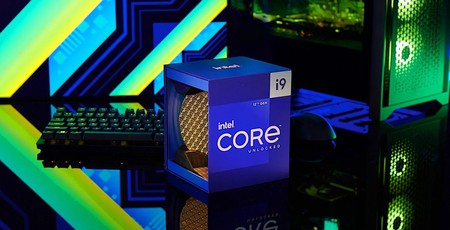
In a move that marks the most significant architectural shift for the company in over a decade, Intel has officially pulled back the curtain on its 12th Generation "Alder Lake-S" desktop processors. Following months of speculation and a detailed preview at Intel Architecture Day in August, the semiconductor giant has finally unveiled the specific SKUs, pricing, and platform requirements for its new hybrid-architecture chips. Built on the advanced "Intel 7" process node, these processors represent a bold departure from traditional x86 design, ushering in an era of performance-hybrid computing aimed at reclaiming the crown in both gaming and professional content creation.
The Core Lineup: A New Hierarchy of Power
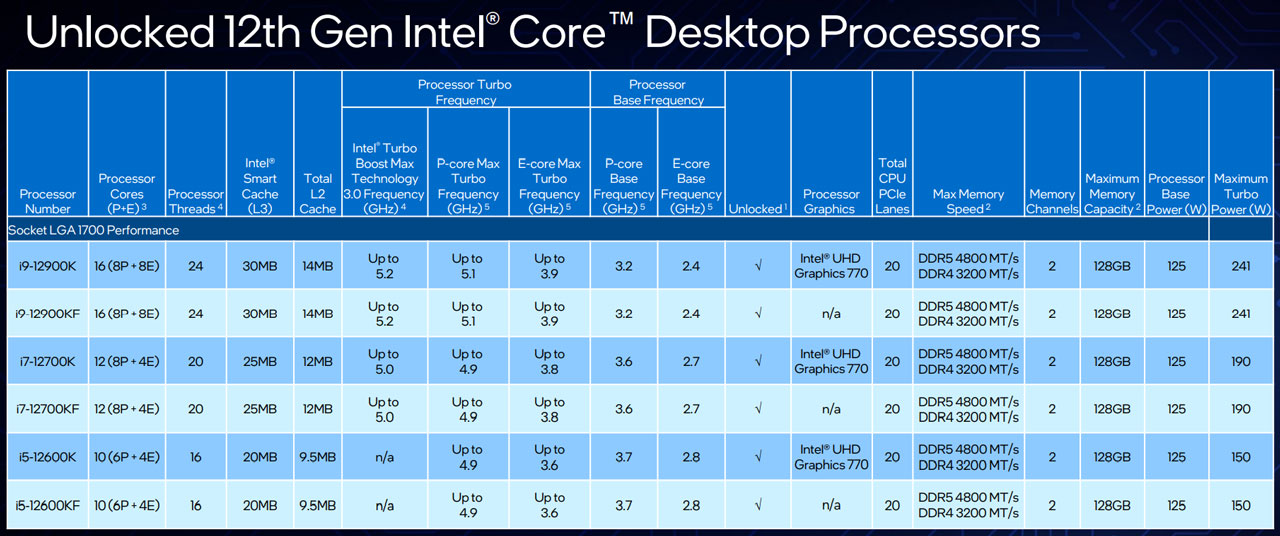
The initial wave of the 12th Gen family focuses exclusively on the enthusiast segment, featuring six "unlocked" SKUs designed for overclockers and high-end system builders. The lineup consists of three primary tiers, each available in a standard version (with integrated graphics) and a "KF" variant (sans integrated graphics).
- Intel Core i9-12900K/KF: The flagship model, boasting 16 cores (8 Performance-cores and 8 Efficient-cores) and 24 threads, with turbo frequencies reaching up to 5.2GHz.
- Intel Core i7-12700K/KF: A powerhouse featuring 12 cores (8 P-cores, 4 E-cores) and 20 threads.
- Intel Core i5-12600K/KF: The mid-range enthusiast choice, utilizing 10 cores (6 P-cores, 4 E-cores) and 16 threads.
For seasoned hardware enthusiasts, the naming conventions remain familiar, but the internal architecture is entirely new. The integration of Performance-cores (P-cores) for heavy, single-threaded tasks and Efficient-cores (E-cores) for background processes and multi-threaded scaling represents Intel’s answer to the evolving demands of modern software.
Chronology of the Alder Lake Rollout
The road to this launch was meticulously paved by Intel to manage market expectations.
- August 2021 (Architecture Day): Intel provided the first technical deep dive into the Alder Lake architecture, showcasing the "Intel 7" process (formerly 10nm Enhanced SuperFin) and the introduction of the Thread Director, a hardware-level scheduling technology designed to bridge the gap between P-cores and E-cores within the Windows 11 operating system.
- October 2021 (The Formal Reveal): On a Wednesday evening, Intel hosted its official launch event, detailing the final specifications, power envelopes, and the ecosystem of Z690 motherboards and DDR5 memory kits.
- November 4, 2021 (Public Availability): Intel set this date as the official embargo lift for third-party reviews and the commencement of retail availability for both CPUs and their accompanying Z690-series motherboards.
By staggering these dates, Intel successfully maintained control over the narrative, ensuring that consumers understood the new platform requirements—specifically the need for new sockets and, in many cases, new RAM—well before the hardware hit the shelves.
Supporting Data: Performance Metrics and Power Profiles
One of the most critical aspects of the 12th Gen launch is the updated approach to power consumption. Intel has introduced the "Processor Base Power" (PBP) and "Maximum Turbo Power" (MTP) metrics. While PBP represents the power consumption at base clock speeds, the MTP is the figure that matters for enthusiasts. For the flagship i9-12900K, the chip can pull in excess of 240W under sustained heavy loads. Intel has been transparent that these chips are designed to run at their maximum power limits on enthusiast-grade motherboards, necessitating high-end cooling solutions.
The Gaming Benchmark Controversy
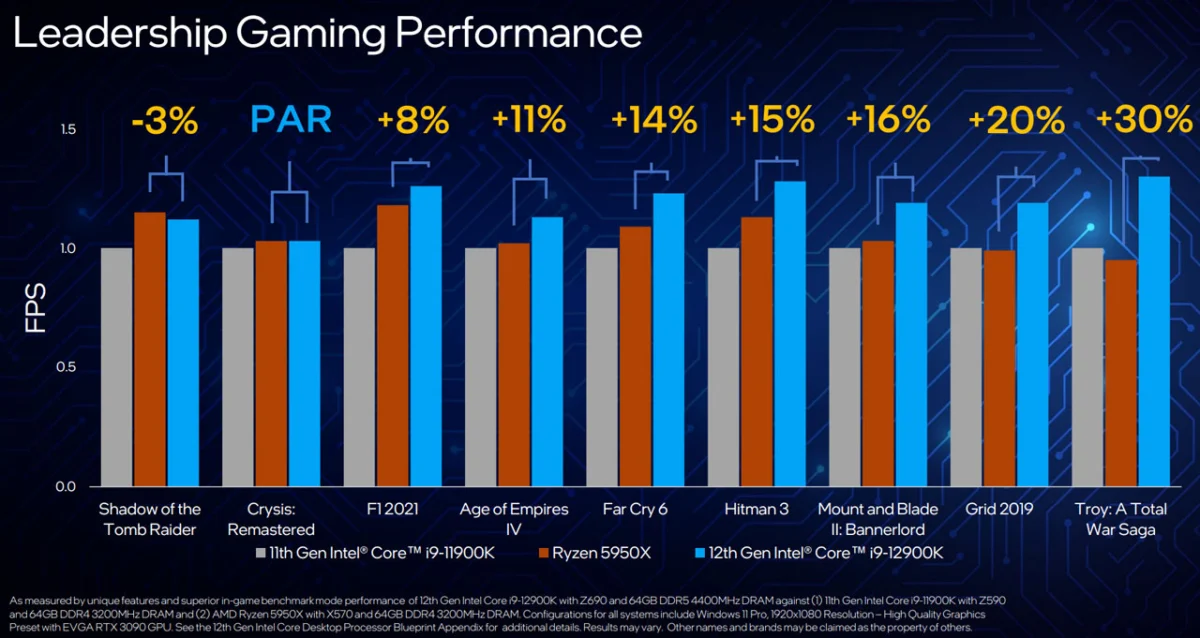
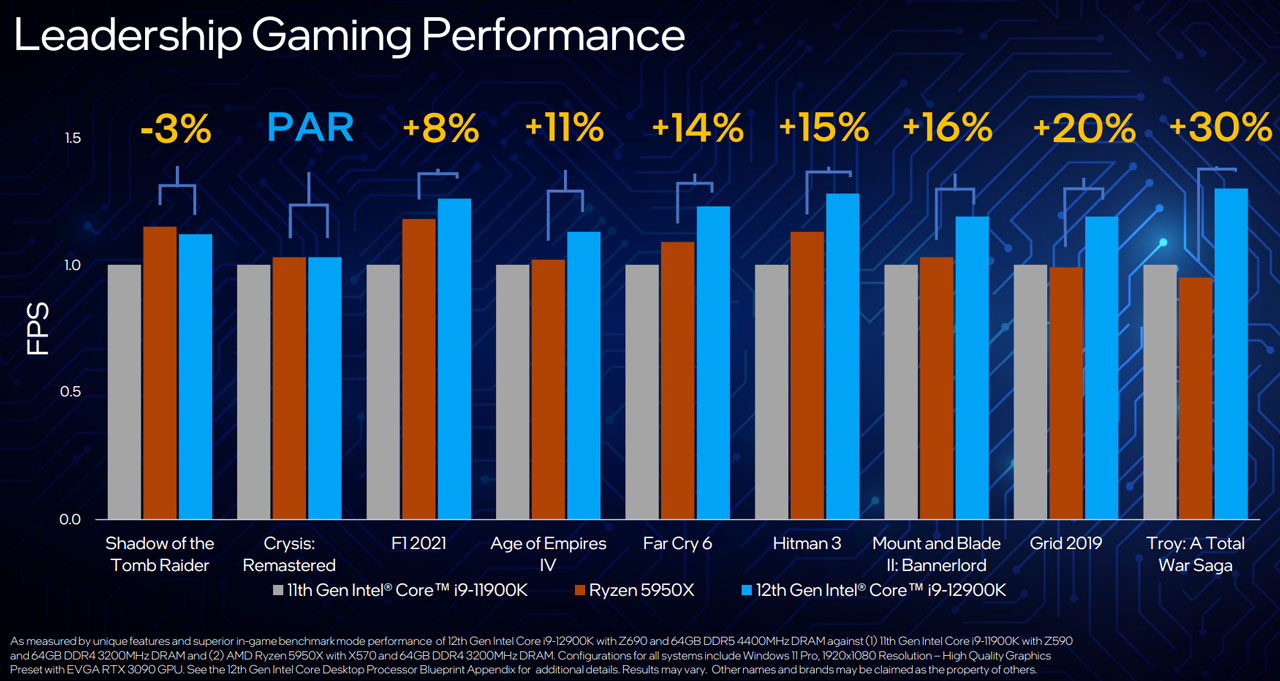
Intel’s internal testing suggests the i9-12900K is the "world’s best gaming processor," with data indicating a 12% performance lead over the AMD Ryzen 9 5950X in select modern titles. However, the industry has approached these figures with caution. At the time of the announcement, it was noted that the Intel test systems were running on Windows 11 without the then-recent patches intended to fix AMD’s L3 cache latency issues. Given that these Windows 11 performance bugs could impact AMD chips by up to 15%, many analysts have noted that the 12% lead claimed by Intel may be partially attributed to an unoptimized software environment for their competitor.
Content Creation Gains
While gaming benchmarks are subject to debate, Intel’s gains in content creation are more definitive. By leveraging the increased core count and the efficiency of the hybrid architecture, the 12th Gen chips demonstrate a performance uplift of at least 33% over the 11th Gen "Rocket Lake" predecessors in multi-threaded creative applications. This underscores the utility of E-cores, which handle secondary tasks, freeing up P-cores to focus exclusively on the primary creative workload.
Official Responses and Ecosystem Integration
Intel has not worked in a vacuum; the success of Alder Lake relies heavily on its partners. Alongside the processors, the 600-series chipset (spearheaded by the Z690) has been introduced. This platform is a significant departure from previous generations, offering support for PCIe 5.0 and the transition to DDR5 memory.
The Motherboard Explosion
Hardware manufacturers have embraced the platform with unprecedented enthusiasm. ASUS, for instance, has launched nineteen distinct Z690 models, covering everything from compact mini-ITX boards for small-form-factor builds to massive E-ATX boards designed for liquid-nitrogen overclocking.
Memory Transitions
G.Skill and other major memory vendors have also joined the fray, pushing the boundaries of DDR5 speed. With kits reaching speeds of 6800MT/s, the memory subsystem has become a critical bottleneck to overcome, and motherboard manufacturers have integrated advanced signal integrity features to support these high-speed modules.
Implications for the Market
The launch of the 12th Gen Core series marks a pivotal moment for the x86 landscape.
The Shift to Hybrid Architecture
For years, the industry operated under the assumption that all cores on a CPU should be identical. Intel’s pivot to a hybrid model forces software developers to optimize for a "heterogeneous" computing environment. This has significant implications for future operating systems and application scheduling, as software must now be "aware" of which tasks are best suited for a high-performance core versus an efficiency core.
Competitive Pressure on AMD
With a competitive pricing structure—starting at $290 for the i5-12600K up to $590 for the i9-12900K—Intel has signaled that it is no longer content to compete solely on performance; it is competing on value. This pricing strategy puts immense pressure on AMD’s existing Ryzen 5000 series, forcing a market recalibration that ultimately benefits the consumer.
The Early Adopter’s Dilemma
The transition to a new platform is rarely without friction. By requiring the LGA 1700 socket and encouraging (though not always mandating) a move to DDR5, Intel is asking enthusiasts to invest heavily in a new ecosystem. While the performance gains are undeniable, the cost of entry—CPU, motherboard, and potentially new RAM—is significant. However, for those seeking the bleeding edge of performance, particularly in productivity and high-refresh-rate gaming, the 12th Gen Alder Lake platform stands as a formidable new benchmark in the evolution of silicon.
As the industry moves past the November 4th launch date, the true test will be how the platform handles long-term thermals and whether the Windows 11 Thread Director proves to be as seamless as promised in real-world, diverse software environments. For now, Intel has successfully reclaimed the narrative, positioning itself once again as the aggressive innovator in the high-performance desktop arena.









No comments yet. Be the first to join the conversation!