

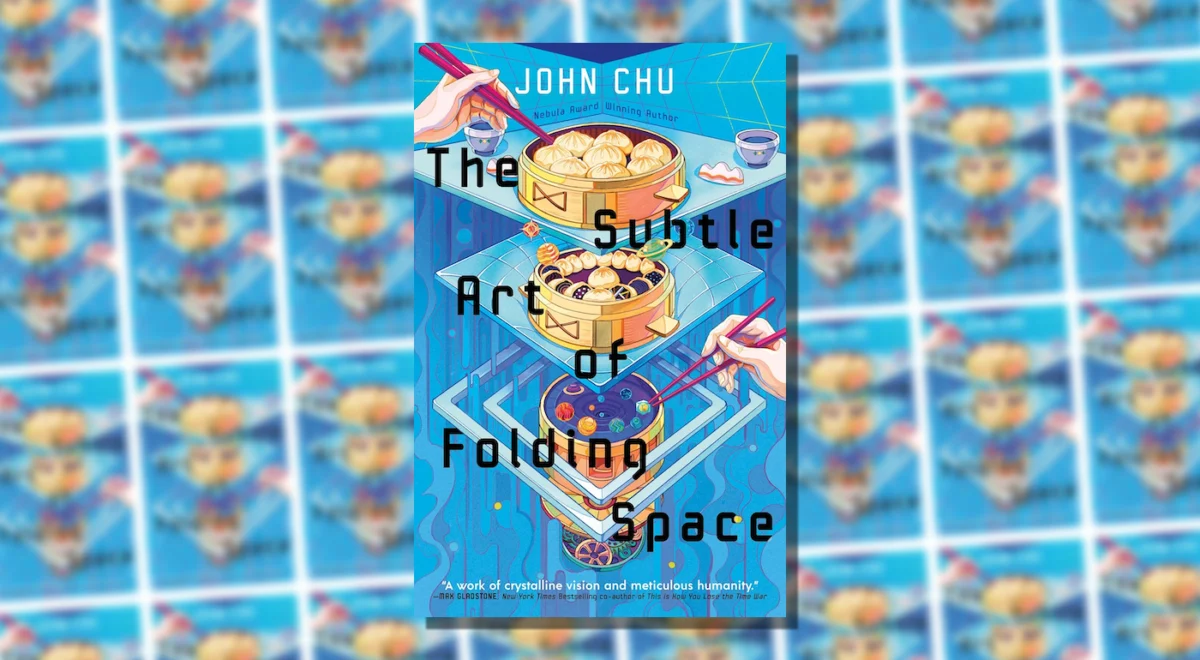
What is the moral cost of a miracle? If the survival of the entire universe hung in the balance, could you bring yourself to sacrifice the person you love most? These are not merely abstract philosophical inquiries; they are the visceral, high-stakes questions that propel the narrative of John Chu’s latest novel, The Subtle Art of Folding Space.
After more than a decade of acclaim in the short fiction sphere, Chu has delivered a debut novel that is as ambitious as it is emotionally devastating. By blending the cold, structural mechanics of "hard" science fiction with the messy, intimate tapestries of intergenerational trauma within an immigrant family, Chu creates a story that refuses to be neatly categorized.
Main Facts: The Architect of Reality
At the center of the novel is Ellie, a "maintainer" within the universal skunkworks. In Chu’s world-building, reality is not a static constant but an engineered construct. Every universe possesses a skunkworks—a subterranean engine room of physics where architects design, builders implement, and verifiers check for errors.
Ellie’s life is defined by her role as a builder, maintaining the "gates and pipes" that keep reality functional. Her family is deeply embedded in this system: her mother is a legendary builder, her sister Chris is a cruel taskmaster, and her cousin Daniel is a precise verifier. The story ignites when a series of catastrophic "hold-time violations" begins to unravel the fabric of the universe. The source of this instability? Ellie’s mother, who has been trapped in a state of suspended animation within the skunkworks.
Ellie is forced to choose: terminate her mother’s life to repair the fundamental errors and save the cosmos, or preserve her mother’s life and risk the total collapse of reality. Unlike many genre works that treat such dilemmas as climax points, Chu uses this choice as the inciting incident. The novel is fundamentally concerned with the "after"—the long, painful, and often volatile aftermath of a decision that can never be undone.
Chronology of Consequences
The narrative trajectory of The Subtle Art of Folding Space moves from the claustrophobic tension of a family home to the sprawling, abstract corridors of cosmic engineering.
- The Discovery: Ellie is dispatched by her sister, Chris, to investigate a glitch. With the aid of her cousin Daniel, she discovers that the systemic instability is tied to her mother’s comatose state.
- The Fateful Choice: The protagonist confronts the reality that her mother’s "death trap"—a manifestation of the unresolved, toxic dynamics of their household—has become a metaphysical hazard.
- The Post-Choice Reality: The bulk of the novel chronicles the journey of Ellie and Daniel as they attempt to purge the system of the culprit behind the glitch. As they "hop" between realities, the physical travel mirrors their internal journey through suppressed memories and systemic familial abuse.
- The Confrontation: The resolution is not a tidy victory. Instead, it is an exploration of the lingering damage caused by a life spent seeking the approval of a mother who prioritized the expectations of others over the well-being of her own children.
Supporting Data: The Anatomy of Trauma
Central to the novel’s success is its unflinching depiction of the Asian immigrant experience, specifically the weight of duty and the toxicity of "daughterly obligation."
Chris, the eldest daughter, embodies the darker side of this cultural expectation. By making her own suffering—and her performance of caretaking—her entire personality, she traps her mother and alienates her family. Her behavior toward Ellie and their cousin Daniel, who was ostracized by his own parents for being gay, highlights a cycle of trauma where victims become perpetrators in an attempt to maintain a semblance of control.
Chu expertly contrasts the characters of Ellie and Daniel to illustrate the different ways one can survive such an upbringing. Daniel, having been rejected by his parents, built a "found family"—a community of queer individuals who provide the stability he lacked as a child. Ellie, by contrast, remains tethered to the trauma of her origin. She spends her life "raking herself over the coals" to appease her sister and mother, effectively acting as a visitor in her own life.

The narration itself reinforces this disparity. Through third-person limited perspective, Ellie perceives Daniel as a near-divine figure—handsome, stable, and powerful—while she views herself through a lens of diminishment. This is not necessarily an objective truth, but a subjective manifestation of the deep-seated inferiority complex cultivated by her sister’s psychological warfare.
Official Responses and Stylistic Reception
The Subtle Art of Folding Space has polarized readers who prefer strictly demarcated genre boundaries. The novel occupies a liminal space between hard science fiction and high fantasy, and it does not offer the systematic, easily digestible world-building often associated with "hard" SF.
The "Hard" Science Fiction Debate
Chu’s descriptions of the skunkworks and the physics of "folding space" are dense and technical. For some, this represents the height of imaginative world-building; for others, the jargon can feel impenetrable. The novel assumes the reader is willing to "put in the work" to understand the mechanics, refusing to hold the reader’s hand through its more abstract conceptualizations.
The Fantasy Overlap
Simultaneously, the novel features elements that lean heavily into fantasy: characters manifesting fire, crafting items from nothing, and interacting with entities that defy conventional alien categorization. The book functions as a hybrid, where the "science" of the universe is merely a thin veil over what is essentially a magical or mythological struggle. As a result, readers who enjoy genre-bending will find a rich, layered experience, while those who demand a consistent "logic" to their speculative fiction may find the narrative fluidity frustrating.
Implications: A Work of Creative Powerhouse
The implication of Chu’s debut is clear: he is a writer who is not interested in tropes, but in the humanity hidden beneath the surface of science fiction concepts. The book’s refusal to provide easy answers or "neat and tidy" endings serves as a reflection of real-world trauma. Just as the errors in the skunkworks cannot be patched without understanding the fundamental, emotional "glitches" that caused them, the characters cannot move forward until they confront the reality of their pasts.
The novel suggests that the most profound "folding of space" does not happen between stars, but within the distance between family members. It is a story about the transition from being defined by the expectations of others to defining oneself through the lens of one’s own agency.
In conclusion, The Subtle Art of Folding Space is a challenging, dense, and ultimately rewarding achievement. It is a book that demands to be read, re-read, and discussed. It cements John Chu’s position as a significant voice in modern literature—one who understands that the most complex machines in the universe are not the ones we build, but the ones we are born into. Whether or not readers agree with the scientific logic of his skunkworks, they will be hard-pressed to deny the emotional resonance of his characters’ journey.
As the reader reaches the final page, the "questions" they are left with are not failures of the narrative, but invitations to further reflection. In an era of formulaic storytelling, Chu’s refusal to conform is not just refreshing; it is vital.










No comments yet. Be the first to join the conversation!