Jia Lissa
The pursuit of a functional, fault-tolerant quantum computer has long been defined by a fundamental technological tug-of-war. On one side are the systems built upon atomic and ionic qubits, which offer exquisite, flexible control but require massive, complex, and notoriously difficult-to-scale laser and vacuum infrastructure. On the other are the electronic-based systems, such as quantum dots, which leverage the existing, highly refined prowess of semiconductor manufacturing but suffer from "geometric rigidity"—the qubits are locked into place exactly where they were printed, limiting the sophistication of error-correction codes that can be implemented.
This week, however, a landmark study published in Nature by researchers at Delft University of Technology and the startup QuTech has shattered this dichotomy. The team successfully demonstrated that spin-based qubits housed within quantum dots can be physically shifted from one location to another across a chip without destroying the fragile quantum information they carry. This breakthrough suggests that the dream of mass-produced, flexible, and scalable quantum processors may finally be within reach.
Main Facts: A Paradigm Shift in Semiconductor Qubits
At the heart of the research is the quantum dot—a nanoscale confinement zone that traps a single electron. By manipulating the electron’s spin, scientists can create a qubit capable of existing in a superposition of states. While quantum dots have always been lauded for their compatibility with standard CMOS chip fabrication, their "fixed-wire" nature has been their Achilles’ heel.
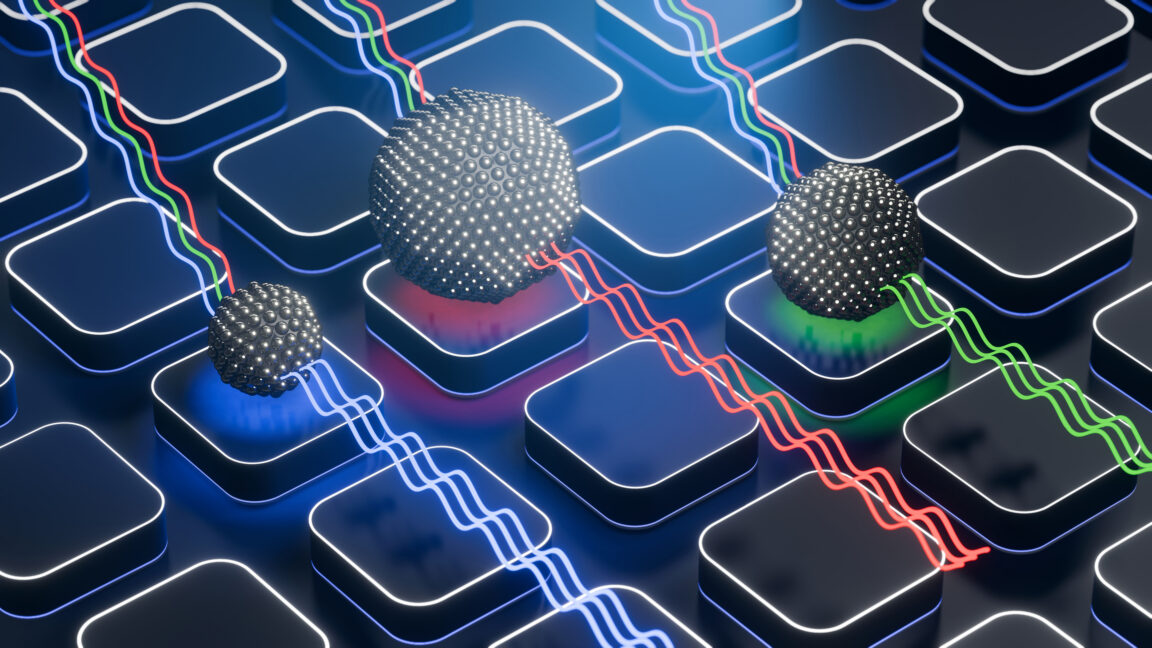
In a conventional quantum dot array, qubits are static. If an algorithm requires a specific interaction between two qubits that are not adjacent, the chip simply cannot accommodate it. The Delft/QuTech collaboration fundamentally changed this by creating a linear array of six quantum dots. Using a precise sequence of electrical pulses, the researchers were able to "shuttle" an electron from one dot to its neighbor.
Crucially, this movement does not result in decoherence. The researchers demonstrated that the electron can be moved, subjected to two-qubit gate operations (which entangle the spins), and then moved back to its origin while retaining its quantum state. With two-qubit gate fidelities exceeding 99 percent and successful quantum teleportation demonstrations at 87 percent, the study proves that "movable" spin qubits are not just theoretically possible—they are physically viable.
Chronology: The Road to Dynamic Quantum Circuits
The evolution of this research reflects a decade-long maturation of solid-state quantum computing.
- 2015–2018 (The Foundational Phase): Initial experiments focused on the basic stability of spin qubits in silicon-based quantum dots. Researchers proved that, with the right cooling and shielding, spin qubits could maintain coherence long enough to perform single-qubit rotations.
- 2020–2023 (The Gate Complexity Era): Focus shifted to two-qubit gates. Scientists successfully entangled adjacent electrons, but the "static" nature of the architecture meant that scaling required massive, complex inter-qubit wiring that hindered performance.
- 2024 (The Conceptual Pivot): Inspired by the success of trapped-ion systems—which use electromagnetic fields to shuffle ions for gate operations—the quantum dot community began exploring "shuttling" mechanisms.
- May 2026 (The Breakthrough): The Delft/QuTech team publishes the results of their six-dot array, marking the first successful demonstration of long-range entanglement and teleportation via electron-spin shuttling in a manufactured semiconductor environment.
Supporting Data: Fidelity and Efficiency
The performance metrics reported in the Nature paper provide a compelling case for the scalability of this architecture. In the realm of quantum computing, "fidelity" (a measure of accuracy) is the gold standard. A 99 percent fidelity rate for two-qubit gates is a significant achievement for a prototype device. While current commercial supercomputers and fault-tolerant prototypes push for higher fidelities, the fact that this was achieved on a system capable of physical relocation is unprecedented.
The "teleportation" success rate of 87 percent is perhaps even more striking. In quantum mechanics, teleportation is the process by which a quantum state is transferred from one location to another without the physical object traversing the intervening space. By combining physical shuttling with state teleportation, the team has essentially created a "quantum bus," allowing data to be moved across a chip at will. This architecture mimics the "interaction zones" proposed for neutral atom arrays, where qubits are moved in and out of storage to be processed only when necessary.
Official Responses and Industry Perspectives
The scientific community has reacted with cautious optimism. Dr. Elena Rossi, a lead researcher in solid-state quantum architectures, noted, "The Delft team has essentially bridged the gap between the static silicon world and the dynamic ion-trap world. They have proven that you don’t have to sacrifice the manufacturing benefits of silicon to achieve the architectural flexibility of atoms."
However, industry experts are careful to note the "gap to production." The current chip only features six dots—a far cry from the thousands or millions of qubits required for a cryptographically useful, fault-tolerant quantum computer.
"The hurdle now is not the physics of moving the electron; it is the infrastructure of managing that movement at scale," said a representative from a leading semiconductor firm. "We are talking about a massive increase in the complexity of the control electronics required to manage these ‘shuttling’ pulses. It’s an engineering challenge, but it is a solvable one."
Implications: The Future of Quantum Manufacturing
The implications of this development are profound for the competitive landscape of quantum computing. If quantum dots can indeed support arbitrary connectivity, the primary advantage of competing technologies (like trapped ions or neutral atoms) diminishes significantly.

1. Unified Manufacturing
The most immediate implication is the ability to leverage existing semiconductor fabrication facilities. While companies like Google or IBM have invested heavily in superconducting circuits, those circuits require exotic materials and ultra-precise manufacturing that differs significantly from standard microchip production. If spin-based quantum dots become the dominant architecture, the path to mass-producing quantum processors could be as straightforward as current CPU production.
2. Algorithmic Flexibility
Static chips are "hard-wired" for specific algorithms. A chip designed for one error-correction protocol cannot easily switch to another. The "movable dot" architecture allows for dynamic reconfiguration. As better, more efficient error-correction codes are developed in the future, hardware could be updated via firmware rather than requiring a complete hardware redesign.
3. The "Quantum Bus" Architecture
This paper validates the "storage and processing" model. In the future, a quantum chip might look like a series of "memory banks" (storage zones) connected to a "CPU core" (interaction zones). By shuttling qubits back and forth, the chip can minimize noise-induced errors—since qubits only enter the interaction zones when they are being computed upon—and maximize the utility of the hardware.
4. A Longer Timeline to Maturity
Despite the excitement, the authors and peer reviewers agree: we are years away from a commercial-grade processor based on this tech. The current device is a testbed. The path forward involves increasing the number of dots, refining the pulse timing, and, most importantly, improving the baseline fidelity of the qubits themselves to handle the "wear and tear" of frequent movement.
Conclusion
The ability to move quantum information within a semiconductor chip is a fundamental victory for the "quantum dot" camp. By demonstrating that silicon-based qubits can be as flexible as their atomic counterparts, the Delft/QuTech team has effectively rewritten the roadmap for quantum scaling. While the challenges of integration, cooling, and error correction remain formidable, the "movable dot" has transformed from a theoretical curiosity into a concrete engineering objective.
As we move toward the next generation of quantum hardware, this research serves as a reminder that the winning architecture may not be the one that starts with the most qubits, but the one that offers the most control over how those qubits interact. For now, the quantum dot has officially moved to the front of the line.


 Asep Darmawan
 Rifan Muazin