

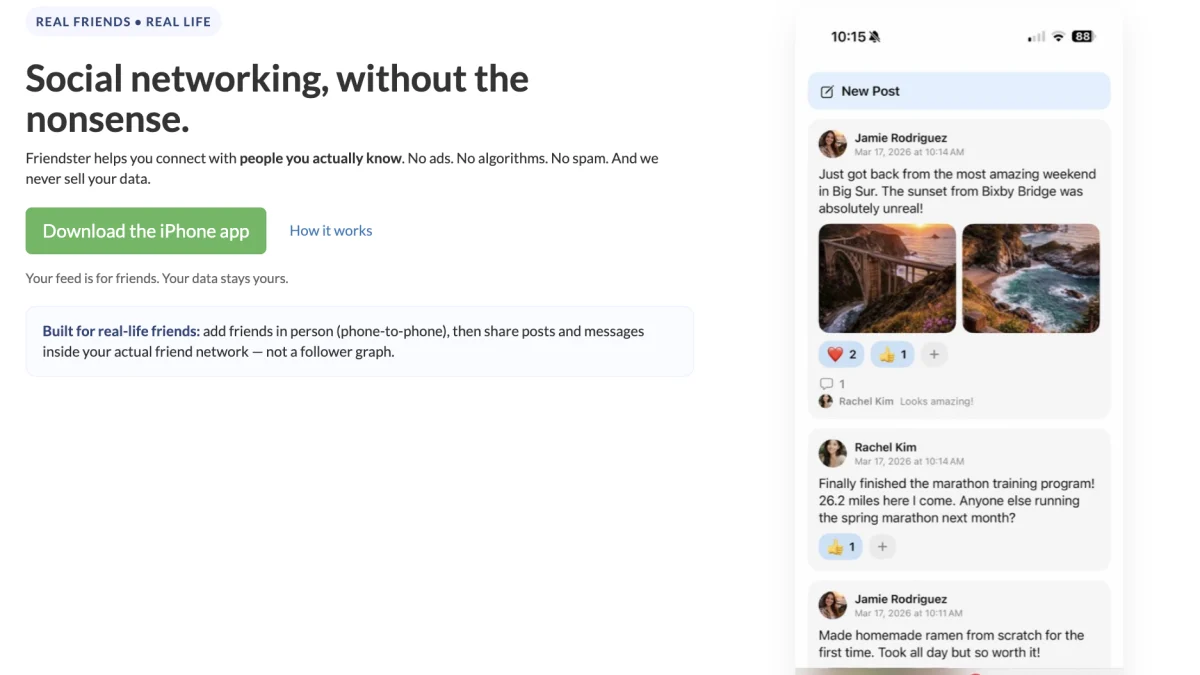
In an era defined by doom-scrolling, hyper-targeted advertising, and the relentless pressure of algorithmic feeds, the ghost of social media past has returned to haunt the modern landscape. Friendster, the platform that essentially birthed the social networking phenomenon in the early 2000s, has been resurrected. However, this is not a nostalgia play or a digital museum exhibit. The new Friendster is a radical experiment in human connection, stripped of the features that define today’s digital giants.
Under the stewardship of entrepreneur Mike Carson, the platform has returned with a singular, provocative premise: a social network where the digital experience is entirely contingent upon physical presence. By eliminating feeds, ads, and follow suggestions, Friendster is attempting to prove that the most valuable connections are the ones forged in the real world, not the virtual one.
The Genesis of a Digital Pioneer: A Brief Chronology
To understand the weight of Friendster’s return, one must look back at its foundational role in the internet age. Launched in March 2002 by Jonathan Abrams, Friendster was the original titan of the social web. Long before Facebook became a household name or MySpace dominated the cultural zeitgeist, Friendster provided the architectural blueprint for what a "social network" could be.
The Rise and Fall (2002–2015)
At its peak, Friendster was a cultural phenomenon. It revolutionized the concept of the "social graph," allowing users to map their real-world connections online. However, the platform was notoriously plagued by technical difficulties—slow load times and server crashes became its undoing. As users grew frustrated, competitors like MySpace surged, offering more customization and stability.
By the late 2000s, Friendster had largely faded from the American consciousness. It found a second life in Southeast Asia, where it maintained a loyal user base for years. In 2011, the company pivoted to social gaming, a desperate attempt to stay relevant in a landscape now dominated by the meteoric rise of Facebook. The pivot failed to halt the decline, and in 2015, the site was shuttered, seemingly destined to be a mere footnote in tech history.
The Acquisition and Rebirth (2023–Present)
The revival began in 2023, not in a boardroom, but through a serendipitous discovery. Mike Carson, while browsing the web, noticed that Friendster.com—a domain once synonymous with the dawn of the social era—had been reduced to a landing page for invasive pop-up advertisements.
Carson reached out to the domain owner, who had acquired it at an expired domain auction for $7,456. After a negotiation process, Carson secured the rights to the name. The acquisition cost was roughly $20,000 in Bitcoin, combined with a separate digital asset that generated approximately $9,000 in annual revenue. With the domain in hand, Carson began building a platform that sought to do the exact opposite of what the modern web demands.
A Philosophy of "Nothingness": How the New Friendster Works
The most striking feature of the new Friendster is its emptiness. Upon downloading the iOS app and completing the registration process, the user is met with a blank void. There is no "For You" page, no trending hashtags, and no influencers vying for attention.
The Physicality Requirement
The core mechanism of the new Friendster is the "NFC-like" physical handshake. To follow another user, the platform requires that two individuals physically tap their phones together while the app is open. This is not a security feature in the traditional sense; it is a philosophical barrier. By requiring physical proximity, the app enforces a "real-life first" policy. You cannot build a following on Friendster unless you have actually met the people you are connecting with.
The Absence of Algorithms
Carson’s vision is explicitly anti-algorithmic. In today’s social media environment, algorithms are designed to maximize "time on site," often by surfacing provocative, anger-inducing, or addictive content. By removing the feed entirely, Friendster removes the incentive for users to perform, shout, or bait for engagement. The platform is designed to be a tool for existing relationships rather than a content-delivery engine.
Supporting Data and Future Features
While the current version of Friendster is minimalist, Carson has outlined a roadmap that balances his philosophy of physical connection with the functional needs of a social network.
The "Friends of Friends" Expansion
Acknowledging the limitations of a purely physical network, Carson plans to introduce a "Friends of Friends" feature. This will allow users to connect online with individuals they have not met in person, provided they share a common, verified physical connection. This tiered trust system is designed to prevent the platform from becoming a megaphone for strangers while allowing for organic network growth.
The "Fading Connection" Nudge
Perhaps the most controversial and innovative proposed feature is the "Fading Connection" notification. The app will track when a user has not been in the same physical space as a connection for more than a year. The app will then send a gentle reminder, nudging the user to reach out or meet up. Carson frames this not as a punishment, but as a reminder of the fragility of human relationships. "Real friendships are kept alive in person, not online," he explains.
Implications for the Future of Social Media
The return of Friendster arrives at a pivotal moment in the history of the internet. We are currently witnessing a "post-platform" migration, where users are growing increasingly weary of the toxic, ad-heavy environments of major social networks.
The Antithesis of the Attention Economy
Friendster is a direct challenge to the attention economy. If successful, it proves that there is a market for software that does less rather than more. By refusing to monetize through ads or engagement-based algorithms, Carson is placing a bet on a subscription or alternative business model that prioritizes the user’s mental well-being over the shareholder’s bottom line.
The Challenge of User Retention
Despite the philosophical appeal, the practical hurdles are immense. Social networks thrive on "network effects"—the idea that a platform becomes more valuable as more people join. If a user downloads Friendster and finds a blank screen, the immediate impulse is to delete the app. The "empty room" problem is the greatest existential threat to the platform. To survive, Friendster must convince users that the lack of content is a feature, not a failure, and that the effort of physical connection is worth the reward of a curated, authentic social circle.
A Return to Human-Centric Design
The broader implication of this experiment is a potential shift in design philosophy. For two decades, we have been building social tools that maximize the reach of our communication. Friendster is the first major effort to build a tool that maximizes the depth of our communication. If this model gains traction, it could force Silicon Valley to reconsider the ethics of the infinite scroll and the algorithmic feed.
Conclusion: Is the Past the Future?
Friendster is no longer a graveyard for early internet nostalgia; it is a laboratory for social sustainability. Whether or not it succeeds depends on a cultural shift that is currently underway: a collective desire to reclaim our attention and our relationships from the clutches of Big Tech.
The app remains, for now, a daunting, empty space. It is a mirror held up to our social lives, reflecting only what we bring to it. If we are willing to put in the work—the physical, intentional work of meeting our friends—Friendster may well provide the antidote to the digital noise that has defined the last twenty years. But if we remain hooked on the dopamine loops of algorithmic feeds, Friendster may find itself, once again, a forgotten relic of a different time.
As Mike Carson continues to iterate on his vision, the tech world will be watching. We have spent the last two decades seeing how much we can connect with the world at large. Perhaps the next two decades will be defined by how much we can reconnect with the people sitting right next to us.












No comments yet. Be the first to join the conversation!